

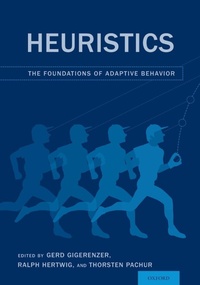
Heuristics
The Foundations of Adaptive Behavior
Published on 14. January 2016
Book
Paperback/Softback
880 pages
978-0-19-049462-9 (ISBN)
Description
How do people make decisions when time is limited, information unreliable, and the future uncertain? Based on the work of Nobel laureate Herbert Simon and with the help of colleagues around the world, the Adaptive Behavior and Cognition (ABC) Group at the Max Planck Institute for Human Development in Berlin has developed a research program on simple heuristics, also known as fast and frugal heuristics. In the social sciences, heuristics have been believed to be generally inferior to complex methods for inference, or even irrational. Although this may be true in "small worlds " where everything is known for certain, we show that in the actual world in which we live, full of uncertainties and surprises, heuristics are indispensable and often more accurate than complex methods. Contrary to a deeply entrenched belief, complex problems do not necessitate complex computations. Less can be more. Simple heuristics exploit the information structure of the environment, and thus embody ecological rather than logical rationality. Simon (1999) applauded this new program as a "revolution in cognitive science, striking a great blow for sanity in the approach to human rationality. "
By providing a fresh look at how the mind works as well as the nature of rationality, the simple heuristics program has stimulated a large body of research, led to fascinating applications in diverse fields from law to medicine to business to sports, and instigated controversial debates in psychology, philosophy, and economics. In a single volume, the present reader compiles key articles that have been published in journals across many disciplines. These articles present theory, real-world applications, and a sample of the large number of existing experimental studies that provide evidence for people's adaptive use of heuristics.
By providing a fresh look at how the mind works as well as the nature of rationality, the simple heuristics program has stimulated a large body of research, led to fascinating applications in diverse fields from law to medicine to business to sports, and instigated controversial debates in psychology, philosophy, and economics. In a single volume, the present reader compiles key articles that have been published in journals across many disciplines. These articles present theory, real-world applications, and a sample of the large number of existing experimental studies that provide evidence for people's adaptive use of heuristics.
Reviews / Votes
This volume makes a powerful case for the importance of fast and frugal heuristics in explaining a wide range of aspects of cognition. It brings together the latest developments in one of the most influential research programmes in the decision sciences, and will provide a valuable stimulus for, and a challenge to, research across the field."Nick Chater, University College London The Gigerenzer, Hertwig, and Pachur volume is a collection of 40 previously
published articles, some of which have been modified to suit the occasion. There are also
very helpful introductions to each article. The articles illustrate the variety of ways in which
people use heuristics, or rules of thumb, to quickly make decisions. * John G. Benjafield, PsycCRITIQUES * Over the last two decades, Gerd Gigerenzer and his colleagues have pioneered a fundamentally new approach to human decision-making. This research framework-the simple heuristics program-recasts classic questions in ways that open up vital new avenues of research and understanding. This fascinating and authoritative volume brings together for the first time a comprehensive set of articles that explore the theoretical foundations of this revolutionary approach, as well as tests of its psychological reality and practical importance in everyday decision-making * John Tooby and Leda Cosmides, Center for Evolutionary Psychology, University of California, Santa Barbara *
More details
Language
English
Place of publication
New York
United States
Target group
College/higher education
Dimensions
Height: 254 mm
Width: 178 mm
Thickness: 47 mm
Weight
1623 gr
ISBN-13
978-0-19-049462-9 (9780190494629)
Copyright in bibliographic data and cover images is held by Nielsen Book Services Limited or by the publishers or by their respective licensors: all rights reserved.
Schweitzer Classification
Other editions
Additional editions
Book
05/2011
1st Edition
Oxford University Press Inc
€234.50
Shipment within 15-20 days
Persons
Gerd Gigerenzer is Director of the Center for Adaptive Behavior and Cognition at the Max Planck Institute for Human Development in Berlin, and former Professor of Psychology at the University of Chicago. He won the AAAS Prize for the best article in the behavioral sciences and the Association of American Publishers Prize for the best book in the social and behavioral sciences. His recent books include Rationality for Mortals, Gut Feelings, and Risk Savvy .
Ralph Hertwig is Director of the Center for Adaptive Rationality at the Max Planck Institute for Human Development in Berlin. His research investigates how individuals and groups juggle the simultaneous demands of uncertainty, data scarcity, and limits in cognitive resources when making decisions. He was previously Chair of Cognitive and Decision Sciences and Dean of the Faculty of Psychology at the University of Basel, and he is a recipient of the Heinz Heckhausen Young Scientist Prize.
Ralph Hertwig is Director of the Center for Adaptive Rationality at the Max Planck Institute for Human Development in Berlin. His research investigates how individuals and groups juggle the simultaneous demands of uncertainty, data scarcity, and limits in cognitive resources when making decisions. He was previously Chair of Cognitive and Decision Sciences and Dean of the Faculty of Psychology at the University of Basel, and he is a recipient of the Heinz Heckhausen Young Scientist Prize.
Content
Introduction
List of Contributors
Appetizer
1. Homo heuristicus: Why Biased Minds Make Better Inferences.
Gerd Gigerenzer, and Henry Brighton
Part I: Theory
Opening the adaptive toolbox
2. Reasoning the Fast and Frugal Way: Models of Bounded Rationality.
Gerd Gigerenzer, and Daniel G. Goldstein
3. Models of Ecological Rationality: The Recognition Heuristic.
Daniel Goldstein and Gerd Gigerenzer
4. How Forgetting Aids Heuristic Inference.
Lael J. Schooler and R. Hertwig
5. Simple Heuristics and Rules of Thumb: Where Psychologists and Behavioral Biologists Might Meet.
John M.C. Hutchinson and Gerd Gigerenzer
6. Naive and Yet Enlightened: From Natural Frequencies to Fast and Frugal Decision Trees.
Laura Martignon, Oliver Vitouch, Masinori Takezawa, and Malcolm R. Forster
7. The Priority Heuristic: Making Choices without Trade-Offs.
Eduard Brandstaetter, Gerd Gigerenzer, and Ralph Hertwig
8. One-Reason Decision making: Modeling Violations of Expected Utility Theory.
Konstantinos V. Katsikopoulos and Gerd Gigerenzer
9. The Similarity Heuristic.
Daniel Read and Yael Grushka-Cockayne
10. Hindsight Bias: A By-Product of Knowledge Updating?
Ulrich Hoffrage, Ralph Hertwig, and Gerd Gigerenzer
How are heuristics selected?
11. SSL: A Theory of How People Learn to Select Strategies.
Jorg Rieskamp and Philipp E. Otto
Part II: Tests
When do heuristics work?
12. Fast, Frugal, and Fit: Simple Heuristics for Paired Comparison.
Laura Martignon and Ulrich Hoffrage
13. Heuristic and Linear Lodels of Judgment: Matching Rules and Environments.
Robin M. Hogarth and Natalia Karelaia
14. Categorization with Limited Resources: A Family of Simple Heuristics.
Laura Martignon, Konstantinos V. Katsikopoulo, and Jan K. Woike
15. A Signal Detection Analysis of the Recognition Heuristic.
Timothy J. Pleskac
16. The Relative Success of Recognition-Based Iinference in Multichoice Decisions.
Rachel McCloy, C. Philip Beaman, and T. Smith
When do people rely on one good reason?
17. The Quest for Take-the-Best.
Arndt Broeder
18. Empirical Tests of a Fast and Frugal Heuristic: Not Everyone "Takes-the-Best."
Ben R. Newell, Nicola J. Weston, and David R. Shanks
19. A Response-Time Approach to Comparing Generalized Rational and Take-the-Best Models of Decision Making.
F. Bryan Bergert and Robert M. Nosofsky
20. Sequential Processing of Cues in Memory-Based Multi-Attribute Decisions.
Arndt Broeder and Wolfgang Gaissmaier
21. Does Imitation Benefit Cue-OrderLlearning?
Rocio Garcia-Retamero, Masanori Takezawa, and Gerd Gigerenzer
22. The Aging Decision Maker: Cognitive Aging and the Adaptive Selection of Decision Strategies.
Rui Mata, Lael J. Schooler, and Joerg Rieskamp
When do people rely on name recognition?
23. On the Psychology of the Recognition Heuristic: Retrieval Primacy as a Key Determinant of its Use.
Thorsten Pachur and Ralph Hertwig
24. The Recognition Heuristic in Memory-Based Inference: Is Recognition a Non-Compensatory Cue?
Thorsten Pachur, Arndt Broeder, and Julian N. Marewski
25. Why You Think Milan is Larger than Modena: Neural Correlates of the Recognition Heuristic.
Kirsten G. Volz, Lael J. Schooler, Ricarda I. Schubotz, Markus Raab, Gerd Gigerenzer, and D. Yves von Cramon
26. Fluency Heuristic: A Model of How the Mind Exploits a By-Product of Information Retrieval.
Ralph Hertwig, Stefan M. Herzog, Lael J. Schooler, and Torsten Reimer
27. The Use of Recognition in Group Decision Making.
Torsten Reimer and Konstantinos V. Katsikopoulos
Part III: Heuristics in the Wild
Crime
28. Psychological Models of Professional Decision Making.
Mandeep K. Dhami
29. Geographic Profiling: The Fast, Frugal, and Accurate Way.
Brent Snook, Paul J. Taylor, and Craig Bennel
30. Take-the-Best in Expert-Novice Decision Strategies for Residential Burglary.
Rocio Garcia-Retamero and Mandeep K. Dhami
Sports
31. Predicting Wimbledon Tennis Results 2005 by Player Name Recognition.
Benjamin Scheibehenne and Arndt Broeder
32. Heuristics in Sports That Help Ws Win.
W.M. Bennis and Torsten Pachur
33. How Dogs Navigate to Catch Frisbees.
Dennis M. Shaffer, Scott M. Krauchunas, Marianna Eddy, and Michael K. McBeath
Investment
34. Optimal versus Naive Diversification: How Inefficient in the 1/N Portfolio Strategy?
Victor DeMiguel, Lorenzo Garlappi, and Raman Uppal
35. Parental Investment: How an Equity Motive Can Produce Inequality.
Ralph Hertwig, Jennifer Nerissa Davis, and Frank J. Sulloway
36. Instant Customer Base analysis: Managerial Heuristics Often "Get It Right."
Markus Wuebben and Florian v. Wangenheim
Everyday things
37. Green Defaults: Information Presentation and Pro-Environmental Behavior.
Daniel Pichert and Konstantinois V. Katsikopoulos
38. "IfEL": Satisficing Algorithms for Mapping Conditional Statements onto Social Domains.
Alejandro Lopez-Rousseau and Timothy Ketelaar
39. Applying One-Reason Decision Making: The Prioritisation of Literature Searches
Michael D. Lee, Natasha Loughlin, and Ingrid B. Lundberg
40. Aggregate Age-at-Marriage Patterns from Individual Mate-Search Heuristics.
Peter M. Todd, Francesco C. Billari, and Jorge Simao
References
Name index
Subject index
List of Contributors
Appetizer
1. Homo heuristicus: Why Biased Minds Make Better Inferences.
Gerd Gigerenzer, and Henry Brighton
Part I: Theory
Opening the adaptive toolbox
2. Reasoning the Fast and Frugal Way: Models of Bounded Rationality.
Gerd Gigerenzer, and Daniel G. Goldstein
3. Models of Ecological Rationality: The Recognition Heuristic.
Daniel Goldstein and Gerd Gigerenzer
4. How Forgetting Aids Heuristic Inference.
Lael J. Schooler and R. Hertwig
5. Simple Heuristics and Rules of Thumb: Where Psychologists and Behavioral Biologists Might Meet.
John M.C. Hutchinson and Gerd Gigerenzer
6. Naive and Yet Enlightened: From Natural Frequencies to Fast and Frugal Decision Trees.
Laura Martignon, Oliver Vitouch, Masinori Takezawa, and Malcolm R. Forster
7. The Priority Heuristic: Making Choices without Trade-Offs.
Eduard Brandstaetter, Gerd Gigerenzer, and Ralph Hertwig
8. One-Reason Decision making: Modeling Violations of Expected Utility Theory.
Konstantinos V. Katsikopoulos and Gerd Gigerenzer
9. The Similarity Heuristic.
Daniel Read and Yael Grushka-Cockayne
10. Hindsight Bias: A By-Product of Knowledge Updating?
Ulrich Hoffrage, Ralph Hertwig, and Gerd Gigerenzer
How are heuristics selected?
11. SSL: A Theory of How People Learn to Select Strategies.
Jorg Rieskamp and Philipp E. Otto
Part II: Tests
When do heuristics work?
12. Fast, Frugal, and Fit: Simple Heuristics for Paired Comparison.
Laura Martignon and Ulrich Hoffrage
13. Heuristic and Linear Lodels of Judgment: Matching Rules and Environments.
Robin M. Hogarth and Natalia Karelaia
14. Categorization with Limited Resources: A Family of Simple Heuristics.
Laura Martignon, Konstantinos V. Katsikopoulo, and Jan K. Woike
15. A Signal Detection Analysis of the Recognition Heuristic.
Timothy J. Pleskac
16. The Relative Success of Recognition-Based Iinference in Multichoice Decisions.
Rachel McCloy, C. Philip Beaman, and T. Smith
When do people rely on one good reason?
17. The Quest for Take-the-Best.
Arndt Broeder
18. Empirical Tests of a Fast and Frugal Heuristic: Not Everyone "Takes-the-Best."
Ben R. Newell, Nicola J. Weston, and David R. Shanks
19. A Response-Time Approach to Comparing Generalized Rational and Take-the-Best Models of Decision Making.
F. Bryan Bergert and Robert M. Nosofsky
20. Sequential Processing of Cues in Memory-Based Multi-Attribute Decisions.
Arndt Broeder and Wolfgang Gaissmaier
21. Does Imitation Benefit Cue-OrderLlearning?
Rocio Garcia-Retamero, Masanori Takezawa, and Gerd Gigerenzer
22. The Aging Decision Maker: Cognitive Aging and the Adaptive Selection of Decision Strategies.
Rui Mata, Lael J. Schooler, and Joerg Rieskamp
When do people rely on name recognition?
23. On the Psychology of the Recognition Heuristic: Retrieval Primacy as a Key Determinant of its Use.
Thorsten Pachur and Ralph Hertwig
24. The Recognition Heuristic in Memory-Based Inference: Is Recognition a Non-Compensatory Cue?
Thorsten Pachur, Arndt Broeder, and Julian N. Marewski
25. Why You Think Milan is Larger than Modena: Neural Correlates of the Recognition Heuristic.
Kirsten G. Volz, Lael J. Schooler, Ricarda I. Schubotz, Markus Raab, Gerd Gigerenzer, and D. Yves von Cramon
26. Fluency Heuristic: A Model of How the Mind Exploits a By-Product of Information Retrieval.
Ralph Hertwig, Stefan M. Herzog, Lael J. Schooler, and Torsten Reimer
27. The Use of Recognition in Group Decision Making.
Torsten Reimer and Konstantinos V. Katsikopoulos
Part III: Heuristics in the Wild
Crime
28. Psychological Models of Professional Decision Making.
Mandeep K. Dhami
29. Geographic Profiling: The Fast, Frugal, and Accurate Way.
Brent Snook, Paul J. Taylor, and Craig Bennel
30. Take-the-Best in Expert-Novice Decision Strategies for Residential Burglary.
Rocio Garcia-Retamero and Mandeep K. Dhami
Sports
31. Predicting Wimbledon Tennis Results 2005 by Player Name Recognition.
Benjamin Scheibehenne and Arndt Broeder
32. Heuristics in Sports That Help Ws Win.
W.M. Bennis and Torsten Pachur
33. How Dogs Navigate to Catch Frisbees.
Dennis M. Shaffer, Scott M. Krauchunas, Marianna Eddy, and Michael K. McBeath
Investment
34. Optimal versus Naive Diversification: How Inefficient in the 1/N Portfolio Strategy?
Victor DeMiguel, Lorenzo Garlappi, and Raman Uppal
35. Parental Investment: How an Equity Motive Can Produce Inequality.
Ralph Hertwig, Jennifer Nerissa Davis, and Frank J. Sulloway
36. Instant Customer Base analysis: Managerial Heuristics Often "Get It Right."
Markus Wuebben and Florian v. Wangenheim
Everyday things
37. Green Defaults: Information Presentation and Pro-Environmental Behavior.
Daniel Pichert and Konstantinois V. Katsikopoulos
38. "IfEL": Satisficing Algorithms for Mapping Conditional Statements onto Social Domains.
Alejandro Lopez-Rousseau and Timothy Ketelaar
39. Applying One-Reason Decision Making: The Prioritisation of Literature Searches
Michael D. Lee, Natasha Loughlin, and Ingrid B. Lundberg
40. Aggregate Age-at-Marriage Patterns from Individual Mate-Search Heuristics.
Peter M. Todd, Francesco C. Billari, and Jorge Simao
References
Name index
Subject index