

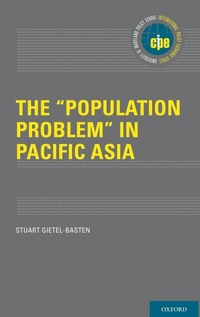
The "Population Problem" in Pacific Asia
Published on 5. September 2019
Book
Hardback
240 pages
978-0-19-936107-6 (ISBN)
Description
Despite the twenty-first century's often being referred to as the Asian Century-indicating hope for economic growth and the rebalancing of the global order-population aging and stagnation present an existential threat to the success of China and other territories of Pacific Asia (namely Japan, Taiwan, Hong Kong, Singapore, and South Korea). This book argues that the "population problem," rooted in low fertility, has thus far been largely considered in a linear way: low fertility leads to population stagnation and rapid aging, so fixing low fertility should correct the problem. However, a multi-dimensional lens is essential to appreciating the scale and nature of the issue-and, indeed, to determining whether it is an issue at all. Stuart Gietel-Basten examines how the issue of low fertility has been constructed, how blame has been apportioned, and why policies designed to tackle it have yielded few results. Drawing on an array of primary and secondary sources as well as examples from scholarly and popular literature,The "Population Problem" in Pacific Asia takes a comparative approach to fertility in the region and locates mainland China in its regional context. It serves as a useful resource for government workers, stakeholders, and students and scholars in sociology, demography, geography, economics, and area studies.
Reviews / Votes
Stuart Gietel-Basten's book traces out very effectively the trends in fertility and population size and structure in the Pacific Asian countries, offers an insightful analysis of the factors keeping fertility low, the policy concerns of their governments, and some approaches to enabling their population to realize their family building desires. His book raises many important issues, in some cases in innovative ways. * Gavin W. Jones, Australian National University, Social Forces * Gietel-Basten has gathered the findings [of his research] in this book, in short readable chapters and a strong critical narrative of 178 pages. The result is a timely warning against single-minded approaches to population policy, and a reminder that millions of individual decision makers can have enormous influences on fertility rates even in communal-based societies, at times undermining the intentions of authoritarian leaders. * Population and Development Review * It is a rare treasure: a book written by a demographer that is a real delight to read....It is clearly written with a wide readership in mind, though it also has much to offer population specialists * Population Studies * Something's happening out there and Stuart Gietel-Basten has a better idea of what it might be than any other demographer currently working on the planet. This modestly titled book is about something far greater than the issue of population in part of Asia. Here, the first substantial and rigorous academic evidence on the topic is collated, synthesised, and presented. More of the world is heading for sustained very low fertility than that part currently projected to continue growing in population within a couple of generations' time. It began in earnest in Pacific Asia. This is the first book to tell the most important story of our current century. * Danny Dorling, PhD, Halford Mackinder Professor of Geography, University of Oxford * This is a genuinely impressive book. It gives us a thorough and extremely well-documented panorama of the lowest-low fertility syndrome in Pacific Asia and China. But of far greater importance, it helps us understand that the gap between desired and actual childbearing is a multi-dimensional problem. Pacific Asia cannot expect a return to higher fertility with one policy, be it family allowances or early childcare; a thoroughgoing institutional realignment is a must. This conclusion, I believe, can readily be generalized to the low-fertility nations of Europe. The 'Population Problem' in Pacific Asia is as relevant for policymakers as it is for academics. * Gosta Esping-Andersen, PhD, Professor, Bocconi University * The future of world population growth will largely depend on the speed of fertility decline in Africa and on the question how low fertility will fall in Asia. This well written book introduces the reader to the determinants of very low fertility in Pacific Asia and discusses its economic, social, and policy implications. A must for everyone interested in Asian and world population. * Wolfgang Lutz, PhD, Founding Director, Wittgenstein Centre for Demography and Global Human Capital * At last, here is a book which scrutinises a wide range of contexts and data on the demographic profiles of Pacific Asian countries leading to it having 'population problem' in quotation marks-connoting 'so-called,' 'alleged,' or similar. That sceptical rejection is quite correct. The book is an academic work in demography, but I hope it will be read by politicians to get through to them that superficial, ill-informed speeches and policy proposals that implicitly or explicitly demonise women are likely to be totally nugatory in their impacts. * David Cope, PhD, MSc, Former Director, UK Parliamentary Office of Science and Technology *More details
Series
Language
English
Place of publication
New York
United States
Target group
College/higher education
Professional and scholarly
Dimensions
Height: 240 mm
Width: 161 mm
Thickness: 18 mm
Weight
529 gr
ISBN-13
978-0-19-936107-6 (9780199361076)
Copyright in bibliographic data and cover images is held by Nielsen Book Services Limited or by the publishers or by their respective licensors: all rights reserved.
Schweitzer Classification
Other editions
Additional editions
Stuart Gietel-Basten
The "Population Problem" in Pacific Asia
E-Book
06/2019
1st Edition
OUP eBook
€39.49
Available for download
Stuart Gietel-Basten
The "Population Problem" in Pacific Asia
E-Book
06/2019
1st Edition
OUP eBook
€39.49
Available for download
Person
Stuart Gietel-Basten, PhD, is Associate Professor of Social Science and Public Policy at the Hong Kong University of Science and Technology. His research explores the causes and consequences of low fertility in east and south-east Asia. He has co-authored an introduction to demography entitled Why Demography Matters and has co-edited a volume entitled Family Demography in Asia.
Content
Chapter 1. Economic Boom, Demographic Bomb?
Chapter 2. Low Fertility, Population Decline, and Aging: Pacific Asia's "Population Problem"
Chapter 3. Towards a Multidimensional Measurement of Fertility in Pacific Asia?
Chapter 4. Fertility Preferences in Low-Fertility Pacific Asia
Chapter 5. Why Does the Two-Child Ideal Turn into a One-Child Intention?
Chapter 6. Childlessness and the Retreat from Marriage"
Chapter 7. The Two-Child Policy: China's Silver Bullet?
Chapter 8. Towards a Holistic View of Childbearing in China
Chapter 9. Conclusions
Chapter 2. Low Fertility, Population Decline, and Aging: Pacific Asia's "Population Problem"
Chapter 3. Towards a Multidimensional Measurement of Fertility in Pacific Asia?
Chapter 4. Fertility Preferences in Low-Fertility Pacific Asia
Chapter 5. Why Does the Two-Child Ideal Turn into a One-Child Intention?
Chapter 6. Childlessness and the Retreat from Marriage"
Chapter 7. The Two-Child Policy: China's Silver Bullet?
Chapter 8. Towards a Holistic View of Childbearing in China
Chapter 9. Conclusions