

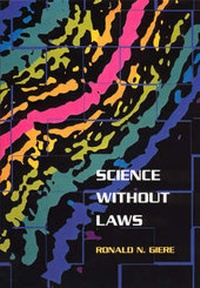
Science without Laws
Published on 1. June 1999
Book
Hardback
292 pages
978-0-226-29208-3 (ISBN)
Description
This text offers a mediating experience perspective on an increasingly volatile line of enquiry. The author does not question major findings of modern science: for example, that the universe is expanding or that inheritance is carried by DNA molecules with a double helical structure. But like many critics of modern science, he rejects the widespread notion of science - deriving ultimately from the Enlightenment - as a uniquely rational activity leading to the discovery of universal truths underlying all natural phenomena. Ronald Giere argues that it is better to understand scientists as merely constructing more or less abstract models of limited aspects of the world. Such an understanding makes possible a resolution of the issues at stake in the science wars. The critics of science are seen to be correct in rejecting the Enlightenment idea of science and its defenders are seen to be correct in insisting that science does produce genuine knowledge of the natural world. Giere argues that to criticize the Enlightenment ideal is not to criticize science itself and that to defend science one need not defend the Enlightenment ideal.
The book thus stakes out a middle ground in these debates by showing how science can be better conceived in other ways.
The book thus stakes out a middle ground in these debates by showing how science can be better conceived in other ways.
More details
Series
Language
English
Place of publication
Chicago
United States
Publishing group
The University of Chicago Press
Target group
College/higher education
Professional and scholarly
Illustrations
7 halftones, 15 line drawings, 3 tables, 3 maps
Dimensions
Height: 235 mm
Width: 160 mm
Weight
530 gr
ISBN-13
978-0-226-29208-3 (9780226292083)
Copyright in bibliographic data and cover images is held by Nielsen Book Services Limited or by the publishers or by their respective licensors: all rights reserved.
Schweitzer Classification