

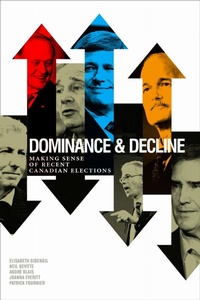
Dominance and Decline
Making Sense of Recent Canadian Elections
Published on 15. March 2012
Book
Paperback/Softback
240 pages
978-1-4426-0389-9 (ISBN)
Description
Coming out of the 2000 Canadian federal election, the dominance of the Liberal Party seemed assured. By 2011 the situation had completely reversed: the Liberals suffered a crushing defeat, failing even to become the official opposition and recording their lowest ever share of the vote. Dominance and Decline provides a comprehensive, comparative account of Canadian election outcomes from 2000 through to 2008. The book explores the meaning of those outcomes within the context of the larger changes that have marked Canada's party system since 1988. It also shows how these trends were consistent with the outcome of the 2011 federal election. Throughout the book a variety of voting theories are revisited and reassessed in light of this analysis.
More details
Language
English
Place of publication
Toronto
Canada
Product notice
Paperback (trade)
Dimensions
Height: 226 mm
Width: 150 mm
Thickness: 15 mm
Weight
318 gr
ISBN-13
978-1-4426-0389-9 (9781442603899)
Copyright in bibliographic data and cover images is held by Nielsen Book Services Limited or by the publishers or by their respective licensors: all rights reserved.
Schweitzer Classification
Persons
Elisabeth Gidengil is Hiram Mills Professor and Director of the Centre for the Study of Democratic Citizenship at McGill University.
Neil Nevitte is Professor of Political Science and cross-appointed as Professor at the School of Public Policy and Governance and the School of Global Affairs at the University of Toronto.
Andre Blais is Professor of Political Science and Canada Research Chair in Electoral Studies at the Universite de Montreal.
Joanna Everitt is a professor and Dean of the Faculty of Arts at the University of New Brunswick.
Patrick Fournier is Professor of Political Science at the Universite de Montreal.
Neil Nevitte is Professor of Political Science and cross-appointed as Professor at the School of Public Policy and Governance and the School of Global Affairs at the University of Toronto.
Andre Blais is Professor of Political Science and Canada Research Chair in Electoral Studies at the Universite de Montreal.
Joanna Everitt is a professor and Dean of the Faculty of Arts at the University of New Brunswick.
Patrick Fournier is Professor of Political Science at the Universite de Montreal.
Content
List of Figures and Tables
Acknowledgements
Introduction
1. Explaining Vote Choice
2. The Changing Social Bases of Party Support
3. Values and Beliefs
4. Party Loyalties
5. Does the Economy Matter?
6. The Issues and the Vote
7. Party Leaders: "The Superstars" of Canadian Politics?
8. Strategic Considerations
9. The Greens and the Perils of Being a "Single-Issue" Party
10. Electoral Dynamics in Quebec
11. The Shifting Contours of Canadian Elections
Appendix A: Estimating the Multistage Models
Appendix B: Values and Beliefs
Appendix C: The Determinants of Vote Choice
References
Index
Acknowledgements
Introduction
1. Explaining Vote Choice
2. The Changing Social Bases of Party Support
3. Values and Beliefs
4. Party Loyalties
5. Does the Economy Matter?
6. The Issues and the Vote
7. Party Leaders: "The Superstars" of Canadian Politics?
8. Strategic Considerations
9. The Greens and the Perils of Being a "Single-Issue" Party
10. Electoral Dynamics in Quebec
11. The Shifting Contours of Canadian Elections
Appendix A: Estimating the Multistage Models
Appendix B: Values and Beliefs
Appendix C: The Determinants of Vote Choice
References
Index