

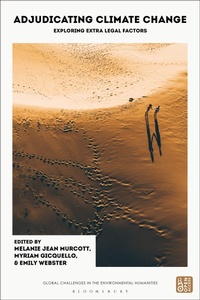
Adjudicating Climate Change
Exploring Extra-Legal Factors
Will be published approx. on 18. February 2027
Book
Hardback
272 pages
978-1-350-50162-1 (ISBN)
Description
Adopting a multidisciplinary approach to climate adjudication, this open access book addresses how adjudicators decide cases by considering the influence of psychology, philosophy, legal education, film, literature, political economy, political ecology, judicial appointments, history, and climate science on their decision-making and ultimately on the (inconsistent) outcomes in climate cases.
Drawing upon the humanities, science of climate change and/or social sciences to identify extra-legal factors that may drive the decision-making processes and outcomes of climate cases, this book uses case studies from different jurisdictions across the globe, addressing climate cases decided or pending in Africa, Asia, Europe, Latin and North America, and Oceania.
In all, the volume will:
- Engage with extra-legal influence to how show judges and arbitrators make their decisions in climate cases, shedding light on the inconsistent responses that climate cases have generated so far
- Challenge assumptions of legal universalism, by recognising differences in how the law works in various
- Inform actors involved in climate litigation (lawyers, judges, arbitrators, disputants), policymakers, and the public about how cases are decided.
The ebook editions of this book are available open access under a CC BY-NC-ND 4.0 licence on bloomsburycollections.com. Open access was funded by the Universities of Cambridge, Newcastle and Oxford.
Drawing upon the humanities, science of climate change and/or social sciences to identify extra-legal factors that may drive the decision-making processes and outcomes of climate cases, this book uses case studies from different jurisdictions across the globe, addressing climate cases decided or pending in Africa, Asia, Europe, Latin and North America, and Oceania.
In all, the volume will:
- Engage with extra-legal influence to how show judges and arbitrators make their decisions in climate cases, shedding light on the inconsistent responses that climate cases have generated so far
- Challenge assumptions of legal universalism, by recognising differences in how the law works in various
- Inform actors involved in climate litigation (lawyers, judges, arbitrators, disputants), policymakers, and the public about how cases are decided.
The ebook editions of this book are available open access under a CC BY-NC-ND 4.0 licence on bloomsburycollections.com. Open access was funded by the Universities of Cambridge, Newcastle and Oxford.
Reviews / Votes
This inspiring volume offers a compelling exploration of climate litigation beyond the confines of law, bringing together a rich diversity of voices. The collection is marked by a strong sense of intellectual generosity and shared purpose, reflecting the collaborative spirit in which it was brought together. Its multidisciplinary approach illuminates how legal reasoning intersects with the social, political, and scientific dimensions of climate action, and opens new pathways for deeper scholarly engagement with the complex landscape in which climate litigation operates. It will resonate beyond legal scholarship and be of real value to those engaged in advancing climate justice. * Leslie-Anne Duvic-Paoli, Reader in Environmental Law at King's College London, UK * Exemplifying multidisciplinarity at its best, this volume brilliantly illuminates the often-overlooked "extra-legal factors" that remain pivotal to adjudicating climate litigation. The constituent essays are wide-ranging in their geographical scope and disciplinary reach, successfully combining analytical depth with empirical breadth. The editors have curated an essential collection for scholars, legal practitioners, and activists interested in influencing the outcome of adjudication for climate justice. -- Professor Cajetan Iheka, Yale University, author of 'African Ecomedia: Network Forms, Planetary Politics:'More details
Series
Language
English
Place of publication
London
United Kingdom
Publishing group
Bloomsbury Publishing PLC
Target group
Professional and scholarly
Product notice
Laminated cover
Dimensions
Height: 234 mm
Width: 156 mm
Thickness: 14 mm
Weight
454 gr
ISBN-13
978-1-350-50162-1 (9781350501621)
Copyright in bibliographic data and cover images is held by Nielsen Book Services Limited or by the publishers or by their respective licensors: all rights reserved.
Schweitzer Classification
Persons
Melanie Murcott is Associate Professor of Public Law at the University of Cape Town, South Africa.
Myriam Gicquello is Lecturer in Mediation and Alternative Dispute Resolution, Newcastle University, UK.
Myriam Gicquello is Lecturer in Mediation and Alternative Dispute Resolution, Newcastle University, UK.
Content
List of contributors
Foreword
Acknowledgments
Introduction
Myriam Gicquello (Newcastle University, UK), Melanie Jean Murcott (University of Cape Town, Lawtons Africa, South Africa) and Emily Webster (Late of University of Cambridge, UK).
1. Beyond Legal Doctrine: Justifying an Analysis of Extra-Legal Factors Shaping Climate Adjudication.
Myriam Gicquello (Newcastle University, UK), Melanie Jean Murcott (University of Cape Town, South Africa), Emily Webster (University of Cambridge, UK) and Allan Basajjasubi (Natural Justice, South Africa)
PART 1: Inward-Looking Extra-Legal Factors
2. Contested Histories, Positionality and the Judiciary in the United-Kingdom, Canada and the United-States
Jessica Crow (University of Cambridge, UK) and Tejas Rao (University of Cambridge, UK)
3. On the Relationship Between the Federal Judicial Appointments Process and Recognition of Climate Rights in the United-States and South Africa
James R. May (Washburn University, USA) and Chris Oxtoby (University of Cape Town, South Africa)
4. Feelings Over (Legal) Reason: The Impact of Pre-Existing Beliefs and Ideologies on Climate Adjudication in the United-States
Myriam Gicquello (Newcastle University, UK)
PART 2: Outward-Looking Extra-Legal Factors
5. Adjudicating Climate Injustice in Postcolonial African Environmental Literatures: Imbolo Mbue's How Beautiful We Were as Legal Archive and Testimony
Paul Ugor (University of Waterloo, Canada)
6. Charting the Indigenous Experience of Climate Litigation and Environmental Advocacy in Australia
Harjeevan S. Narulla (Doughty Street Chambers, University of Oxford, London School of Economics, UK) and Ganur Maynard (North Australian Aboriginal Justice Agency, Darwin, Australia)
7. Vernacularising Climate Change Adjudication in India: Seeing the 'Other' Way from the Perspective of Subaltern Farmers
Nairita Roy Chaudhuri (Tilburg University, The Netherlands)
8. State Responsibility and Climate Justice: Extra-Legal Influences in Latin American Courts
Sol Meckievi (University of Oxford, University of Cambridge, UK)
9. Climate Anxiety as Injustice and Climate Education as Empowerment: Lessons for Adjudication
Silvia Cesa-Bianchi (University of Milano-Bicocca, Italy, Sciences Po Paris, France), Rob Amos (Birkbeck University of London, UK) and Debbie Sparks (University of Cape Town, South Africa)
10. Climate Litigation as Template-Making: Adjudication and Homogenisation of Legal Strategies on Loss and Damage
Arpitha Kodiveri (Vassar College, USA)
11. Climate Science in European Courtrooms: More than an Extra-Legal Factor?
Birgit Peters (University of Trier, Germany) and Matteo Fermeglia (University of Amsterdam, The Netherlands)
Conclusion: Key Lessons
Myriam Gicquello (Newcastle University, UK), Melanie Jean Murcott (University of Cape Town, South Africa) and Emily Webster (Late of University of Cambridge, UK).
Index
Foreword
Acknowledgments
Introduction
Myriam Gicquello (Newcastle University, UK), Melanie Jean Murcott (University of Cape Town, Lawtons Africa, South Africa) and Emily Webster (Late of University of Cambridge, UK).
1. Beyond Legal Doctrine: Justifying an Analysis of Extra-Legal Factors Shaping Climate Adjudication.
Myriam Gicquello (Newcastle University, UK), Melanie Jean Murcott (University of Cape Town, South Africa), Emily Webster (University of Cambridge, UK) and Allan Basajjasubi (Natural Justice, South Africa)
PART 1: Inward-Looking Extra-Legal Factors
2. Contested Histories, Positionality and the Judiciary in the United-Kingdom, Canada and the United-States
Jessica Crow (University of Cambridge, UK) and Tejas Rao (University of Cambridge, UK)
3. On the Relationship Between the Federal Judicial Appointments Process and Recognition of Climate Rights in the United-States and South Africa
James R. May (Washburn University, USA) and Chris Oxtoby (University of Cape Town, South Africa)
4. Feelings Over (Legal) Reason: The Impact of Pre-Existing Beliefs and Ideologies on Climate Adjudication in the United-States
Myriam Gicquello (Newcastle University, UK)
PART 2: Outward-Looking Extra-Legal Factors
5. Adjudicating Climate Injustice in Postcolonial African Environmental Literatures: Imbolo Mbue's How Beautiful We Were as Legal Archive and Testimony
Paul Ugor (University of Waterloo, Canada)
6. Charting the Indigenous Experience of Climate Litigation and Environmental Advocacy in Australia
Harjeevan S. Narulla (Doughty Street Chambers, University of Oxford, London School of Economics, UK) and Ganur Maynard (North Australian Aboriginal Justice Agency, Darwin, Australia)
7. Vernacularising Climate Change Adjudication in India: Seeing the 'Other' Way from the Perspective of Subaltern Farmers
Nairita Roy Chaudhuri (Tilburg University, The Netherlands)
8. State Responsibility and Climate Justice: Extra-Legal Influences in Latin American Courts
Sol Meckievi (University of Oxford, University of Cambridge, UK)
9. Climate Anxiety as Injustice and Climate Education as Empowerment: Lessons for Adjudication
Silvia Cesa-Bianchi (University of Milano-Bicocca, Italy, Sciences Po Paris, France), Rob Amos (Birkbeck University of London, UK) and Debbie Sparks (University of Cape Town, South Africa)
10. Climate Litigation as Template-Making: Adjudication and Homogenisation of Legal Strategies on Loss and Damage
Arpitha Kodiveri (Vassar College, USA)
11. Climate Science in European Courtrooms: More than an Extra-Legal Factor?
Birgit Peters (University of Trier, Germany) and Matteo Fermeglia (University of Amsterdam, The Netherlands)
Conclusion: Key Lessons
Myriam Gicquello (Newcastle University, UK), Melanie Jean Murcott (University of Cape Town, South Africa) and Emily Webster (Late of University of Cambridge, UK).
Index