

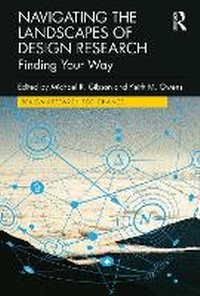
Navigating the Landscapes of Design Research
Finding Your Way
1st Edition
Will be published approx. on 18. March 2026
Book
Hardback
220 pages
978-1-032-78316-1 (ISBN)
Description
This book provides emerging and established designers and design educators, along with their collaborators, with a means to understand how and why the landscape of design research has come to exist as it does, and how and why its various destinations and pathways connect.
It is an accessible "guide" for those in and around design who have little to no experience with planning and conducting research to inform their decision-making. Specifically, the book makes the case that an integration of research and design is critical in a world shaped by an increasingly complex and pervasive amalgam of challenges: social, technological, environmental, economic, and political. The need to expand shared understandings of research has also become acute because this landscape is increasingly traversed by those who are seeking evidence-based outcomes to their needs rather than solutions shaped by aesthetic polish, subjective client demands, or simple cost-benefit formulas.
The book will be of interest to scholars and designers working in design studies and design research, as well as to design practitioners who are increasingly called upon to understand and act upon data gleaned from evidence-based research.
It is an accessible "guide" for those in and around design who have little to no experience with planning and conducting research to inform their decision-making. Specifically, the book makes the case that an integration of research and design is critical in a world shaped by an increasingly complex and pervasive amalgam of challenges: social, technological, environmental, economic, and political. The need to expand shared understandings of research has also become acute because this landscape is increasingly traversed by those who are seeking evidence-based outcomes to their needs rather than solutions shaped by aesthetic polish, subjective client demands, or simple cost-benefit formulas.
The book will be of interest to scholars and designers working in design studies and design research, as well as to design practitioners who are increasingly called upon to understand and act upon data gleaned from evidence-based research.
More details
Series
Language
English
Place of publication
London
United Kingdom
Publishing group
Taylor & Francis Ltd
Target group
College/higher education
Postgraduate and Undergraduate Advanced
Illustrations
54 s/w Photographien bzw. Rasterbilder, 3 s/w Zeichnungen, 13 s/w Tabellen, 57 s/w Abbildungen
13 Tables, black and white; 3 Line drawings, black and white; 54 Halftones, black and white; 57 Illustrations, black and white
Dimensions
Height: 246 mm
Width: 174 mm
Weight
490 gr
ISBN-13
978-1-032-78316-1 (9781032783161)
Copyright in bibliographic data and cover images is held by Nielsen Book Services Limited or by the publishers or by their respective licensors: all rights reserved.
Schweitzer Classification
Other editions
Additional editions
E-Book
03/2026
1st Edition
Routledge
€60.49
Available for download
E-Book
03/2026
1st Edition
Routledge
€60.49
Available for download
Persons
Michael R. Gibson is a Professor of Communication Design at The University of North Texas, U.S.A, who has led graduate programs in design research and interaction design. Gibson's investigations have yielded positive outcomes in the facilitation of healthcare on behalf of children and older adults, and regarding the development and implementation of design processes in the K-12 education space.
Keith M. Owens' experiences as a design researcher and Professor of Communication Design at The University of North Texas, U.S.A, have afforded him opportunities to blend his extensive, experiential knowledge of professional design with his scholarship in ways that have allowed him to address a wide variety of issues in and around socially focused design practice.
Keith M. Owens' experiences as a design researcher and Professor of Communication Design at The University of North Texas, U.S.A, have afforded him opportunities to blend his extensive, experiential knowledge of professional design with his scholarship in ways that have allowed him to address a wide variety of issues in and around socially focused design practice.
Content
Introduction 1. Why We Need Design Research Now More Than Ever 2. Adaptation to Context: Design Research Evolves to Serve Design Practices 3. Understanding what design research IS and is NOT 4. Mapping Curiosity 5. Design Research Activity: Actions and Subjects of Study 6. Visualizing Confidence in Intelligence Analysis: A Case of Design Exploration in Interdisciplinary Research 7. Design Research into Action: Exploring Evidence-Based Design (EBD) and Related Interpretivist Approaches to Discovery, Decision and Agency 8. Emergent Design Research: Reconceiving Biodesign-in-Action 9. Expanding the Domains of Design Decision-Making and Practice 10. A Position Paper: Cultivating Attunement to the Raw Materials of Problem Formulation 11. Design Research and Practice Responsibility: Accounting for Ourselves, Our Creations and Others A Summative Conclusion