

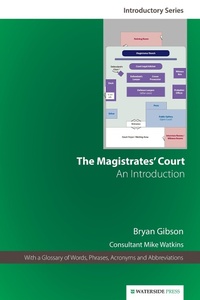
The Magistrates' Court
An Introduction
5th Edition
Published on 30. April 2009
Book
Paperback/Softback
194 pages
978-1-904380-52-8 (ISBN)
Description
The Magistrates' Court: An Introduction is a simple speedy summary. This fully revised Fifth Edition* takes account of the wide scale changes which have affected the work of Justices of the Peace and their courts in recent years. A unique handbook Consistently rated excellent by reviewers Especially useful for newcomers to the topic A most useful introduction that can be used alongside other training materials or as an ideal self-study guide. Also includes a Timeline and an extensive Glossary of Words, Phrases, Acronyms and Abbreviations - the language of the system - which will be of particular use to people wishing to quickly get to grips with the terminology of the magistrates' courts. Reviews 'This invaluable book...aims to inform and explain, and that it does admirably': The Magistrate 'It is no small wonder that this excellent book has remained in print for two decades.
It really is a benchmark book managing the basic concepts with a suitable level of detail radically re-written and updated for 2010': Phillip Taylor MBE & Elizabeth Taylor, Richmond Green Chambers Topics covered include: the history of the magistracy and its robust heritage the modern-day magistrates' court recent changes in administration and powers how people become JPs their training, development, mentoring and appraisal fundamental principals and tenets the key relationship between JPs and their legal advisers trial in the magistrates' court summary justice, crime and anti-social behaviour sentencing and connected items guidelines, advice and judicial oversight important rules and procedures diversity, equality, fairness and human rights relationship to the Crown Court (and other courts) magistrates and district judges reasoned decision-making location within the wider Criminal Justice System the role of the Ministry of Justice the role of HM Court Service adult courts, youth courts and family courts road traffic and other 'specialist' areas civil and 'non-police' matters a range of 'everyday topics' sample procedures open justice, media reporting and public confidence key committees, liaison arrangements and membership bodies a wealth of further detail (but all 'uncluttered' by technical data).
Authors Bryan Gibson is editor-in-chief, Waterside Press. He is a barrister, former co-editor of Justice of the Peace and a regular contributor to specialist journals. He was for 25 years a justices' clerk and during much of that time an elected member of the Council of the Justices' Clerks' Society (and chair of its Criminal Law Committee). He is co-author (with Paul Cavadino) of The Criminal Justice System, author of The New Ministry of Justice, The New Home Office, and The Pocket A-Z of Criminal Justice (amongst many others). He has also written for The Guardian, The Stage and numerous journals including Justice of the Peace, The Independent Monitor, and Prison Journal. Mike Watkins is an experienced trainer of magistrates who has written materials for the Judicial Studies Board, Magistrates' Association and Universities of Birmingham and Cambridge. (* previous editions were titled Introduction to the Magistrates' Court)
It really is a benchmark book managing the basic concepts with a suitable level of detail radically re-written and updated for 2010': Phillip Taylor MBE & Elizabeth Taylor, Richmond Green Chambers Topics covered include: the history of the magistracy and its robust heritage the modern-day magistrates' court recent changes in administration and powers how people become JPs their training, development, mentoring and appraisal fundamental principals and tenets the key relationship between JPs and their legal advisers trial in the magistrates' court summary justice, crime and anti-social behaviour sentencing and connected items guidelines, advice and judicial oversight important rules and procedures diversity, equality, fairness and human rights relationship to the Crown Court (and other courts) magistrates and district judges reasoned decision-making location within the wider Criminal Justice System the role of the Ministry of Justice the role of HM Court Service adult courts, youth courts and family courts road traffic and other 'specialist' areas civil and 'non-police' matters a range of 'everyday topics' sample procedures open justice, media reporting and public confidence key committees, liaison arrangements and membership bodies a wealth of further detail (but all 'uncluttered' by technical data).
Authors Bryan Gibson is editor-in-chief, Waterside Press. He is a barrister, former co-editor of Justice of the Peace and a regular contributor to specialist journals. He was for 25 years a justices' clerk and during much of that time an elected member of the Council of the Justices' Clerks' Society (and chair of its Criminal Law Committee). He is co-author (with Paul Cavadino) of The Criminal Justice System, author of The New Ministry of Justice, The New Home Office, and The Pocket A-Z of Criminal Justice (amongst many others). He has also written for The Guardian, The Stage and numerous journals including Justice of the Peace, The Independent Monitor, and Prison Journal. Mike Watkins is an experienced trainer of magistrates who has written materials for the Judicial Studies Board, Magistrates' Association and Universities of Birmingham and Cambridge. (* previous editions were titled Introduction to the Magistrates' Court)
Reviews / Votes
'This invaluable book...aims to inform and explain, and that it does admirably': The MagistrateMore details
Series
Edition
5th Revised edition
Language
English
Place of publication
Winchester
United Kingdom
Target group
Professional and scholarly
Edition type
Revised edition
Product notice
Paperback (trade)
Illustrations
1, black & white illustrations
Dimensions
Height: 234 mm
Width: 156 mm
Thickness: 10 mm
Weight
304 gr
ISBN-13
978-1-904380-52-8 (9781904380528)
Copyright in bibliographic data and cover images is held by Nielsen Book Services Limited or by the publishers or by their respective licensors: all rights reserved.
Schweitzer Classification
Other editions
Additional editions
E-Book
05/2009
1st Edition
Waterside Press
€40.49
Available for download
Persons
Bryan Gibson is editor-in-chief, Waterside Press. He is a barrister, former co-editor of Justice of the Peace and a regular contributor to specialist journals. He was for 25 years a justices' clerk and during much of that time an elected member of the Council of the Justices' Clerks' Society (and chair of its Criminal Law Committee). He is co-author (with Paul Cavadino) of The Criminal Justice System, author of The New Ministry of Justice, The New Home Office, and The Pocket A-Z of Criminal Justice (amongst many others). He has also written for The Guardian, The Stage and numerous journals including Justice of the Peace, The Independent Monitor, and Prison Journal. Mike Watkins is an experienced trainer of magistrates who has written materials for the Judicial Studies Board, Magistrates' Association and Universities of Birmingham and Cambridge.
Content
Topics covered include: * the history of the magistracy and its robust heritage * the modern-day magistrates' court * recent changes in administration and powers * how people become JPs * their training, development, mentoring and appraisal * fundamental principals and tenets * the key relationship between JPs and their legal advisers * trial in the magistrates' court * summary justice, crime and anti-social behaviour * sentencing and connected items * guidelines, advice and judicial oversight * important rules and procedures * diversity, equality, fairness and human rights * relationship to the Crown Court (and other courts) * magistrates and district judges * reasoned decision-making * location within the wider Criminal Justice System * the role of the Ministry of Justice * the role of HM Court Service * adult courts, youth courts and family courts * road traffic and other 'specialist' areas * civil and 'non-police' matters * a range of 'everyday topics' * sample procedures * open justice, media reporting and public confidence * key committees, liaison arrangements and membership bodies * a wealth of further detail (but all 'uncluttered' by technical data).