

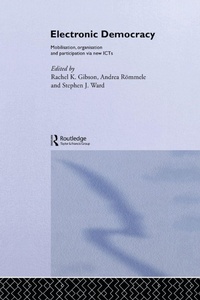
Electronic Democracy
Mobilisation, Organisation and Participation via new ICTs
1st Edition
Published on 19. May 2014
Book
Paperback/Softback
224 pages
978-1-138-01019-2 (ISBN)
Description
Electronic Democracy analyses the impact of new information and communication technologies (ICTs) within representative democracy, such as political parties, pressure groups, new social movements and executive and legislative bodies. Arguing for the validity of social perspective in theory building, it examines how representative democracies are adapting to new ICTs. It features a number of comparative studies focusing on the UK, the US, Sweden, Germany, Korea and Australia.
More details
Series
Language
English
Place of publication
London
United Kingdom
Publishing group
Taylor & Francis Ltd
Target group
College/higher education
Dimensions
Height: 234 mm
Width: 156 mm
Thickness: 12 mm
Weight
348 gr
ISBN-13
978-1-138-01019-2 (9781138010192)
Copyright in bibliographic data and cover images is held by Nielsen Book Services Limited or by the publishers or by their respective licensors: all rights reserved.
Schweitzer Classification
Other editions
Additional editions
Rachel Gibson | Andrea Roemmele | Steven Ward
Electronic Democracy
Mobilisation, Organisation and Participation via new ICTs
E-Book
07/2004
Routledge
€64.49
Available for download
Rachel Gibson | Andrea Roemmele | Steven Ward
Electronic Democracy
Mobilisation, Organisation and Participation via new ICTs
E-Book
07/2004
Routledge
€64.49
Available for download
Rachel Gibson | Andrea Roemmele | Steven Ward
Electronic Democracy
Mobilisation, Organisation and Participation via new ICTs
Book
01/2004
Routledge
€206.30
Shipment within 15-20 days
Persons
Rachel K. Gibson is Deputy Director of the Centre for Social Research in the Research School of Social Sciences (RSSS) at the Australian National University, Australia. Andrea Roemmele is Senior Research Fellow at the Mannheim Centre for European Social Research (MZES) at the University of Mannheim, Germany. Stephen J. Ward is Senior Lecturer in Politics at the European Studies Research Institute, University of Salford, UK.
Content
Preface and acknowledgements 1 Introduction: representative democracy and the Internet 2 Electronic democracy and the 'mixed polity': symbiosis or conflict? 3 The citizen as consumer: e-government in the United Kingdom and the United States 4 Digital parliaments and electronic democracy: a comparison between the US House, the Swedish Riksdag and the German Bundestag 5 Digital democracy: ideas, intentions and initiatives in Swedish local governments 6 Cyber-campaigning grows up: a comparative content analysis of websites for US Senate and gubernatorial races, 1998-2000 7 Global legal pluralism and electronic democracy 8 Problems@labour: towards a net-internationalism? 9 Rethinking political participation: experiments in Internet activism in Australia and Britain 10 Conclusion: the future of representative democracy in the digital era