

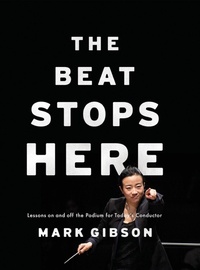
The Beat Stops Here
Lessons on and off the Podium for Today's Conductor
Published on 9. March 2017
Book
Hardback
320 pages
978-0-19-060587-2 (ISBN)
Description
In The Beat Stops Here: Lessons on and off the Podium for Today's Conductor, master conductor Mark Gibson addresses the technique of conducting as an extension of intimate knowledge of the score to the hands and arms. He employs a variety of everyday activities and motions (brushing the dog, Tinkerbelle, the "door knob") to describe the physical aspects of the role. He advocates a comprehensive, detailed approach to score study, addressing major works bar-by-bar in terms of both musical analysis and conducting method. Finally, Gibson explores the various roles a conductor plays, as a teacher, a scholar and a member of the musical community. His writing is highly focused, with an occasionally tongue-in-cheek, discussing everything from motivic development in Brahms to how to hold a knife and fork in public. In short, The Beat Stops Here is a compendium of style and substance in the real world of today's conductor.
Reviews / Votes
Filled with fabulous imagery, an insightful book from a master teacher! * Neil Varon, Professor of Conducting, at the Eastman School of Music *More details
Language
English
Place of publication
New York
United States
Target group
Professional and scholarly
Dimensions
Height: 286 mm
Width: 221 mm
Thickness: 22 mm
Weight
1058 gr
ISBN-13
978-0-19-060587-2 (9780190605872)
Copyright in bibliographic data and cover images is held by Nielsen Book Services Limited or by the publishers or by their respective licensors: all rights reserved.
Schweitzer Classification
Other editions
Additional editions
Book
03/2017
Oxford University Press Inc
€51.50
Shipment within 15-20 days
E-Book
02/2017
1st Edition
OUP eBook
€23.99
Available for download

E-Book
02/2017
1st Edition
OUP eBook
€23.99
Available for download
Person
Director of Orchestral Studies at the College-Conservatory of Music, University of Cincinnati, Mark Gibson enjoys a teaching and conducting career that spans four decades and three continents. Among his former students are many of today's up and coming maestros, including Xian Zhang, Tung-Chieh Chuang, Annunziata Tomaro and Olivier Ochanine. Mr. Gibson is a native of New Jersey.
Content
Acknowledgements
Preface
Foreword: Teaching Conducting
List of Musical Examples and Illustrations
PART 1: REPERTOIRE LESSONS
Introduction to Repertoire Lessons
A Glossary of Conducting Gesture
Chapter 1. Overture
Ludwig van Beethoven: "Die Geschoepfe des Prometheus," Op. 43 (1801)
Gioacchino Rossini: La Cenerentola (1817)
Felix Mendelssohn: "Die schoene Melusine," Op. 32 (1833)
Giuseppe Verdi: Les Vepres Siciliennes (I Vespri Siciliani) (1855)
Johannes Brahms: Tragische Ouvertuere, Op. 81 (1880)
Chapter 2. Opera
Wolfgang Amadeus Mozart: Don Giovanni, K. 527 (1787)
Sestetto: "Solo, solo in buio loco"
Giuseppe Verdi: Un ballo in maschera (1859)
Finale 3? Scena e Romanza:
"Forse la soglia attinseELMa se m'e forza perderti"
Jules Massenet: Manon (1884)
Duo: "Pardonnez-moi, Dieu de toute puissance"
Giacomo Puccini: Madama Butterfly (1904)
Duetto: "Viene la sera"
Chapter 3. Smaller symphonic works
W.A.Wolfgang Amadeus Mozart: Symphony No. 29 in A Major, K. 201 (1774)
Antonin Dvorak: Scherzo Capriccioso, Op. 66 (1883)
Maurice Ravel: Valses nobles et sentimentales (1911, orch. 1912)
Chapter 4. Concerto and solo works
Ludwig van Beethoven: Piano Concerto no. 4 in G Major, Op. 58 (1805-6)
Gustav Mahler: Des knaben Wunderhorn (1887-1899); Four songs
Jean Sibelius: Violin Concerto in D Minor, Op. 47 (1904)
Chapter 5. Larger symphonic works
Nikolai Rimsky-Korsakov: Scheherazade, Op. 35 (1888)
Igor Stravinsky: Petrouchka: Scenes burlesques en 4 tableaux (1911, rev. 1947)
PART 2: PROFESSIONAL LESSONS
Chapter 6. The Conductor as Teacher
Not the Eternal Tao
Are Two Hands Better?
MAKE YOUR OWN METRONOME!
Storytelling
Heads, Shoulders, Knees and Toes
Developing Score Reading Skills (by A. Tomaro)
Quantifiable
Chapter 7. The Conductor as Scholar
On Rewriting the Act 3 Finale of Bizet's Les Pecheurs de Perles (1863)
Heroism Denied: Movement Order in Mahler's Sixth Symphony (1903-4, rev. 1906)
Puccini's Turandot (1924): A Conductor's Perspective
Chapter 8. The Conductor as Leader
Working with the Orchestra: Bill of Rights
Three-part Conducting Rules
More Rules for the Road
Talk Show - a cautionary tale
Quiz Show
Working in the Opera House:"Gott, welch dunkel hier!"
Working with Singers: A Breed Apart
Working with Chorus: Dreamers of Dreams
Building a Career: Ou voulez-vous allez?
POSTSCRIPT: Present and Future Tense
Appendix A: Musical works and editions
Appendix B: Texts and Translations
Appendix C: Tempo Indications and Metronome Markings
Appendix D: Endnotes
Appendix E: Resource materials/bibliography
INDEX
Preface
Foreword: Teaching Conducting
List of Musical Examples and Illustrations
PART 1: REPERTOIRE LESSONS
Introduction to Repertoire Lessons
A Glossary of Conducting Gesture
Chapter 1. Overture
Ludwig van Beethoven: "Die Geschoepfe des Prometheus," Op. 43 (1801)
Gioacchino Rossini: La Cenerentola (1817)
Felix Mendelssohn: "Die schoene Melusine," Op. 32 (1833)
Giuseppe Verdi: Les Vepres Siciliennes (I Vespri Siciliani) (1855)
Johannes Brahms: Tragische Ouvertuere, Op. 81 (1880)
Chapter 2. Opera
Wolfgang Amadeus Mozart: Don Giovanni, K. 527 (1787)
Sestetto: "Solo, solo in buio loco"
Giuseppe Verdi: Un ballo in maschera (1859)
Finale 3? Scena e Romanza:
"Forse la soglia attinseELMa se m'e forza perderti"
Jules Massenet: Manon (1884)
Duo: "Pardonnez-moi, Dieu de toute puissance"
Giacomo Puccini: Madama Butterfly (1904)
Duetto: "Viene la sera"
Chapter 3. Smaller symphonic works
W.A.Wolfgang Amadeus Mozart: Symphony No. 29 in A Major, K. 201 (1774)
Antonin Dvorak: Scherzo Capriccioso, Op. 66 (1883)
Maurice Ravel: Valses nobles et sentimentales (1911, orch. 1912)
Chapter 4. Concerto and solo works
Ludwig van Beethoven: Piano Concerto no. 4 in G Major, Op. 58 (1805-6)
Gustav Mahler: Des knaben Wunderhorn (1887-1899); Four songs
Jean Sibelius: Violin Concerto in D Minor, Op. 47 (1904)
Chapter 5. Larger symphonic works
Nikolai Rimsky-Korsakov: Scheherazade, Op. 35 (1888)
Igor Stravinsky: Petrouchka: Scenes burlesques en 4 tableaux (1911, rev. 1947)
PART 2: PROFESSIONAL LESSONS
Chapter 6. The Conductor as Teacher
Not the Eternal Tao
Are Two Hands Better?
MAKE YOUR OWN METRONOME!
Storytelling
Heads, Shoulders, Knees and Toes
Developing Score Reading Skills (by A. Tomaro)
Quantifiable
Chapter 7. The Conductor as Scholar
On Rewriting the Act 3 Finale of Bizet's Les Pecheurs de Perles (1863)
Heroism Denied: Movement Order in Mahler's Sixth Symphony (1903-4, rev. 1906)
Puccini's Turandot (1924): A Conductor's Perspective
Chapter 8. The Conductor as Leader
Working with the Orchestra: Bill of Rights
Three-part Conducting Rules
More Rules for the Road
Talk Show - a cautionary tale
Quiz Show
Working in the Opera House:"Gott, welch dunkel hier!"
Working with Singers: A Breed Apart
Working with Chorus: Dreamers of Dreams
Building a Career: Ou voulez-vous allez?
POSTSCRIPT: Present and Future Tense
Appendix A: Musical works and editions
Appendix B: Texts and Translations
Appendix C: Tempo Indications and Metronome Markings
Appendix D: Endnotes
Appendix E: Resource materials/bibliography
INDEX