

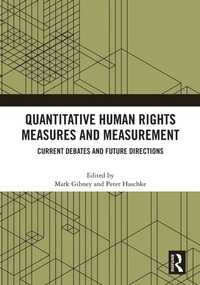
Quantitative Human Rights Measures and Measurement
Current Debates and Future Directions
1st Edition
Published on 9. October 2024
Book
Paperback/Softback
152 pages
978-1-032-48143-2 (ISBN)
Description
In this edited volume, leading experts of human rights measurement address the challenges scholarship of human rights face as well as explore approaches and means to overcoming them.
The book seeks to further answer three specific and related questions. First, what do existing measures of human rights conditions tell us about the state of human rights? Are conditions improving or deteriorating? Second, how might scholars improve their measurement efforts and observe states' human rights practices given efforts by governments to hide human rights abuses and to make them essentially "unobservable"? Finally, what challenges might scholars encounter in the future as the conceptualization of human rights develops and changes, and as new methods and technologies (e.g., natural language processing, machine learning) are introduced into the study of human rights?
This book will be of interest to students and scholars of human rights politics, power, development, and governance. The chapters in this book were originally published as a special issue of Journal of Human Rights.
The book seeks to further answer three specific and related questions. First, what do existing measures of human rights conditions tell us about the state of human rights? Are conditions improving or deteriorating? Second, how might scholars improve their measurement efforts and observe states' human rights practices given efforts by governments to hide human rights abuses and to make them essentially "unobservable"? Finally, what challenges might scholars encounter in the future as the conceptualization of human rights develops and changes, and as new methods and technologies (e.g., natural language processing, machine learning) are introduced into the study of human rights?
This book will be of interest to students and scholars of human rights politics, power, development, and governance. The chapters in this book were originally published as a special issue of Journal of Human Rights.
More details
Language
English
Place of publication
London
United Kingdom
Publishing group
Taylor & Francis Ltd
Target group
College/higher education
Academic, Postgraduate, and Undergraduate
Dimensions
Height: 254 mm
Width: 178 mm
Thickness: 9 mm
Weight
322 gr
ISBN-13
978-1-032-48143-2 (9781032481432)
Copyright in bibliographic data and cover images is held by Nielsen Book Services Limited or by the publishers or by their respective licensors: all rights reserved.
Schweitzer Classification
Other editions
Additional editions
Mark Gibney | Peter Haschke
Quantitative Human Rights Measures and Measurement
Current Debates and Future Directions
E-Book
05/2023
1st Edition
Routledge
€55.49
Available for download
Mark Gibney | Peter Haschke
Quantitative Human Rights Measures and Measurement
Current Debates and Future Directions
Book
05/2023
1st Edition
Routledge
€196.00
Shipment within 10-20 days
Mark Gibney | Peter Haschke
Quantitative Human Rights Measures and Measurement
Current Debates and Future Directions
E-Book
05/2023
1st Edition
Routledge
€55.49
Available for download
Persons
Mark Gibney is the Belk Distinguished Professor of Humanities and Professor of Political Science at the University of North Carolina, Asheville. He is a co-director of the Political Terror Scale Human Rights data collection project.
Peter Haschke is Associate Professor of Political Science at the University of North Carolina, Asheville and co-director of the Political Terror Scale project.
Peter Haschke is Associate Professor of Political Science at the University of North Carolina, Asheville and co-director of the Political Terror Scale project.
Content
Introduction: Quantitative Human Rights Measures 1. Changing standards or political whim? Evaluating changes in the content of US State Department Human Rights Reports following presidential transitions 2. Path dependence and human rights improvement 3. What bias? Changing standards, information effects, and human rights measurement 4. 'Who did what for whom?' Amnesty International's Urgent Actions as activist-generated data 5. Human rights data for everyone: Introducing the Human Rights Measurement Initiative (HRMI) 6. Advocacy output: Automated coding documents from human rights organizations 7. How to teach machines to read human rights reports and identify judgments at scale 8. Introducing DyoRep: A database of perpetrator-victim dyads within repressive spells 9. Words count: Discourse and the quantitative analysis of international norms