

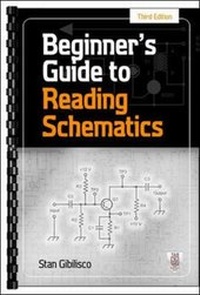
Beginner's Guide to Reading Schematics, Third Edition
3rd Edition
Published on 16. November 2013
Book
Spiral bound
192 pages
978-0-07-182778-2 (ISBN)
Description
Translate schematic diagrams into today's cutting-edge electronicsNavigate the roadmaps of simple electronic circuits andcomplex systems with help from an experienced engineer.With all-new art and demo circuits you can build, thishands-on, illustrated guide explains how to understand andcreate high-precision electronics diagrams. Find out how toidentify parts and connections, decipher element ratings,and apply diagram-based information in your own projects.Beginner's Guide to Reading Schematics, Third Edition, also contains valuable appendices covering symbols and resistor color codes.
Featuring detailed coverage of:
Schematic, block, and pictorial diagramsResistors and capacitorsInductors and transformersSwitches, conductors, and cablesDiodes, transistors, and logic gatesElectron tubesCells and batteriesVoltage dividers and reducersBreadboards and wire wrappingElectronics troubleshooting
Featuring detailed coverage of:
Schematic, block, and pictorial diagramsResistors and capacitorsInductors and transformersSwitches, conductors, and cablesDiodes, transistors, and logic gatesElectron tubesCells and batteriesVoltage dividers and reducersBreadboards and wire wrappingElectronics troubleshooting
More details
Edition
3rd edition
Language
English
Place of publication
New York
United States
Publishing group
McGraw-Hill Education - Europe
Target group
Professional and scholarly
Illustrations
125 Illustrations
Dimensions
Height: 226 mm
Width: 224 mm
Thickness: 13 mm
Weight
274 gr
ISBN-13
978-0-07-182778-2 (9780071827782)
Schweitzer Classification
Other editions
Additional editions
Stan Gibilisco
Beginner's Guide to Reading Schematics, 3E
E-Book
10/2013
1st Edition
McGraw-Hill Education
€69.49
Available for download
Person
Stan Gibilisco is a professional technical writer who specializes in books on electronics and science topics. He is the author of The Encyclopedia of Electronics, The McGraw-Hill Encyclopedia of Personal Computing, and The Illustrated Dictionary of Electronics, as well as over 20 other technical books. His published works have won numerous awards. The Encyclopedia of Electronics was chosen a "Best Reference Book of the 1980s" by the American Library Association, which also named his McGraw-Hill Encyclopedia of Personal Computing a "Best Reference of 1996."
Content
Chapter 1. What's The Scheme
Block Diagrams
Flowcharts
Schematic Symbology
Schematic Interconnections
Visual language
SummaryChapter 2. Block Diagrams
Functional Drawings
Current and Signal Paths
Flowcharts
Process Paths
Summary
Chapter 3. Component Symbols
Resistors and Potentiometers
Capacitors
Inductors and Transformers
Switches
Plugs, Jacks, and Outlets
Diodes and Transistors
Electron Tubes
Cells and Batteries
Wires and Cables
Grounds and Antennas
Integrated Circuits
Exotic Symbols
Summary
Chapter 4. Simple Circuits
Getting Started
Component Labeling
Troubleshooting with Schematics
Other Forms of Designation
Schematic/Block Combinations
Summary
Chapter 5. Complex Circuits
Identifying the Building Blocks
Analyzing Large Schematics
Page Breaks
Getting Comfortable with Large Schematics
Summary
Chapter 6. Pictorial Diagrams
General Pictorials
Breadboard Layouts
Circuit-Board Layouts
Three-Dimensional Drawings
Summary
APPENDIX A. Table of Symbols
APPENDIX B. Resistor Color Codes
Block Diagrams
Flowcharts
Schematic Symbology
Schematic Interconnections
Visual language
SummaryChapter 2. Block Diagrams
Functional Drawings
Current and Signal Paths
Flowcharts
Process Paths
Summary
Chapter 3. Component Symbols
Resistors and Potentiometers
Capacitors
Inductors and Transformers
Switches
Plugs, Jacks, and Outlets
Diodes and Transistors
Electron Tubes
Cells and Batteries
Wires and Cables
Grounds and Antennas
Integrated Circuits
Exotic Symbols
Summary
Chapter 4. Simple Circuits
Getting Started
Component Labeling
Troubleshooting with Schematics
Other Forms of Designation
Schematic/Block Combinations
Summary
Chapter 5. Complex Circuits
Identifying the Building Blocks
Analyzing Large Schematics
Page Breaks
Getting Comfortable with Large Schematics
Summary
Chapter 6. Pictorial Diagrams
General Pictorials
Breadboard Layouts
Circuit-Board Layouts
Three-Dimensional Drawings
Summary
APPENDIX A. Table of Symbols
APPENDIX B. Resistor Color Codes