

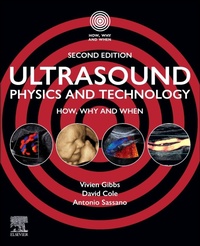
Ultrasound Physics and Technology
How, Why and When
2nd Edition
Published on 10. April 2026
Book
Paperback/Softback
150 pages
978-0-443-40923-3 (ISBN)
Description
Part of the popular How, Why and When series of introductory textbooks, Ultrasound Physics and Technology is ideally tailored for students and healthcare practitioners needing a comprehensive understanding of the basic principles behind how sound waves and echoes create ultrasound images.
Easy to read, concise and highly accessible, this book is perfect for readers who do not have a physics or technology background. It covers how ultrasound produces diagnostic images, why it is used in different clinical scenarios, and when its use as a diagnostic tool is appropriate.
The book has been fully updated to incorporate the latest technology and developments, and will be an invaluable guide for all sonography practitioners and students who wish to practise ultrasound safely and effectively.
Covers all the fundamental physics and technological knowledge needed to practise ultrasound effectively, including safety aspects, quality assurance, and the latest techniques and developments
Clear and concise explanations for those new to ultrasound physics and technology - no prior knowledge or experience necessary
Step-by-step introduction to the topics, covered in a logical order - each chapter builds on content covered in previous chapters
Learning outcomes and chapter summaries support learning
Easy to read and follow - written in non-technical language for readers from a variety of training backgrounds.
Takes a non-mathematical approach to explain the principles of ultrasound physics
Uses a variety of examples from clinical practice used to bring learning to life
Ideal for students but also valuable as a quick reference guide for all medical practitioners of ultrasound, from sonographers to doctors and midwives
New to this edition
Covers advancements in transducer technology
Looks at integration of ultrasound with other imaging modalities such as CT and MRI for more accurate diagnostic evaluations.
Covers new 3D/4D ultrasound in obstetric imaging
Explores artificial intelligence and machine learning to automate image interpretation and optimise workflow in ultrasound technology
Easy to read, concise and highly accessible, this book is perfect for readers who do not have a physics or technology background. It covers how ultrasound produces diagnostic images, why it is used in different clinical scenarios, and when its use as a diagnostic tool is appropriate.
The book has been fully updated to incorporate the latest technology and developments, and will be an invaluable guide for all sonography practitioners and students who wish to practise ultrasound safely and effectively.
Covers all the fundamental physics and technological knowledge needed to practise ultrasound effectively, including safety aspects, quality assurance, and the latest techniques and developments
Clear and concise explanations for those new to ultrasound physics and technology - no prior knowledge or experience necessary
Step-by-step introduction to the topics, covered in a logical order - each chapter builds on content covered in previous chapters
Learning outcomes and chapter summaries support learning
Easy to read and follow - written in non-technical language for readers from a variety of training backgrounds.
Takes a non-mathematical approach to explain the principles of ultrasound physics
Uses a variety of examples from clinical practice used to bring learning to life
Ideal for students but also valuable as a quick reference guide for all medical practitioners of ultrasound, from sonographers to doctors and midwives
New to this edition
Covers advancements in transducer technology
Looks at integration of ultrasound with other imaging modalities such as CT and MRI for more accurate diagnostic evaluations.
Covers new 3D/4D ultrasound in obstetric imaging
Explores artificial intelligence and machine learning to automate image interpretation and optimise workflow in ultrasound technology
Reviews / Votes
Review of the previous edition:"The authors using their experienced background in ultrasound education have provided a concise overview of ultrasound physics and instrumentation to the new ultrasound user in a simple and clear manner. For the postgraduate ultrasound student the book can be a useful complement in aiding comprehension of the principles of physics and instrumentation...This would be a useful reference book in the clinical department." --Becky Mulloy, Lecturer City University
More details
Series
Edition
2nd edition
Language
English
Place of publication
London
United Kingdom
Publishing group
Elsevier Health Sciences
Target group
Professional and scholarly
Product notice
Paperback (trade)
Unsewn / adhesive bound
Dimensions
Height: 232 mm
Width: 186 mm
Thickness: 8 mm
Weight
272 gr
ISBN-13
978-0-443-40923-3 (9780443409233)
Copyright in bibliographic data and cover images is held by Nielsen Book Services Limited or by the publishers or by their respective licensors: all rights reserved.
Schweitzer Classification
Other editions
Previous edition
Book
06/2009
Churchill Livingstone
€75.00
Shipment within 10-20 days
Persons
Editor
Senior Lecturer, Faculty of Health and Social Care, University of West of England, Bristol, UK
Senior Lecturer and Postgraduate Ultrasound Programme Director, Division of Radiography, University of Central England, Birmingham, UK
Senior Lecturer, Faculty of Health and Social Care, University of the West of England, Bristol, UK
Content
1. Introduction to Diagnostic Ultrasound
2. Principles and Physics of Ultrasound Imaging: Simple Terminology Definitions
3. The Piezoelectric Effect
4. Acoustic Impedance
5. The Ultrasound Beam
6. Transducers
7. Resolution
8. Ultrasound Interactions and Attenuation
9. Artifacts
10. Instrumentation and Controls
11. Physical Principles of Doppler Ultrasound
12. Ultrasound Safety
13. Quality Assurance and Performance Testing
14. Technological Advances in Ultrasound Imaging
15. Multiple Choice Questions and Answers
2. Principles and Physics of Ultrasound Imaging: Simple Terminology Definitions
3. The Piezoelectric Effect
4. Acoustic Impedance
5. The Ultrasound Beam
6. Transducers
7. Resolution
8. Ultrasound Interactions and Attenuation
9. Artifacts
10. Instrumentation and Controls
11. Physical Principles of Doppler Ultrasound
12. Ultrasound Safety
13. Quality Assurance and Performance Testing
14. Technological Advances in Ultrasound Imaging
15. Multiple Choice Questions and Answers