

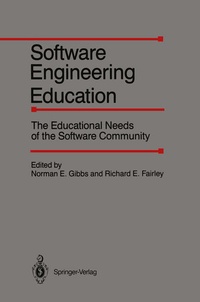
Software Engineering Education
The Educational Needs of the Software Community
Published on 20. March 2013
Book
Paperback/Softback
XVII, 439 pages
978-1-4612-9129-9 (ISBN)
Description
Focus on masters' level education in software engineering.
Topics discussed include: software engineering principles,
current software engineering curricula, experiences with ex-
isting courses, and the future of software engineering edu-
cation.
More details
Edition
Softcover reprint of the original 1st ed. 1987
Language
English
Place of publication
New York
United States
Target group
Professional and scholarly
Research
Illustrations
XVII, 439 p.
Dimensions
Height: 235 mm
Width: 155 mm
Thickness: 25 mm
Weight
692 gr
ISBN-13
978-1-4612-9129-9 (9781461291299)
DOI
10.1007/978-1-4612-4720-3
Schweitzer Classification
Other editions
Additional editions
Norman E. Gibbs | Richard E. Fairley
Software Engineering Education
The Educational Needs of the Software Community
Book
12/1986
Springer
€85.55
Article exhausted; check different version
Content
Section I Keynote Speech and Opening Discussion.- People Are Our Most important Product.- Opening Discussion.- Section II.- 1 Software Engineering Principles.- The Experimental Aspects of a Professional Degree in Software Engineering.- Cognitive Science View of Software Engineering.- Software Engineering Education: An Idealized Scenario.- Essential Elements of Software Engineering Education Revisited.- Software Engineering and Computer Science: How Do They Differ?.- The Environment for the Software Engineer.- Considerations for Graduate Software Engineering Education: An Air Force Perspective.- Why Is Software Engineering So Difficult?.- Technology Selection Education for Software Engineers.- Graduate-level Software Engineering Education: A Practitioner's Viewpoint.- Some Observations on the Nature of the Software Engineering "Problem" and Their Implications for Software Engineering Education.- 2 Current Software Engineering Curricula.- Adapting to Changing Needs: A New Perspective on Software Engineering Education at Texas Christian University.- The Software Engineering First Degree at Imperial College, London.- The Master of Software Engineering Program at Seattle University after Six Years.- Academic/Industrial Collaboration in a Postgraduate Master of Science Degree in Software Engineering.- 3 Experiences with Existing Courses.- Skills versus Knowledge in Software Engineering Education: A Retrospective on the Wang Institute MSE Program.- Experience with a Software Engineering Project Course.- Software Engineering Project Laboratory: The Bridge Between University and Industry.- Software Projects in an Academic Environment.- Exercises in Software Engineering.- 4 Future of Software Engineering Education.- Trends in National Science Foundation Funded Research andTheir Impact on Software Engineering Education.- Software Engineering: Anomalies in Today's Education and a Prospectus for the Future.- Education for the Future of Software Engineering.- 5 Bibliography.- Section III Transcripts.- Report of the Software Engineering Principles Working Group.- Report of the Current Software Engineering Curricula Working Groups: A. Report of the Subgroup on Existing Curricula.- Report of the Current Software Engineering Curricula Working Groups: B. Report of the Subgroup on Best Curriculum.- Report of the Future Software Engineering Curriculum Working Group.- Section IV Appendix.- Appendix 1 Proposed Curriculum for a Master of Software Engineering (MSE).- Appendix 2 Educational Needs of the Software Community.