

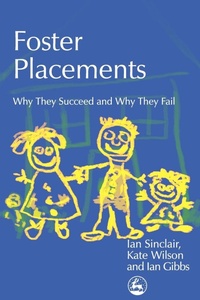
Foster Placements
Why They Succeed and Why They Fail
Published on 15. October 2004
Book
Paperback/Softback
272 pages
978-1-84310-173-4 (ISBN)
Description
How can we determine success in foster placements? Based on exhaustive research, the authors discuss the primary concerns in foster placement planning, considering the high frequency of placement breakdowns, their impact on the child's behaviour and school performance, and the challenges this places on foster families.
The specific needs of the foster child are given close attention in determining a pathway to success. By monitoring and describing the individual characteristics of the child within the context of the placement, the authors are able to reveal what types of supports are most beneficial.
The implications for this research are considerable. Social workers are given new methods of assessing the needs of foster children which emphasise the process of care and not just the outcome. Policy makers are provided with rich qualitative accounts with which to increase and strengthen the success of foster placements. This is essential reading for social workers, policy makers and foster families.
The specific needs of the foster child are given close attention in determining a pathway to success. By monitoring and describing the individual characteristics of the child within the context of the placement, the authors are able to reveal what types of supports are most beneficial.
The implications for this research are considerable. Social workers are given new methods of assessing the needs of foster children which emphasise the process of care and not just the outcome. Policy makers are provided with rich qualitative accounts with which to increase and strengthen the success of foster placements. This is essential reading for social workers, policy makers and foster families.
Reviews / Votes
Once more, the team at the University of York presents us with a rigorous study replete with elements contributing to debate and decision-making. -- Child and Family Social Work One hopes that this excellent series will be widely read. -- Adoption & FosteringMore details
Series
Language
English
Place of publication
London
United Kingdom
Target group
Professional and scholarly
Product notice
Paperback (UK-trade)
Dimensions
Height: 234 mm
Width: 156 mm
Thickness: 15 mm
Weight
424 gr
ISBN-13
978-1-84310-173-4 (9781843101734)
Copyright in bibliographic data and cover images is held by Nielsen Book Services Limited or by the publishers or by their respective licensors: all rights reserved.
Schweitzer Classification
Other editions
Additional editions

E-Book
10/2004
Jessica Kingsley Publishers
from
€37.19
Available for download
Persons
Ian Sinclair is Co-director of the Social Work Research and Development Unit at The University of York. His research interests include attachment theory and the evaluation of social work and social work services. Ian Gibbs is a researcher at the Social Work Research and Development Unit at The University of York. His research interests include Leadership, resources and efficiency in children's homes; quality of care for children in residential and foster care; costs and quality issues in residential care and nursing homes; financial resources available to elderly people. Kate Wilson is Chair of Social Work at the Centre for Social Work. She teaches on the children and families pathway on the Centre's post-graduate programme in social work and on the post-qualifying programme in child care. She has researched and published widely in the fields of therapeutic work and child welfare, including books on social work with couples, social work in a legal context, on non-directive play therapy and journal articles on literature and social work, play therapy in statutory and legal settings, and adoption and fostering.
Content
1. Introduction. 2.The Sample: Characteristics and Reasons for Placement. 3. Placements and Destinations. 4. A Kind of Loving: The Children's Accounts. 5. Outcomes. 6. Explanations: Social Worker and Carer Accounts. 7. The Case Studies. 8. Spirals of Interaction. 9. Measuring Success. 10. Foster Children: Characteristics, Personalities and Problems. 11. Birth Families: Characteristics and Patterns of Contact. 12. Foster Families' Characteristics: Reactions to Child and Approach to Main Carer. 13. Social Work Support. 14. Other Forms of Supports. 15. Change and Containment. 16. Summary and Conclusion. Appendix 1: Are our Samples Representative? Appendix 2: Selection of Placements for Interview. References.