

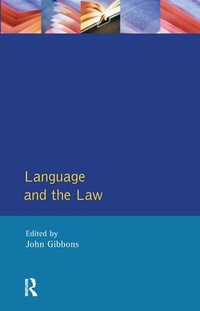
Language and the Law
Published on 19. January 2017
Book
Hardback
490 pages
978-1-138-18087-1 (ISBN)
Description
Explains and describes the ways that language use in the legal system can create inequality and disadvantage. It examines the three main areas where the two intersect: the central issue of the language of the law; the disadvantage which language can impose before the law, and forensic linguistics - the use of linguistic evidence in legal processes.
Each section of the book is preceded by an introduction by the editor which sets the paper within a conceptual framework. Lawyer's opinions are not neglected even though the collection is written mainly by linguists. The section concludes with a lawyer's response, in which a prominent lawyer with a particular interest in the content of the section responds to the papers.
Each section of the book is preceded by an introduction by the editor which sets the paper within a conceptual framework. Lawyer's opinions are not neglected even though the collection is written mainly by linguists. The section concludes with a lawyer's response, in which a prominent lawyer with a particular interest in the content of the section responds to the papers.
More details
Series
Language
English
Place of publication
London
United Kingdom
Publishing group
Taylor & Francis Ltd
Target group
College/higher education
Dimensions
Height: 216 mm
Width: 138 mm
Weight
453 gr
ISBN-13
978-1-138-18087-1 (9781138180871)
Copyright in bibliographic data and cover images is held by Nielsen Book Services Limited or by the publishers or by their respective licensors: all rights reserved.
Schweitzer Classification
Other editions
Additional editions
John Peter Gibbons
Language and the Law
E-Book
09/2014
1st Edition
Routledge
€80.49
Available for download
John Peter Gibbons
Language and the Law
E-Book
09/2014
1st Edition
Routledge
€80.49
Available for download
Person
John Peter Gibbons
Content
Part 1: Language constructing law
Introduction, John Gibbons
1. The language of the law, Yon Maley
2. Accident and absolute liability in anthropology, Laurence Goldman
3. Orality, literacy, and performativity in Anglo-Saxon wills, Brenda Danet and Bryna Bogoch
4. Cognitive structuring in legislative provisions, Vijay Bhatia
5. Ideological exchanges in British magistrate courts, Snadra Harris
6. Video depositions: linguistic endorsement and caveats, Bethyl A. Pearson and Rebecca White Berch
7. Lawyer's response to language constructing law, Margaret O'Toole
Part 2: Language and disadvantage before the law
Introduction, John Gibbons
8. Cross-examining children in criminal courts: child welfare under attack, Mark Brennan
9. Interactional styles in the courtroom: an example from northern Australia, Michael Walsh
10. A case of communicative clash: Aboriginal English and the legal system, Diana Eades
11. Addressing social issues through linguistic evidence, William Labov and Wendell A. Harris
12. Lawyer's response to language and disadvantage before the law, John Carroll
Part 3: Forensic linguistics
Introduction, John Gibbons
13. Auditory and acoustic analysis in speaker recognition, Francis Nolan
14. The limitations of voice identification, Alex Jones
15. Forensic analysis of personal written texts: a case study, Robert Eagleson
16. Computers, statistics and disputed authorship, Wilfred Smith
17. Powerful evidence for the defence: an exercise in forensic discourse analysis, Malcolm Coulthard
18. Confidentiality of linguistic material: the case of Aboriginal land claims, Jane Simpson
19. Lawyer's response to forensic linguistics, Dyson Heydon
Bibliography
Index
Introduction, John Gibbons
1. The language of the law, Yon Maley
2. Accident and absolute liability in anthropology, Laurence Goldman
3. Orality, literacy, and performativity in Anglo-Saxon wills, Brenda Danet and Bryna Bogoch
4. Cognitive structuring in legislative provisions, Vijay Bhatia
5. Ideological exchanges in British magistrate courts, Snadra Harris
6. Video depositions: linguistic endorsement and caveats, Bethyl A. Pearson and Rebecca White Berch
7. Lawyer's response to language constructing law, Margaret O'Toole
Part 2: Language and disadvantage before the law
Introduction, John Gibbons
8. Cross-examining children in criminal courts: child welfare under attack, Mark Brennan
9. Interactional styles in the courtroom: an example from northern Australia, Michael Walsh
10. A case of communicative clash: Aboriginal English and the legal system, Diana Eades
11. Addressing social issues through linguistic evidence, William Labov and Wendell A. Harris
12. Lawyer's response to language and disadvantage before the law, John Carroll
Part 3: Forensic linguistics
Introduction, John Gibbons
13. Auditory and acoustic analysis in speaker recognition, Francis Nolan
14. The limitations of voice identification, Alex Jones
15. Forensic analysis of personal written texts: a case study, Robert Eagleson
16. Computers, statistics and disputed authorship, Wilfred Smith
17. Powerful evidence for the defence: an exercise in forensic discourse analysis, Malcolm Coulthard
18. Confidentiality of linguistic material: the case of Aboriginal land claims, Jane Simpson
19. Lawyer's response to forensic linguistics, Dyson Heydon
Bibliography
Index