

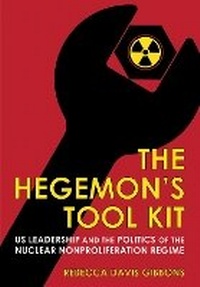
The Hegemon's Tool Kit
US Leadership and the Politics of the Nuclear Nonproliferation Regime
Published on 15. July 2022
Book
Hardback
240 pages
978-1-5017-6485-1 (ISBN)
Description
At a moment when the nuclear nonproliferation regime is under duress, Rebecca Davis Gibbons provides a trenchant analysis of the international system that has, for more than fifty years, controlled the spread of these catastrophic weapons. The Hegemon's Tool Kit details how that regime works and how, disastrously, it might falter.
In the early nuclear age, experts anticipated that all technologically-capable states would build these powerful devices. That did not happen. Widespread development of nuclear arms did not occur, in large part, because a global nuclear nonproliferation regime was created. By the late-1960s, the United States and the Soviet Union had drafted the Treaty on the Non-Proliferation of Nuclear Weapons (NPT), and across decades the regime has expanded, with more agreements and more nations participating. As a result, in 2022, only nine states possess nuclear weapons.
Why do most states in the international system adhere to the nuclear nonproliferation regime? The answer lies, Gibbons asserts, in decades of painstaking efforts undertaken by the US government. As the most powerful state during the nuclear age, the United States had many tools with which to persuade other states to join or otherwise support nonproliferation agreements.
The waning of US global influence, Gibbons shows in The Hegemon's Tool Kit, is a key threat to the nonproliferation regime. So, too, is the deepening global divide over progress on nuclear disarmament. To date, the Chinese government is not taking significant steps to support the nuclear nonproliferation regime, and as a result, the regime may face a harmful leadership gap.
In the early nuclear age, experts anticipated that all technologically-capable states would build these powerful devices. That did not happen. Widespread development of nuclear arms did not occur, in large part, because a global nuclear nonproliferation regime was created. By the late-1960s, the United States and the Soviet Union had drafted the Treaty on the Non-Proliferation of Nuclear Weapons (NPT), and across decades the regime has expanded, with more agreements and more nations participating. As a result, in 2022, only nine states possess nuclear weapons.
Why do most states in the international system adhere to the nuclear nonproliferation regime? The answer lies, Gibbons asserts, in decades of painstaking efforts undertaken by the US government. As the most powerful state during the nuclear age, the United States had many tools with which to persuade other states to join or otherwise support nonproliferation agreements.
The waning of US global influence, Gibbons shows in The Hegemon's Tool Kit, is a key threat to the nonproliferation regime. So, too, is the deepening global divide over progress on nuclear disarmament. To date, the Chinese government is not taking significant steps to support the nuclear nonproliferation regime, and as a result, the regime may face a harmful leadership gap.
Reviews / Votes
Edgar's research is in many ways original and innovative, and it thus opens a wide new field of research in Soviet studies that others might want to expand.(International Affairs)
More details
Series
Language
English
Place of publication
Ithaca
United States
Product notice
Paper over boards
Dimensions
Height: 229 mm
Width: 152 mm
Thickness: 24 mm
Weight
907 gr
ISBN-13
978-1-5017-6485-1 (9781501764851)
Copyright in bibliographic data and cover images is held by Nielsen Book Services Limited or by the publishers or by their respective licensors: all rights reserved.
Schweitzer Classification
Other editions
Additional editions
Rebecca Davis Gibbons
The Hegemon's Tool Kit
US Leadership and the Politics of the Nuclear Nonproliferation Regime
E-Book
07/2022
Cornell University Press
€40.49
Available for download
Person
Rebecca Davis Gibbons is Assistant Professor of Political Science at the University of Southern Maine. Follow her on X @RDavisGibbons.