

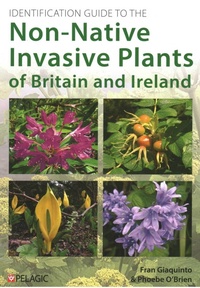
Identification Guide to the Non-Native Invasive Plants of Britain and Ireland
Published on 15. May 2025
Book
Paperback/Softback
168 pages
978-1-78427-564-8 (ISBN)
Description
This accessible guide gives you the tools to be confident in identifying and managing frequently encountered non-native invasive plants in Britain and Ireland.
Invasive alien species (IAS) are one of the biggest drivers of global biodiversity loss along with climate change and habitat fragmentation. If allowed to colonise unchecked, they can have irreversible negative impacts on the integrity of the natural environment and associated ecosystem services. In spite of widescale efforts, there has been an almost exponential increase in new introductions to Britain and Ireland in the last 20 years. The only way we can tackle them is to engage both professionals and the public in mapping their distribution, and to encourage everyone to take the right actions to contain them. This book will help you:
Identify frequently encountered non-native invasive plants and know their potential impacts.
Differentiate lookalikes, including how to separate native species from closely related non-native invasive species.
Understand the extent of invasive potential, including trees, grasses, freshwater aquatics and seaweeds.
Quickly check the legislation so you know which species should be reported and to whom.
Prevent mistakes - often, with best intentions, people take action which makes the situation worse.
Avoid introducing invasive species into your gardens and local environment.
Packed with illustrations, maps and tips, this book is a practical tool and reference for professional ecologists, environmentalists, gardeners and everyone interested in the protection and sustainable management of our countryside and green spaces.
Invasive alien species (IAS) are one of the biggest drivers of global biodiversity loss along with climate change and habitat fragmentation. If allowed to colonise unchecked, they can have irreversible negative impacts on the integrity of the natural environment and associated ecosystem services. In spite of widescale efforts, there has been an almost exponential increase in new introductions to Britain and Ireland in the last 20 years. The only way we can tackle them is to engage both professionals and the public in mapping their distribution, and to encourage everyone to take the right actions to contain them. This book will help you:
Identify frequently encountered non-native invasive plants and know their potential impacts.
Differentiate lookalikes, including how to separate native species from closely related non-native invasive species.
Understand the extent of invasive potential, including trees, grasses, freshwater aquatics and seaweeds.
Quickly check the legislation so you know which species should be reported and to whom.
Prevent mistakes - often, with best intentions, people take action which makes the situation worse.
Avoid introducing invasive species into your gardens and local environment.
Packed with illustrations, maps and tips, this book is a practical tool and reference for professional ecologists, environmentalists, gardeners and everyone interested in the protection and sustainable management of our countryside and green spaces.
Reviews / Votes
...very instructive and useful...the book is ideal for amateurs and professionals, and as the authors say for gardeners, professional ecologists, environmentalists and all that seek protection of nature and green spaces. -- John Feltwell * Wildlife Matters * This identification guide is faithful to its aims and intentions. It certainly provides a very useful tool for training invasive species champions to identify invasive plants, collect data, take action and inform others to facilitate IAS management actions in Britain and Ireland. -- Frances Lucy * The Irish Naturalists' Journal * This is a charming and attractive little book that provides a very thorough introduction to non-native invasive plants... The delightful watercolours and copious colour plates aid in the identification and usefully include many look-a-like species. * In Practice *More details
Series
Language
English
Place of publication
Exeter
United Kingdom
Target group
Professional and scholarly
Product notice
Paperback (trade)
Dimensions
Height: 148 mm
Width: 210 mm
Thickness: 9 mm
Weight
322 gr
ISBN-13
978-1-78427-564-8 (9781784275648)
Copyright in bibliographic data and cover images is held by Nielsen Book Services Limited or by the publishers or by their respective licensors: all rights reserved.
Schweitzer Classification
Other editions
Additional editions
Fran Giaquinto | Phoebe O'Brien
Identification Guide to the Non-Native Invasive Plants of Britain and Ireland
E-Book
05/2025
Pelagic Publishing
€39.99
Available for download
Persons
Fran Giaquinto CEnv MCIEEM is a plant ecologist who has focused on the prevention and sustainable management of invasive species since 2009.
Phoebe O'Brien is an independent field botanist specialising in vascular plant identification and grassland ecology. She is one of the vice-county recorders for Co. Clare, Ireland, for the Botanical Society of Britain and Ireland, and works on national surveys and local biodiversity projects.
The authors have collaborated on two previous plant identification guides.
Phoebe O'Brien is an independent field botanist specialising in vascular plant identification and grassland ecology. She is one of the vice-county recorders for Co. Clare, Ireland, for the Botanical Society of Britain and Ireland, and works on national surveys and local biodiversity projects.
The authors have collaborated on two previous plant identification guides.
Content
Preface
Acknowledgements
Introduction
At-a-glance guide to flower colour and leaf shape
Species accounts
Trees
Shrubs
Climbers
Large plants
Herbs
Clubmoss
Grasses
Rush
Lily-like
Marginal
Aquatics
Coastal
Seaweeds
Legislation
Dispersal methods
Glossary
Resources
References
Index
Acknowledgements
Introduction
At-a-glance guide to flower colour and leaf shape
Species accounts
Trees
Shrubs
Climbers
Large plants
Herbs
Clubmoss
Grasses
Rush
Lily-like
Marginal
Aquatics
Coastal
Seaweeds
Legislation
Dispersal methods
Glossary
Resources
References
Index