

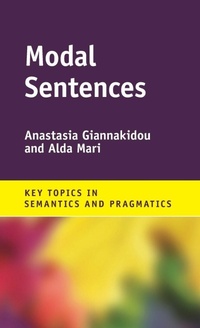
Modal Sentences
Will be published approx. on 31. December 2025
Book
Hardback
250 pages
978-1-108-83937-2 (ISBN)
Description
Building on the logical tradition of possible world semantics, this innovative book explores the rich and diverse empirical domain of modality in language, offering an ambitious theory of linguistic modality as indicative of uncertainty. It covers a wide variety of languages ranging from English, Greek, Italian and French, to Native American and Asian languages, and studies modals alongside evidentials, questions, and imperatives, to enable a deeper understanding of modality. The authors introduce a new analysis of linguistic necessity as conveying evidential bias, identifying new categories such as flexible necessity modals, and offering a framework for the linguistic category of evidentiality as a branch of epistemic modality. They also study the relationship between questions and modals through the concepts of nonveridical equilibrium, reflection, and evidential bias. Laying out the formal semantic tools step-by-step, it is essential reading for both scholars and students of semantics, philosophy, computational linguistics, typology and communication theory.
More details
Series
Language
English
Place of publication
Cambridge
United Kingdom
Target group
College/higher education
Illustrations
Worked examples or Exercises
Dimensions
Height: 222 mm
Width: 145 mm
Thickness: 22 mm
Weight
570 gr
ISBN-13
978-1-108-83937-2 (9781108839372)
Copyright in bibliographic data and cover images is held by Nielsen Book Services Limited or by the publishers or by their respective licensors: all rights reserved.
Schweitzer Classification
Persons
Anastasia Giannakidou is Frank J. McLoraine Professor of Linguistics, University of Chicago. Her recent publications include Truth and Veridicality in Grammar and Thought (with Mari, 2021).
Content
Acknowledgments; Abbreviations; List of figures; 1. Linguistic modality; 2. The landscape of modality; 3. A formal semantic theory for linguistic modality; 4. Unitary modals, the future, and non-biased necessity; 5. Modality and time; 6. Epistemic modality, evidentiality, and evidence; 7. Directive modality: deontic and imperative sentences; 8. Modal structure in questions: reflection, aporia, and bias; Bibliography; Glossary; Index.