

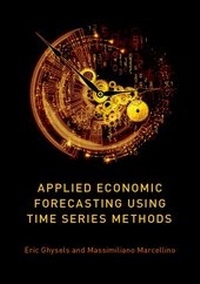
Applied Economic Forecasting using Time Series Methods
Published on 12. April 2018
Book
Hardback
616 pages
978-0-19-062201-5 (ISBN)
Description
Economic forecasting is a key ingredient of decision making both in the public and in the private sector. Because economic outcomes are the result of a vast, complex, dynamic and stochastic system, forecasting is very difficult and forecast errors are unavoidable.
Because forecast precision and reliability can be enhanced by the use of proper econometric models and methods, this innovative book provides an overview of both theory and applications. Undergraduate and graduate students learning basic and advanced forecasting techniques will be able to build from strong foundations, and researchers in public and private institutions will have access to the most recent tools and insights. Readers will gain from the frequent examples that enhance understanding of how to apply techniques, first by using stylized settings and then by real data applications--focusing on macroeconomic and financial topics.
This is first and foremost a book aimed at applying time series methods to solve real-world forecasting problems. Applied Economic Forecasting using Time Series Methods starts with a brief review of basic regression analysis with a focus on specific regression topics relevant for forecasting, such as model specification errors, dynamic models and their predictive properties as well as forecast evaluation and combination. Several chapters cover univariate time series models, vector autoregressive models, cointegration and error correction models, and Bayesian methods for estimating vector autoregressive models. A collection of special topics chapters study Threshold and Smooth Transition Autoregressive (TAR and STAR) models, Markov switching regime models, state space models and the Kalman filter, mixed frequency data models, nowcasting, forecasting using large datasets and, finally, volatility models. There are plenty of practical applications in the book and both EViews and R code are available online.
Because forecast precision and reliability can be enhanced by the use of proper econometric models and methods, this innovative book provides an overview of both theory and applications. Undergraduate and graduate students learning basic and advanced forecasting techniques will be able to build from strong foundations, and researchers in public and private institutions will have access to the most recent tools and insights. Readers will gain from the frequent examples that enhance understanding of how to apply techniques, first by using stylized settings and then by real data applications--focusing on macroeconomic and financial topics.
This is first and foremost a book aimed at applying time series methods to solve real-world forecasting problems. Applied Economic Forecasting using Time Series Methods starts with a brief review of basic regression analysis with a focus on specific regression topics relevant for forecasting, such as model specification errors, dynamic models and their predictive properties as well as forecast evaluation and combination. Several chapters cover univariate time series models, vector autoregressive models, cointegration and error correction models, and Bayesian methods for estimating vector autoregressive models. A collection of special topics chapters study Threshold and Smooth Transition Autoregressive (TAR and STAR) models, Markov switching regime models, state space models and the Kalman filter, mixed frequency data models, nowcasting, forecasting using large datasets and, finally, volatility models. There are plenty of practical applications in the book and both EViews and R code are available online.
Reviews / Votes
"This book, by two masters of applied time-series forecasting, is modern, well-balanced, and insightful. And special chapters on things like forecasting in Big Data and/or mixed-frequency data environments enhance its appeal, as does the full set of EViews and R code supplied. Applied Economic Forecasting using Time Series Methods will be an invaluable resource for students and practitioners alike." - Francis X. Diebold, Paul F. and Warren S. MillerProfessor of Economics; Professor of Finance and Statistics, University of Pennsylvania
"This book is highly welcome as it shows how forecasting is done in practice. For instance, how to use bridge models for now-casting GDP and a (B)VAR model to project it over the next few quarters. Eric Ghysels and Massimiliano Marcellino adopt a pragmatic approach to introduce the time-series models most widely used in forecasting." - Marco Buti, Director-General for Economic and Financial Affairs at the European Commission
"Forecasting economic activity and inflation is at the core of monetary policy analysis in central banks. This book combines a very clear exposition of both basic and advanced time series models for forecasting with plenty of practical examples ready for use by practitioners. It's an excellent introduction to the world of forecasting." - Frank Smets, Director General Economics, European Central Bank
"This excellent book offers a hands-on introduction to students and researchers with an interest in economic forecasting. It offers in-depth treatments of topics not covered by most textbooks, notably forecasting with mixed-frequency data and nonlinear models, and is full of useful empirical examples. The book is a pleasure to read and highly recommended for anyone with an interest in understanding the nuts and bolts of economic forecasting." - Allan
Timmermann, Atkinson/Epstein Endowed Chair Professor of Finance, Rady School of Management, Professor of Finance and Economics, University of California, San Diego
More details
Language
English
Place of publication
New York
United States
Target group
College/higher education
Dimensions
Height: 261 mm
Width: 182 mm
Thickness: 48 mm
Weight
1448 gr
ISBN-13
978-0-19-062201-5 (9780190622015)
Copyright in bibliographic data and cover images is held by Nielsen Book Services Limited or by the publishers or by their respective licensors: all rights reserved.
Schweitzer Classification
Other editions
Additional editions
Eric Ghysels | Massimiliano Marcellino
Applied Economic Forecasting using Time Series Methods
E-Book
03/2018
1st Edition
OUP eBook
€90.99
Available for download
Eric Ghysels | Massimiliano Marcellino
Applied Economic Forecasting using Time Series Methods
E-Book
03/2018
1st Edition
OUP eBook
€90.99
Available for download
Persons
Eric Ghysels is the Edward M. Bernstein Distinguished Professor of Economics at UNC Chapel Hill, Professor of Finance at the Kenan-Flagler Business School and CEPR Fellow.
Massimiliano Marcellino is Professor of Econometrics at Bocconi University, fellow of CEPR and IGIER.
Massimiliano Marcellino is Professor of Econometrics at Bocconi University, fellow of CEPR and IGIER.
Author
Edward M. Bernstein Distinguished Professor of Economics and Professor of FinanceEdward M. Bernstein Distinguished Professor of Economics and Professor of Finance, Kenan-Flagler School of Business, University of North Carolina, Chapel Hill
Professor of EconometricsProfessor of Econometrics, Bocconi University
Content
Preface
PART I: Forecasting with the Linear Regression Model
Chapter 1 -The Baseline Linear Regression Model
Chapter 2 - Model Mis-Specification
Chapter 3 - The Dynamic Linear Regression Model
Chapter 4 - Forecast Evaluation and Combination
PART II: Forecasting with Time Series Models
Chapter 5 - Univariate Time Series Models
Chapter 6 - VAR Models
Chapter 7 - Error Correction Models
Chapter 8 - Bayesian VAR Models
PART III: TAR, Markov Switching and State Space Models
Chapter 9 - TAR and STAR Models
Chapter 10 - Markov Switching Models
Chapter 11 - State Space Models and the Kalman Filter
PART IV: Mixed Frequency, Large Datasets and Volatility
Chapter 12 - Models for Mixed Frequency Data
Chapter 13 - Models for Large Datasets
Chapter 14 - Forecasting Volatility
PART I: Forecasting with the Linear Regression Model
Chapter 1 -The Baseline Linear Regression Model
Chapter 2 - Model Mis-Specification
Chapter 3 - The Dynamic Linear Regression Model
Chapter 4 - Forecast Evaluation and Combination
PART II: Forecasting with Time Series Models
Chapter 5 - Univariate Time Series Models
Chapter 6 - VAR Models
Chapter 7 - Error Correction Models
Chapter 8 - Bayesian VAR Models
PART III: TAR, Markov Switching and State Space Models
Chapter 9 - TAR and STAR Models
Chapter 10 - Markov Switching Models
Chapter 11 - State Space Models and the Kalman Filter
PART IV: Mixed Frequency, Large Datasets and Volatility
Chapter 12 - Models for Mixed Frequency Data
Chapter 13 - Models for Large Datasets
Chapter 14 - Forecasting Volatility