

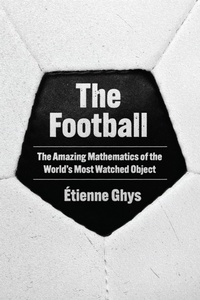
The Football
The Amazing Mathematics of the World's Most Watched Object
Published on 19. August 2025
Book
Hardback
136 pages
978-0-691-26312-0 (ISBN)
Description
An illustration-packed dive into the geometry, engineering, and physics of soccer balls
The Football takes readers on an entertaining and fact-filled exploration of the mathematical secrets of the most popular spherical object on the planet. The football is familiar to billions of fans across the globe, but how many really look at it? Do footballs all have the same shape? Spoiler: not exactly. How does their shape affect how they play? With Etienne Ghys as our guide, we discover why ballistics, friction, and air flow are key to scoring goals-and why the football is a mathematical problem that engineers are still trying to solve.
Ghys begins with the classic Telstar ball used in the 1970 World Cup in Mexico. Its twelve black pentagons and twenty white hexagons are what most of us picture when we think of the sport. Following the story through successive World Cups, he shows how engineers constantly challenge themselves to reinvent the ball, aiming for a perfect sphere while accounting for manufacturing requirements and aerodynamics. Along the way, Ghys introduces us to the mathematics of Platonic solids, symmetries, polyhedra, turbulence, roughness, drag, and spin. He paints engaging portraits of the engineers and sports insiders who study and apply these phenomena and explains how the skills of players factor into how the ball behaves, whether the game is being played in stadiums, schoolyards, or backyards.
Featuring a wealth of color illustrations, The Football blends a lively narrative with insights from a world-renowned geometer to tell a mathematical story unlike any other.
The Football takes readers on an entertaining and fact-filled exploration of the mathematical secrets of the most popular spherical object on the planet. The football is familiar to billions of fans across the globe, but how many really look at it? Do footballs all have the same shape? Spoiler: not exactly. How does their shape affect how they play? With Etienne Ghys as our guide, we discover why ballistics, friction, and air flow are key to scoring goals-and why the football is a mathematical problem that engineers are still trying to solve.
Ghys begins with the classic Telstar ball used in the 1970 World Cup in Mexico. Its twelve black pentagons and twenty white hexagons are what most of us picture when we think of the sport. Following the story through successive World Cups, he shows how engineers constantly challenge themselves to reinvent the ball, aiming for a perfect sphere while accounting for manufacturing requirements and aerodynamics. Along the way, Ghys introduces us to the mathematics of Platonic solids, symmetries, polyhedra, turbulence, roughness, drag, and spin. He paints engaging portraits of the engineers and sports insiders who study and apply these phenomena and explains how the skills of players factor into how the ball behaves, whether the game is being played in stadiums, schoolyards, or backyards.
Featuring a wealth of color illustrations, The Football blends a lively narrative with insights from a world-renowned geometer to tell a mathematical story unlike any other.
Reviews / Votes
"Erudite and whimsical. . . . A kick for fans and nonfans alike." * Kirkus *More details
Language
English
Place of publication
New Jersey
United States
Product notice
Trade binding
Illustrations
164 color illus.
Dimensions
Height: 206 mm
Width: 141 mm
Thickness: 14 mm
Weight
286 gr
ISBN-13
978-0-691-26312-0 (9780691263120)
Copyright in bibliographic data and cover images is held by Nielsen Book Services Limited or by the publishers or by their respective licensors: all rights reserved.
Schweitzer Classification
Other editions
Additional editions

E-Book
08/2025
1st Edition
Princeton University Press
€19.49
Available for download
Persons
Etienne Ghys is CNRS director of research emeritus at the Ecole normale superieure de Lyon and permanent secretary of the French Academy of Sciences. Inaugural recipient of the prestigious Clay Award for Dissemination of Mathematical Knowledge, he writes a popular mathematics column for Le Monde.