

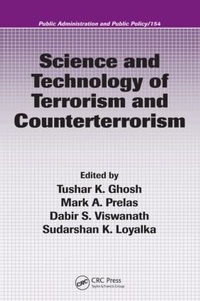
Science and Technology of Terrorism and Counterterrorism
2nd Edition
Published on 4. November 2009
Book
Hardback
604 pages
978-1-4200-7181-8 (ISBN)
Description
Traditionally, resources on terrorism and counterterrorism tend to focus on the social, behavioral, and legal aspects of the subject, with minimal emphasis on the scientific and technological aspects. Taking into account these practical considerations, the second edition of Science and Technology of Terrorism and Counterterrorism discusses the nature of terrorism and the materials used by terrorists. It describes how intelligence professionals and law enforcement personnel can detect and destroy these materials, and how they can deal with terrorist groups.
This volume begins by introducing the shift in analysis of terrorist attacks after September 11, 2001 and summarizes selected case studies. It discusses the origin and nature of terrorism and the factors involved in diplomacy. Covering a broad range of topics, the book examines:
Aerosol dispersion of toxic materials
Bioterrorism and the manufacture, detection, and delivery of biological agents
Agricultural terrorism
Nuclear terrorism and nuclear weapons systems, threats, and safeguards
Chemical terrorism, including manufacture, detection, delivery, and decontamination
Cyber-terrorism
Personal protective equipment
The role of government at federal, state, and local levels
The role of international agencies and their resources, capabilities, and responsibilities
The National Infrastructure Protection Plan
As terrorist activities increase globally, it is critical that those charged with protecting the public understand the myriad of ways in which terrorists operate. While we cannot predict where, when, and how terrorists will strike, our vigilance in staying abreast of the terrorist threat is the only way to have a fighting chance against those who seek to destroy our world.
This volume begins by introducing the shift in analysis of terrorist attacks after September 11, 2001 and summarizes selected case studies. It discusses the origin and nature of terrorism and the factors involved in diplomacy. Covering a broad range of topics, the book examines:
Aerosol dispersion of toxic materials
Bioterrorism and the manufacture, detection, and delivery of biological agents
Agricultural terrorism
Nuclear terrorism and nuclear weapons systems, threats, and safeguards
Chemical terrorism, including manufacture, detection, delivery, and decontamination
Cyber-terrorism
Personal protective equipment
The role of government at federal, state, and local levels
The role of international agencies and their resources, capabilities, and responsibilities
The National Infrastructure Protection Plan
As terrorist activities increase globally, it is critical that those charged with protecting the public understand the myriad of ways in which terrorists operate. While we cannot predict where, when, and how terrorists will strike, our vigilance in staying abreast of the terrorist threat is the only way to have a fighting chance against those who seek to destroy our world.
Reviews / Votes
Intelligently presented and thoroughly referenced and indexed, the book offers a good balance of scientific and managerial information. Through an examination of the history of terrorism, the editors present a series of questions to assist in the development of prevention and emergency management programs. The first chapter looks at the link between the use of technology and the larger concept of terrorism. ... Subsequent, highly educational chapters explain biological, nuclear, chemical, agricultural, and cyber threats with ample definitions, tables, and diagrams. Each provides helpful perspectives for decision and policy makers regarding assessments, prevention, and intervention. ... The text is highly recommended to security professionals who seek a broader understanding of terrorist threats and technical countermeasures.-Paul H. Aube, B.Sc., CPP, CAS (Certified Antiterrorism Specialist) in Security Management, January 2011More details
Series
Edition
2nd edition
Language
English
Place of publication
Bosa Roca
United States
Publishing group
Taylor & Francis Inc
Target group
Professional and scholarly
Professional and Professional Practice & Development
Product notice
Paper over boards
Illustrations
158 s/w Abbildungen, 67 s/w Tabellen
67 Tables, black and white; 158 Illustrations, black and white
Dimensions
Height: 254 mm
Width: 178 mm
Weight
1224 gr
ISBN-13
978-1-4200-7181-8 (9781420071818)
Copyright in bibliographic data and cover images is held by Nielsen Book Services Limited or by the publishers or by their respective licensors: all rights reserved.
Schweitzer Classification
Other editions
Additional editions
Tushar K. Ghosh | Mark A. Prelas | Dabir S. Viswanath
Science and Technology of Terrorism and Counterterrorism
Book
09/2018
2nd Edition
CRC Press
€101.70
Shipment within 10-20 days
Tushar K. Ghosh | Mark A. Prelas | Dabir S. Viswanath
Science and Technology of Terrorism and Counterterrorism
E-Book
11/2009
2nd Edition
CRC Press
€86.99
Available for download
Tushar K. Ghosh | Mark A. Prelas | Dabir S. Viswanath
Science and Technology of Terrorism and Counterterrorism
E-Book
11/2009
2nd Edition
CRC Press
€86.99
Available for download
Previous edition
Tushar K. Ghosh | Mark A. Prelas | Dabir S. Viswanath
Science and Technology of Terrorism and Counterterrorism
Book
08/2002
1st Edition
Marcel Dekker Inc
€89.12
Article exhausted; check for reprint
Persons
Tushar K. Ghosh and Mark A. Prelas are professors of nuclear engineering at the University of Missouri-Columbia (MU). Sudarshan K. Loyalka is a nuclear engineering and chemical engineering professor at the University of Missouri-Columbia. Dabir S. Viswanath is an emeritus professor and Dowell chair of chemical engineering at the University of Missouri-Columbia.
Content
Introduction. A Brief Theory of Terrorism and Technology. The Group Psychology of Terrorism. Aerosols: Fundamentals. Biological Terrorism: Effects, Toxicity, and Effectiveness. Biological Terrorism: Classification and Manufacture. Biological Terrorism: Weaponization and Delivery Systems. Biological Terrorism: Sensors and Detection Systems. Biological Terrorism: Consequences and Medical Preparedness. Biological Terrorism: Preparation for Response-What the Government Can Do in Defending the Homeland. Agroterrorism: Agroeconomic Bioterrorism. Agroterrorism: Attributes and Implications of High-Impact Targets in U.S. Agriculture. Nuclear Terrorism: Nature of Radiation. Nuclear Terrorism: Radiation Detection. Nuclear Terrorism: Radiation Detectors-Applications in Homeland Security. Nuclear Terrorism: Dose and Biological Effects. Nuclear Terrorism: Nuclear Weapons. Nuclear Terrorism: Threats and Countermeasures. Chemical Terrorism: Classification, Synthesis, and Properties. Chemical Terrorism: Toxicity, Medical Management, and Mitigation. Chemical Terrorism: Destruction and Decontamination. Chemical Terrorism: Sensors and Detection Systems. Chemical Terrorism: Weaponization and Delivery System. Chemical Terrorisms: Threats and Countermeasures. Cyber-Terrorism. Personal Protective Equipment. National Response Plan and Preparedness. Government and Voluntary Agencies. The National Infrastructure Protection Plan. Index.