

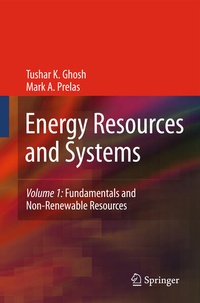
Energy Resources and Systems
Volume 1: Fundamentals and Non-Renewable Resources
Published on 19. October 2010
Book
Paperback/Softback
XX, 778 pages
978-90-481-8494-1 (ISBN)
Description
In the lifetimes of the authors, the world and especially the United States have received three significant "wake-up calls" on energy production and consumption. The first of these occurred on October 15, 1973 when the Yom Kippur War began with an attack by Syria and Egypt on Israel. The United States and many western countries supported Israel. Because of the western support of Israel, several Arab oil exporting nations imposed an oil embargo on the west. These nations withheld five million barrels of oil per day. Other countries made up about one million barrels of oil per day but the net loss of four million barrels of oil production per day extended through March of 1974. This represented 7% of the free world's (i. e. , excluding the USSR) oil production. In 1972 the price of crude oil was about $3. 00 per barrel and by the end of 1974 the price of oil had risen by a factor of 4 to over $12. 00. This resulted in one of the worst recessions in the post World War II era. As a result, there was a movement in the United States to become energy independent. At that time the United States imported about one third of its oil (about five million barrels per day). After the embargo was lifted, the world chose to ignore the "wake-up call" and went on with business as usual.
Reviews / Votes
From the reviews: "This work is the first in a planned three-volume series dealing with energy . . In this first volume, Ghosh and Prelas (both, Univ. of Missouri, Columbia) offer an outstanding consolidation of technical data and knowledge related to conventional energy sources and conversion systems. . This volume is ideally suited for the serious researcher interested in obtaining a thorough overview of conventional energy conversion systems. . Summing Up: Highly recommended. Upper-division undergraduates through professionals." (S. R. Walk, Choice, Vol. 47 (6), February, 2010)More details
Edition
Softcover reprint of hardcover 1st ed. 2009
Language
English
Place of publication
Dordrecht
Netherlands
Target group
Professional and scholarly
Research
Illustrations
XX, 778 p.
Dimensions
Height: 235 mm
Width: 155 mm
Thickness: 43 mm
Weight
1188 gr
ISBN-13
978-90-481-8494-1 (9789048184941)
DOI
10.1007/978-90-481-2383-4
Schweitzer Classification
Other editions
Additional editions
Tushar K. Ghosh | Mark A. Prelas
Energy Resources and Systems
Volume 1: Fundamentals and Non-Renewable Resources
Book
06/2009
Springer
€53.49
Shipment within 15-20 days
Tushar K. Ghosh | Mark A. Prelas
Energy Resources and Systems
Volume 1: Fundamentals and Non-Renewable Resources
E-Book
06/2009
1st Edition
Springer
€53.49
Available for download
Persons
Dr. Shameem Hasan is a nuclear engineer with experience in health physics and environmental science. His expertise includes specific research areas in chemical, environmental, and nuclear engineering. He is an author of over 35 publications including book chapters, journal articles, conference proceedings, technical abstracts, and industrial reports. His Master of Technology degree in Environmental Management centered on the production and synthesis of material, process design, regulations, and policies related to water, wastewater, hazardous, and radioactive materials. Shameem is actively involved in projects on medical isotope separations, new adsorbent materials, mechanisms, and processes for the treatment of industrial toxic wastes, bio-waste, hazardous waste, radioactive waste, and wastewater. He has hands-on experience in the medical use of radioisotopes, radiological accident assessment, and radiological emergency planning and response. Shameem has designed, fabricated, and successfully operated a pilot-scale heavy metal removal unit for treating industrial waste streams. His present research interests include mass transfer processes in adsorption and absorption: experimental and theoretical investigation, production/synthesis of adsorbent materials using bio-polymer, isotope separation, and nanoparticle synthesis and modifications. He holds patents in the area of adsorbents, isotope separation, and energetic nano-particles for thermite materials, and is a consultant on medical isotope separation, radioactive and industrial waste treatment.
Professor emeritus Dabir S. Viswanath's research interests are polymer-ceramic composites, thermal degradation of polymers, thermodynamic properties of liquid mixtures, correlation of thermodynamic and transport properties, heterogeneous catalysis and materials. He received his Ph.D. from University of Rochester, and then taught as Texas A&M University and the Indian Institute of Science. He was a Professor at University of Missouri from 1979 and is now an Emeritus Professor. He received several honors and awards including the Pari Hargovadas Fellowship (Indian Institute of Science), the Lever Brothers Fellowship (University of Rochester), and the Halliburton Travel Awards (University of Missouri). He is a Fellow of the American Institute of Chemical Engineers.
Doctor Veera M. Boddu's technical expertise is evidenced by the array of research projects he leads. He has research expertise in environmental separations (biosorption and membrane separations), advanced oxidation processes for degradation of ordnance-related compounds using nanomaterials, and air emissions control from Army stationary sources. He is a Fellow of the American Institute of Chemical Engineers, a Fellow of the American Institute of Chemists, a Member of the American Chemical Society, a Board-Certified Environmental Engineer (BCEE) by the American Academy of Environmental Engineers. He is a Registered Professional Engineer in the state of Missouri. He received a distinguished achievement medal from the US department of the Army for Civilian Service in June 2004. He also received an ERDC Commanders Award for Civilian Service in May 2008 and Research of the Year at ERDC-CERL in December 2008.
Doctor Tushar K. Ghosh has been Professor in the Nuclear Engineering Program at MU since September, 2004. Following his graduation with a Ph.D. degree in Chemical Engineering in July 1989, from Oklahoma State University in Stillwater, OK, he worked at MU as a Research Assistant Professor in conjunction with the Chemical and Nuclear Engineering Departments and the Particulate Systems Research Center. He was responsible for building several pieces of equipment that are currently being used in the Indoor Air Research Laboratories. His present research interests include nanoparticle production/synthesis, aerosol mechanisms, adsorption on charged particles, sensors for chemical and biological agents.
Content
Engineering Economics.- Units and Unit Conversions.- Thermodynamic Cycles.- Fundamentals of Heat Transfer.- Coal.- Natural Gas.- Petroleum.- Nuclear.- Hubbert Peak Theory.