

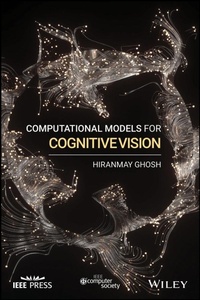
Computational Models for Cognitive Vision
1st Edition
Published on 16. June 2020
Book
Paperback/Softback
256 pages
978-1-119-52786-2 (ISBN)
Description
This book focuses on computing aspects and shows how the cognitive principles borrowed from other disciplines can be used to solve problems of computer vision. The book begins with an introduction to the problems of computer vision and why cognitive principles should be used to solve these problems. Then it moves on to a discussion of deductive, inductive, and abductive reasoning and the psychological observations and deductions of various theories and models of cognitive vision. Other topics covered include knowledge representation techniques, evolution of cognitive architectures, machine learning approaches, and more. The book ends with salient observations and future research directions.
More details
Other editions
Additional editions
Hiranmay Ghosh
Computational Models for Cognitive Vision
E-Book
07/2020
1st Edition
Wiley
€52.99
Available for download
Hiranmay Ghosh
Computational Models for Cognitive Vision
E-Book
07/2020
1st Edition
Wiley
€53.99
Available for download
Person
HIRANMAY GHOSH received his PhD from Department of Electrical Engineering, Indian Institute of Technology, Delhi, and his B.Tech. (Radiophysics & Electronics) and B.Sc. (Hons. In Physics) Degrees from University of Calcutta. His current research interests are Cognitive Systems, Knowledge Representation, Multimedia Systems and E-Learning. He is presently a Research Advisor to TATA Consultancy Services and an Adjunct Faculty with National Institute of Technology Karnataka. During his long professional career, he had served several reputed organizations, like CMC, ECIL and C-DOT and TCS. He had been an Adjunct Faculty with IIT Delhi. He is a Senior Member of IEEE and members of ACM and IUPRAI.
Content
Foreword xi
Preface xiii
Acknowledgments xv
Acronyms xvii
1 Introduction 1
1.1 What is Cognitive Vision 2
1.2 Computational Approaches for Cognitive Vision 3
1.3 A Brief Review of Human Vision 5
1.4 Perception and Cognition 7
1.5 Organization of the Book 9
2 Early Vision 13
2.1 Feature Integration Theory 13
2.2 Structure of Human Eye 14
2.3 Lateral Inhibition 17
2.4 Convolution: Detection of Edges and Orientations 19
2.5 Color and Texture Perception 22
2.6 Motion Perception 26
2.6.1 Intensity-based Approach 26
2.6.2 Token-based Approach 28
2.7 Peripheral Vision 30
2.8 Conclusion 33
3 Bayesian Reasoning for Perception and Cognition 35
3.1 Reasoning Paradigms 36
3.2 Natural Scene Statistics 38
3.3 Bayesian Framework of Reasoning 40
3.4 Bayesian Networks 45
3.5 Dynamic Bayesian Network 49
3.6 Parameter Estimation 51
3.7 On Complexity of Models and Bayesian Inference 54
3.8 Hierarchical Bayesian Models 56
3.9 Inductive Reasoning with Bayesian Framework 59
3.9.1 Inductive Generalization 59
3.9.2 Taxonomy Learning 63
3.9.3 Feature Selection 65
3.10 Conclusion 67
4 Late Vision 71
4.1 Stereopsis and Depth Perception 71
4.2 Perception of Visual Quality 73
4.3 Perceptual Grouping 76
4.4 Foreground-Background Separation 82
4.5 Multi-stability 83
4.6 Object Recognition 85
4.6.1 In-context Object Recognition 86
4.6.2 Synthesis of Bottom-up and Top-down Knowledge 89
4.6.3 Hierarchical Bayesian Network 91
4.6.4 One-shot Learning 93
4.7 Visual Aesthetics 94
4.8 Conclusion 97
5 Visual Attention 99
5.1 Modeling of Visual Attention 101
5.2 Models for Visual Attention 105
5.2.1 Cognitive Models 105
5.2.2 Information-theoretic Models 108
5.2.3 Bayesian Models 109
5.2.4 Context-based Models 111
5.2.5 Object-based Models 114
5.3 Evaluation 116
5.4 Conclusion 118
6 Cognitive Architectures 121
6.1 Cognitive Modeling 122
6.1.1 Paradigms for Modeling Cognition 123
6.1.2 Levels of Abstraction 128
6.2 Desiderata for Cognitive Architectures 130
6.3 Memory Architecture 133
6.4 Taxonomies of Cognitive Architectures 137
6.5 Review of Cognitive Architectures 139
6.5.1 STAR: Selective Tuning Attentive Reference 140
6.5.2 LIDA: Learning Intelligent Distribution Agent 143
6.6 Biologically Inspired Cognitive Architectures 147
6.7 Conclusions 148
7 Knowledge Representation for Cognitive Vision 151
7.1 Classicist Approach to Knowledge Representation 152
7.1.1 First Order Logic 154
7.1.2 Semantic Networks 157
7.1.3 Frame-based Representation 159
7.2 Symbol Grounding Problem 162
7.3 Perceptual Knowledge 164
7.3.1 Representing Perceptual Knowledge 166
7.3.2 Structural Description of Scenes 167
7.3.3 Qualitative Spatial and Temporal Relations 169
7.3.4 Inexact Spatio-temporal Relations 172
7.4 Unifying Conceptual and Perceptual Knowledge 177
7.5 Knowledge-based visual data processing 179
7.6 Conclusion 180
8 Deep Learning for visual cognition 183
8.1 A Brief Introduction to Deep Neural Networks 185
8.1.1 Fully Connected Networks 185
8.1.2 Convolutional Neural Networks 188
8.1.3 Recurrent Neural Networks (RNN) 192
8.1.4 Siamese Networks 196
8.1.5 Graph Neural Networks 196
8.2 Modes of Learning with DNN 199
8.2.1 Supervised Learning 199
8.2.2 Unsupervised Learning with Generative Networks 203
8.2.3 Meta-learning: Learning to Learn 205
8.2.4 Multi-task Learning 215
8.3 Visual Attention 218
8.3.1 Recurrent Attention Models 219
8.3.2 Recurrent Attention Model for Video 223
8.4 Bayesian inferencing with Neural Networks 225
8.5 Conclusion 227
9 Applications of Visual Cognition 229
9.1 Computational Photography 230
9.1.1 Color Enhancement 230
9.1.2 Intelligent Cropping 234
9.1.3 Face Beautification 235
9.2 Digital Heritage 236
9.2.1 Digital Restoration of Images 237
9.2.2 Curating Dance Archives 240
9.3 Social Robots 243
9.3.1 Dynamic and Shared Spaces 244
9.3.2 Recognition of Visual Cues 246
9.3.3 Attention to Socially Relevant Signals 247
9.4 Content Re-purposing 251
9.5 Conclusion 253
10 Conclusion 257
10.1 "What is Cognitive Vision" Revisited 258
10.2 Divergence of approaches 259
10.3 Convergence on the Anvil? 262
Bibliography 265
Index 317