

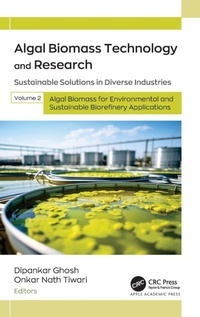
Algal Biomass Technology and Research
Sustainable Solutions in Diverse Industries, Volume 2: Algal Biomass for Environmental and Sustainable Biorefinery Applications
1st Edition
Published on 22. September 2025
Book
Hardback
280 pages
978-1-77491-900-2 (ISBN)
Description
This new two-volume work describes the advances and emerging issues in the use of algal biomass and the prospects of micro- and macroalgae in biotechnology, microbiology, metabolic engineering, synthetic biology, biochemical engineering, and systems biology for the creation of algal cell factories. The books cover a broad spectrum of algal biomass technology for value-added products and for the recycling of environmental pollutants.
Volume 2 focuses on sustainable biorefinery methods based on algae for the treatment of wastewater, for desalination, for bioenergy production, for lignocellulosic waste biomass utilization, and for environmental bioremediation. It also covers the connections between traditional and cutting-edge technologies, emphasizing the production of all types of algal biomass (including macro- and microalgae), with a focus on the bioengineering component. This volume places emphasis on two key areas: engineering implications and biological sciences implications.
Volume 1 explores the impact of process parameters and phytohormones to improve algal biomass generation in various industries, providing consideration of the engineering, biological design, and applications of algal biomass along with relevant implementations.
Volume 2 focuses on sustainable biorefinery methods based on algae for the treatment of wastewater, for desalination, for bioenergy production, for lignocellulosic waste biomass utilization, and for environmental bioremediation. It also covers the connections between traditional and cutting-edge technologies, emphasizing the production of all types of algal biomass (including macro- and microalgae), with a focus on the bioengineering component. This volume places emphasis on two key areas: engineering implications and biological sciences implications.
Volume 1 explores the impact of process parameters and phytohormones to improve algal biomass generation in various industries, providing consideration of the engineering, biological design, and applications of algal biomass along with relevant implementations.
More details
Language
English
Place of publication
Oakville
Canada
Target group
College/higher education
Professional and scholarly
Academic and Postgraduate
Illustrations
15 s/w Abbildungen, 7 farbige Abbildungen, 2 s/w Photographien bzw. Rasterbilder, 13 s/w Zeichnungen, 7 farbige Zeichnungen
7 Line drawings, color; 13 Line drawings, black and white; 2 Halftones, black and white; 7 Illustrations, color; 15 Illustrations, black and white
Dimensions
Height: 240 mm
Width: 161 mm
Thickness: 20 mm
Weight
608 gr
ISBN-13
978-1-77491-900-2 (9781774919002)
Copyright in bibliographic data and cover images is held by Nielsen Book Services Limited or by the publishers or by their respective licensors: all rights reserved.
Schweitzer Classification
Other editions
Additional editions
Dipankar Ghosh | Onkar Nath Tiwari
Algal Biomass Technology and Research
Sustainable Solutions in Diverse Industries, Volume 2: Algal Biomass for Environmental and Sustainable Biorefinery Applications
E-Book
09/2025
1st Edition
Apple Academic Press Inc.
€225.99
Available for download
Dipankar Ghosh | Onkar Nath Tiwari
Algal Biomass Technology and Research
Sustainable Solutions in Diverse Industries, Volume 2: Algal Biomass for Environmental and Sustainable Biorefinery Applications
E-Book
09/2025
1st Edition
Apple Academic Press Inc.
€225.99
Available for download
Persons
Dipankar Ghosh, PhD, is an Associate Professor of Biosciences at JIS University, Kolkata, India. His research interest is in microbial engineering and algal biotechnology. He has published more than 70 peer-reviewed articles and reviews in esteemed international journals as well as multiple book chapters with reputed publication houses that include Elsevier, Springer Nature, Wiley, AAP, CRC Press/Taylor & Francis, and Nova Science Publishers. He earned his PhD at the University of Montreal, Canada, having received a PBEEE doctoral merit scholarship from the Govt. of Canada. He did research as postdoctoral research associate and research fellow at Imperial College, London, UK; Pusan National University, South Korea; University of Turku, Finland; and IIT Kharagpur, India.
Onkar Nath Tiwari, PhD, is a Principal Scientist and Principal Investigator of DBT-ICAR projects at the Centre for Conservation and Utilization of Blue Green Algae, Division of Microbiology, ICARIndian Agricultural Research Institute. He has received honorary fellowships and best paper awards and has chaired several international events and conferences. He has visited several countries for research and academic activities, including the Culture Collection of Algae at the University of Texas at Austin, USA, and institutions in Germany, Italy, Switzerland, United Kingdom, Romania, Japan, and China. He has managed three funded research projects (Government of India) and has completed seven mega projects, with each project worth more than 100 lakhs (over $10 million in USD). He has published over 150 papers and book chapters.
Onkar Nath Tiwari, PhD, is a Principal Scientist and Principal Investigator of DBT-ICAR projects at the Centre for Conservation and Utilization of Blue Green Algae, Division of Microbiology, ICARIndian Agricultural Research Institute. He has received honorary fellowships and best paper awards and has chaired several international events and conferences. He has visited several countries for research and academic activities, including the Culture Collection of Algae at the University of Texas at Austin, USA, and institutions in Germany, Italy, Switzerland, United Kingdom, Romania, Japan, and China. He has managed three funded research projects (Government of India) and has completed seven mega projects, with each project worth more than 100 lakhs (over $10 million in USD). He has published over 150 papers and book chapters.
Content
1. Biomass Valorization: A New Perspective in Algal-Based Sustainable Biorefineries 2. Biomass Production, Harvesting, and Utilization of Microalgae 3. Mechanistic Eradication of Ciprofloxacin from Pharmaceutical Wastewater by Algal Biomass: Current Prospective, Strategies, and Challenges 4. Sustainable Use of Algae in Desalination 5. Tailoring Algal Biomass for Bioenergy Generation 6. Ameliorating Algae-Based Biofuel Generation and Lignocellusic Biomass Degradation by Bioengineering 7. Sustainable Utilization of Algal Biomass for Environmental Bioremediation 8. Multifaceted Applications of Algal Biomass for Bioremediation of Heavy Metals in Polluted Areas 9. Sustainable Use of Algal Biomass for Bioplastic Production