

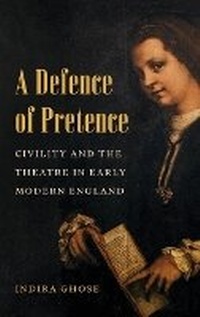
A Defence of Pretence
Civility and the Theatre in Early Modern England
Published on 2. December 2025
Book
Hardback
280 pages
978-0-691-26999-3 (ISBN)
Description
How the drama of Shakespeare's time demonstrates the tensions within civility
Is civility merely a matter of reinforcing status and excluding others? Or is it a lubricant in a polarised world, enabling us to overcome tribal loyalties and cooperate for the common good? In A Defence of Pretence, Indira Ghose argues that it is both. Ghose turns to the drama of Shakespeare's time to explore the notion of civility. The theatre, she suggests, was a laboratory where many of the era's conflicts played out. The plays test the precepts found in treatises on civility and show that, in the complexity and confusion of human life, moral purity is an illusion. We are always playing roles. In these plays, as in social life, pretence is inescapable. Could it be a virtue?
Civility, Ghose finds, is radically ambiguous. The plays of Shakespeare, Jonson and Middleton, grappling with dissimulation, lies and social performance, question the idea of a clear-cut boundary between sincerity and dissembling, between truth and lies. What is decisive is the use to which our play-acting is put. A pretence of mutual respect might serve an ethical end: to foster a sense of common purpose. In life, as in drama, the concept of the common good might be a fiction, but one that is crucial for human society.
Is civility merely a matter of reinforcing status and excluding others? Or is it a lubricant in a polarised world, enabling us to overcome tribal loyalties and cooperate for the common good? In A Defence of Pretence, Indira Ghose argues that it is both. Ghose turns to the drama of Shakespeare's time to explore the notion of civility. The theatre, she suggests, was a laboratory where many of the era's conflicts played out. The plays test the precepts found in treatises on civility and show that, in the complexity and confusion of human life, moral purity is an illusion. We are always playing roles. In these plays, as in social life, pretence is inescapable. Could it be a virtue?
Civility, Ghose finds, is radically ambiguous. The plays of Shakespeare, Jonson and Middleton, grappling with dissimulation, lies and social performance, question the idea of a clear-cut boundary between sincerity and dissembling, between truth and lies. What is decisive is the use to which our play-acting is put. A pretence of mutual respect might serve an ethical end: to foster a sense of common purpose. In life, as in drama, the concept of the common good might be a fiction, but one that is crucial for human society.
Reviews / Votes
"It's always a great pleasure when you discover that what might seem at first sight like a rather esoteric piece of academic research turns out to have immediate, contemporary significance. . . . Politicians of all stripes might benefit from putting a copy on their reading pile."---Terry Potter, Letterpress Project ""A Defence of Pretence offers historians of the Renaissance a valuable new perspective on the relationship between social norms, literary culture, and public life. Ghose provides a salutary reminder that civility has never been synonymous with simple politeness"."---William David Green, History TodayMore details
Language
English
Place of publication
New Jersey
United States
Target group
College/higher education
Product notice
Trade binding
Illustrations
11 b/w illus.
Dimensions
Height: 235 mm
Width: 156 mm
ISBN-13
978-0-691-26999-3 (9780691269993)
Copyright in bibliographic data and cover images is held by Nielsen Book Services Limited or by the publishers or by their respective licensors: all rights reserved.
Schweitzer Classification
Other editions
Additional editions
E-Book
12/2025
1st Edition
Princeton University Press
€30.99
Available for download
Person
Indira Ghose is emeritus professor of English at the University of Fribourg, Switzerland. She is the author of Women Travellers in Colonial India, Shakespeare and Laughter: A Cultural History, Much Ado About Nothing: Language and Writing and Shakespeare in Jest.