

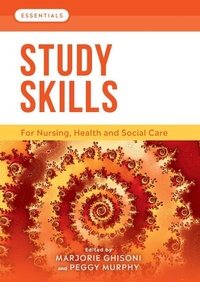
Study Skills
For Nursing, Health and Social Care
Published on 16. December 2019
Book
Paperback/Softback
226 pages
978-1-908625-65-6 (ISBN)
Description
An accessible textbook to help students develop their study skills.
Study Skills is an accessible textbook for nursing, health and social care students seeking to improve their study skills, develop their resilience, enhance their employability and cultivate a love of lifelong learning.
Through clear explanations, helpful hints, activities and quizzes, the book will help you to develop your study skills for both your studies and future career. You will learn:
How to manage your time
How to develop your reading and note-taking skills
How to search the literature and apply critical thinking to your reading
How to write essays and reference your sources
How to use feedback and reflective practice to improve your academic performance
How to deliver effective presentations
This book will help you to develop your study skills and become a resilient lifelong learner.
Essentials is a series of accessible, introductory textbooks for students in nursing, health and social care. New and forthcoming titles in the series:
The Care Process
Communication Skills
Leadership
Mental Health
Promoting Health and Wellbeing
Study Skills
Study Skills is an accessible textbook for nursing, health and social care students seeking to improve their study skills, develop their resilience, enhance their employability and cultivate a love of lifelong learning.
Through clear explanations, helpful hints, activities and quizzes, the book will help you to develop your study skills for both your studies and future career. You will learn:
How to manage your time
How to develop your reading and note-taking skills
How to search the literature and apply critical thinking to your reading
How to write essays and reference your sources
How to use feedback and reflective practice to improve your academic performance
How to deliver effective presentations
This book will help you to develop your study skills and become a resilient lifelong learner.
Essentials is a series of accessible, introductory textbooks for students in nursing, health and social care. New and forthcoming titles in the series:
The Care Process
Communication Skills
Leadership
Mental Health
Promoting Health and Wellbeing
Study Skills
Reviews / Votes
'The contents of the book are laid out in an attractive, bright and easy to navigate format making it inclusive for all. The tone of the content is very positive, helping students enhance their employability and embracing the prospect of becoming a lifelong learner. There are many activities which can be utilised by lecturers during classes, to enhance development of study skills in all related subjects. I would highly recommend this book as an essential text and am already using and recommending it to pre-registration nurses of all fields.'Senior Lecturer, Mental Health Nursing, University of Chester 'Resilience is an underpinning feature of the book and indeed a chapter is dedicated to this discussion. With recent events of COVID-19 pandemic this focus is particularly welcomes as students navigate the balance of their studies with the demands and uncertainties of learning in practice where their resilience is challenged. The chapter on employability skills helps prepare the students for the future workplace which coupled with a chapter on lifelong learning helps futureproof the learner for working in health and social care areas.
In a saturated market of study skills books this book stands out and is a must have for those embarking on programmes of study in health and social care.'
Research Professor, University of Chester 'My favourite thing about this publication was its paradoxical brevity and detail. I felt I was learning something during every paragraph, but that it was chunked into manageable, concise information.
The end of chapters was perfect; a conclusion, a summary, AND a quiz. I thought this was a great idea - to consolidate information, to make it interactive, and to know it's there and I can flick back to that one page when I need to.'
Student nurse
More details
Series
Language
English
Place of publication
Cheltenham
United Kingdom
Target group
College/higher education
Professional and scholarly
Dimensions
Height: 190 mm
Width: 244 mm
Thickness: 12 mm
Weight
474 gr
ISBN-13
978-1-908625-65-6 (9781908625656)
Copyright in bibliographic data and cover images is held by Nielsen Book Services Limited or by the publishers or by their respective licensors: all rights reserved.
Schweitzer Classification
Other editions
Additional editions
E-Book
12/2019
Lantern Publishing
€20.99
Available for download
Previous edition
Marjorie Lloyd | Peggy Murphy
Essential Study Skills for Health and Social Care
Book
09/2008
Reflect Press Ltd
€25.50
Article exhausted; check for reprint
Persons
Marjorie Ghisoni is a Lecturer and course lead for mental health nursing at Bangor University in North Wales. Marjorie qualified as a nurse in 1996 with Bangor University and worked as a community psychiatric nurse for a few years before becoming a lecturer practitioner part-time, then a full-time lecturer in 2003. After gaining her PhD in 2012, Marjorie believes that compassionate understanding of the needs of people in all walks of life is the main component of healthcare skills, education, development and practice.
Peggy Murphy is a Senior Lecturer in adult nursing at Liverpool John Moores University. She has nursing experience in acute medicine and cardiothoracic intensive care and has worked as a registered nurse both in the UK and Australia. She became a nurse lecturer in 2003 and developed an interest in working with students as partners to enhance inclusive practice in nurse education. Peggy was awarded a National Teaching Fellowship by the Higher Education Academy in 2014 for her collaborative work on assessment and feedback. Peggy has published and co-presented her work with students nationally and internationally. She currently acts as a co-convenor for the Researching, Advancing and Inspiring Student Engagement (RAISE) Special Interest Group on partnerships.
Peggy Murphy is a Senior Lecturer in adult nursing at Liverpool John Moores University. She has nursing experience in acute medicine and cardiothoracic intensive care and has worked as a registered nurse both in the UK and Australia. She became a nurse lecturer in 2003 and developed an interest in working with students as partners to enhance inclusive practice in nurse education. Peggy was awarded a National Teaching Fellowship by the Higher Education Academy in 2014 for her collaborative work on assessment and feedback. Peggy has published and co-presented her work with students nationally and internationally. She currently acts as a co-convenor for the Researching, Advancing and Inspiring Student Engagement (RAISE) Special Interest Group on partnerships.
Content
About the authors; Introduction
1. Skills for the resilient learner
Peggy Murphy and Marjorie Ghisoni
1.1 Introduction
1.2 Five ways (5rs) to develop resilience for health and wellbeing
1.3 Developing resilience in everyday life
1.4 Developing resilience for lifelong learning
1.5 Developing resilience for employability
1.6 Conclusion
2. Effective time management
Peggy Murphy
2.1 Introduction
2.2 Strategies to combat time-wasters
2.3 Suggested study toolkit
2.4 Conclusion
3. Reading and note-taking skills
Marjorie Ghisoni
3.1 Finding the right information
3.2 Making concise notes
3.3 Writing a literature review
3.4 Conclusion
4. Skills for literature searching
Seren Roberts
4.1 Introduction
4.2 Starting your literature search
4.3 What is literature?
4.4 Developing a systematic approach to literature reviewing
4.5 Conclusion
5. Skills for critical thinking
Tracy Ross
5.1 Introduction
5.2 What is critical thinking?
5.3 How to think critically: a six-stage process
5.4 How does critical thinking improve resilience?
5.5 How does critical thinking improve employability?
5.6 Conclusion
6. Writing essays and reports
Marjorie Ghisoni
6.1 Introduction
6.2 Begin at the beginning
6.3 Make a plan
6.4 Referencing from journals and books
6.5 Organising and composing your work
6.6 Engineering your work and writing reports
6.7 Spelling and structure
6.8 Conclusion
7. Referencing skills
Helen Thomas, Jacqui Maung, Ella Turner and Paul Verlander
7.1 Referencing and academic integrity
7.2 Plagiarism
7.3 Developing a rigorous approach to referencing
7.4 Referencing
7.5 Conclusion
8. Feedback
Peggy Murphy and Craig Morley
8.1 Introduction
8.2 The purpose of feedback
8.3 Feedback mindset
8.4 Feed-forward
8.5 Action-planning
8.6 Marking rubrics
8.7 What to do after you receive feedback
8.8 Conclusion
9. Reflective writing skills
Marjorie Ghisoni
9.1 Introduction
9.2 Models of reflective practice
9.3 Should we follow our gut instinct?
9.4 Keeping a reflective journal
9.5 Developing reflective resilience in our everyday practice
9.6 Reflective writing, self-compassion and student resilience
9.7 Reflective writing and lifelong learning
9.8 Professional requirements for reflective practice and lifelong learning
9.9 Reflective writing for employability
9.10 Conclusion
10. Skills for teamworking
Liz Lefroy
10.1 Introduction
10.2 What is a team?
10.3 Teamwork in time of change
10.4 Team role theory
10.5 The development of groups and teams
10.6 Communication and sustainable teamwork
10.7 Dealing with conflict
10.8 Resilience
10.9 Conclusion
11. Skills for presentations and public speaking
Paul Jeorrett
11.1 Introduction
11.2 The 3 Ps: preparation, planning, practice
11.3 Delivering the presentation
11.4 Conclusion
12. Skills for employability in health and social care
Marjorie Ghisoni
12.1 Introduction
12.2 Developing employability skills using your lifelong learning skills
12.3 Key lifelong learning skills for employability
12.4 Employability skills and professional practice
12.5 Developing resilience skills to improve your employability
12.6 Developing transferable skills for employability
12.7 Conclusion
13. Skills for the developing professional
Marjorie Ghisoni
13.1 Introduction
13.2 Developing resilience as a professional
13.3 Developing employability skills in professional practice
13.4 Developing lifelong learning skills as a professional
13.4 Conclusion
14. Lifelong learning skills: future-proof your learning
Peggy Murphy
14.1 What is lifelong learning?
14.2 Where does resilience fit into LLL?
14.3 Employability and lifelong learning skills
14.4 Future-proofing learning to maintain professional standards
14.5 Future-proofing learning to maintain professional registration
14.6 Combining reflective practice with a growth mindset
14.7 Conclusion
Answers to chapter quizzes; Index
1. Skills for the resilient learner
Peggy Murphy and Marjorie Ghisoni
1.1 Introduction
1.2 Five ways (5rs) to develop resilience for health and wellbeing
1.3 Developing resilience in everyday life
1.4 Developing resilience for lifelong learning
1.5 Developing resilience for employability
1.6 Conclusion
2. Effective time management
Peggy Murphy
2.1 Introduction
2.2 Strategies to combat time-wasters
2.3 Suggested study toolkit
2.4 Conclusion
3. Reading and note-taking skills
Marjorie Ghisoni
3.1 Finding the right information
3.2 Making concise notes
3.3 Writing a literature review
3.4 Conclusion
4. Skills for literature searching
Seren Roberts
4.1 Introduction
4.2 Starting your literature search
4.3 What is literature?
4.4 Developing a systematic approach to literature reviewing
4.5 Conclusion
5. Skills for critical thinking
Tracy Ross
5.1 Introduction
5.2 What is critical thinking?
5.3 How to think critically: a six-stage process
5.4 How does critical thinking improve resilience?
5.5 How does critical thinking improve employability?
5.6 Conclusion
6. Writing essays and reports
Marjorie Ghisoni
6.1 Introduction
6.2 Begin at the beginning
6.3 Make a plan
6.4 Referencing from journals and books
6.5 Organising and composing your work
6.6 Engineering your work and writing reports
6.7 Spelling and structure
6.8 Conclusion
7. Referencing skills
Helen Thomas, Jacqui Maung, Ella Turner and Paul Verlander
7.1 Referencing and academic integrity
7.2 Plagiarism
7.3 Developing a rigorous approach to referencing
7.4 Referencing
7.5 Conclusion
8. Feedback
Peggy Murphy and Craig Morley
8.1 Introduction
8.2 The purpose of feedback
8.3 Feedback mindset
8.4 Feed-forward
8.5 Action-planning
8.6 Marking rubrics
8.7 What to do after you receive feedback
8.8 Conclusion
9. Reflective writing skills
Marjorie Ghisoni
9.1 Introduction
9.2 Models of reflective practice
9.3 Should we follow our gut instinct?
9.4 Keeping a reflective journal
9.5 Developing reflective resilience in our everyday practice
9.6 Reflective writing, self-compassion and student resilience
9.7 Reflective writing and lifelong learning
9.8 Professional requirements for reflective practice and lifelong learning
9.9 Reflective writing for employability
9.10 Conclusion
10. Skills for teamworking
Liz Lefroy
10.1 Introduction
10.2 What is a team?
10.3 Teamwork in time of change
10.4 Team role theory
10.5 The development of groups and teams
10.6 Communication and sustainable teamwork
10.7 Dealing with conflict
10.8 Resilience
10.9 Conclusion
11. Skills for presentations and public speaking
Paul Jeorrett
11.1 Introduction
11.2 The 3 Ps: preparation, planning, practice
11.3 Delivering the presentation
11.4 Conclusion
12. Skills for employability in health and social care
Marjorie Ghisoni
12.1 Introduction
12.2 Developing employability skills using your lifelong learning skills
12.3 Key lifelong learning skills for employability
12.4 Employability skills and professional practice
12.5 Developing resilience skills to improve your employability
12.6 Developing transferable skills for employability
12.7 Conclusion
13. Skills for the developing professional
Marjorie Ghisoni
13.1 Introduction
13.2 Developing resilience as a professional
13.3 Developing employability skills in professional practice
13.4 Developing lifelong learning skills as a professional
13.4 Conclusion
14. Lifelong learning skills: future-proof your learning
Peggy Murphy
14.1 What is lifelong learning?
14.2 Where does resilience fit into LLL?
14.3 Employability and lifelong learning skills
14.4 Future-proofing learning to maintain professional standards
14.5 Future-proofing learning to maintain professional registration
14.6 Combining reflective practice with a growth mindset
14.7 Conclusion
Answers to chapter quizzes; Index