

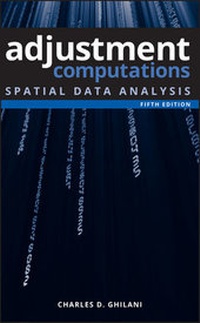
Adjustment Computations
Spatial Data Analysis
5th Edition
Published on 9. April 2010
Book
Hardback
672 pages
978-0-470-46491-5 (ISBN)
Description
the complete guide to adjusting for measurement error--expanded and updated
no measurement is ever exact. Adjustment Computations updates a classic, definitive text on surveying with the latest methodologies and tools for analyzing and adjusting errors with a focus on least squares adjustments, the most rigorous methodology available and the one on which accuracy standards for surveys are based.
This extensively updated Fifth Edition shares new information on advances in modern software and GNSS-acquired data. Expanded sections offer a greater amount of computable problems and their worked solutions, while new screenshots guide readers through the exercises. Continuing its legacy as a reliable primer, Adjustment Computations covers the basic terms and fundamentals of errors and methods of analyzing them and progresses to specific adjustment computations and spatial information analysis. Current and comprehensive, the book features:
* Easy-to-understand language and an emphasis on real-world applications
* Analyzing data in three dimensions, confidence intervals, statistical testing, and more
* An updated support web page containing a 150-page solutions manual, software (STATS, ADJUST, and MATRIX for Windows computers), MathCAD worksheets, and more at http://www.wiley.com/college/ghilani
* The latest information on advanced topics such as the tau criterion used in post-adjustment statistical blunder detection
Adjustment Computations, Fifth Edition is an invaluable reference and self-study resource for working surveyors, photogrammetrists, and professionals who use GNSS and GIS for data collection and analysis, including oceanographers, urban planners, foresters, geographers, and transportation planners. It's also an indispensable resource for students preparing for licensing exams and the ideal textbook for courses in surveying, civil engineering, forestry, cartography, and geology.
no measurement is ever exact. Adjustment Computations updates a classic, definitive text on surveying with the latest methodologies and tools for analyzing and adjusting errors with a focus on least squares adjustments, the most rigorous methodology available and the one on which accuracy standards for surveys are based.
This extensively updated Fifth Edition shares new information on advances in modern software and GNSS-acquired data. Expanded sections offer a greater amount of computable problems and their worked solutions, while new screenshots guide readers through the exercises. Continuing its legacy as a reliable primer, Adjustment Computations covers the basic terms and fundamentals of errors and methods of analyzing them and progresses to specific adjustment computations and spatial information analysis. Current and comprehensive, the book features:
* Easy-to-understand language and an emphasis on real-world applications
* Analyzing data in three dimensions, confidence intervals, statistical testing, and more
* An updated support web page containing a 150-page solutions manual, software (STATS, ADJUST, and MATRIX for Windows computers), MathCAD worksheets, and more at http://www.wiley.com/college/ghilani
* The latest information on advanced topics such as the tau criterion used in post-adjustment statistical blunder detection
Adjustment Computations, Fifth Edition is an invaluable reference and self-study resource for working surveyors, photogrammetrists, and professionals who use GNSS and GIS for data collection and analysis, including oceanographers, urban planners, foresters, geographers, and transportation planners. It's also an indispensable resource for students preparing for licensing exams and the ideal textbook for courses in surveying, civil engineering, forestry, cartography, and geology.
More details
Edition
5. Auflage
Language
English
Place of publication
Chichester
United Kingdom
Publishing group
John Wiley and Sons Ltd
Target group
College/higher education
Professional and scholarly
Dimensions
Height: 23.8 cm
Width: 16.4 cm
Thickness: 3.7 cm
Weight
1032 gr
ISBN-13
978-0-470-46491-5 (9780470464915)
Schweitzer Classification
Other editions
New editions
Book
12/2017
6th Edition
Wiley
€186.50
Shipment within 15-20 days
Previous edition
Book
06/2006
4th Edition
Wiley
€135.00
Article exhausted; check for reprint
Persons
Charles D. Ghilani, PhD, is Professor of Engineering in the Surveying Engineering Program at The Pennsylvania State University
Content
PREFACE.
ACKNOWLEDGMENTS.
1 Introduction.
2 Observations and Their Analysis.
3 Random Error Theory.
4 Confidence Intervals.
5 Statistical Testing.
6 Propagation of Random Errors in Indirectly Measured Quantities.
7 Error Propagation in Angle and Distance Observations.
8 Error Propagation in Traverse Surveys.
9 Error Propagation in Elevation Determination.
10 Weights of Observations.
11 Principles of Least Squares.
12 Adjustment of Level Nets.
13 Precisions of Indirectly Determined Quantities.
14 Adjustment of Horizontal Surveys: Trilateration.
15 Adjustment of Horizontal Surveys: Triangulation.
16 Adjustment of Horizontal Surveys: Traverses and Horizontal Networks.
17 Adjustment of GNSS Networks.
18 Coordinate Transformations.
19 Error Ellipse.
20 Constraint Equations.
21 Blunder Detection in Horizontal Networks.
22 General Least Squares Method and Its Application to Curve Fitting and Coordinate Transformations.
23 Three-Dimensional Geodetic Network Adjustment.
24 Combining GPS and Terrestrial Observations.
25 Analysis of Adjustments.
26 Computer Optimization.
Appendix A Introduction to Matrices.
Appendix B Solution of Equations by Matrix Methods.
Appendix C Nonlinear Equations and Taylor's Theorem.
Appendix D Normal Error Distribution Curve and Other Statistical Tables.
Appendix E Confidence Intervals for the Mean.
Appendix F Map Projection Coordinate Systems.
Appendix G Companion Web Site.
Appendix H Solutions to Selected Problems.
BIBLIOGRAPHY.
INDEX.
ACKNOWLEDGMENTS.
1 Introduction.
2 Observations and Their Analysis.
3 Random Error Theory.
4 Confidence Intervals.
5 Statistical Testing.
6 Propagation of Random Errors in Indirectly Measured Quantities.
7 Error Propagation in Angle and Distance Observations.
8 Error Propagation in Traverse Surveys.
9 Error Propagation in Elevation Determination.
10 Weights of Observations.
11 Principles of Least Squares.
12 Adjustment of Level Nets.
13 Precisions of Indirectly Determined Quantities.
14 Adjustment of Horizontal Surveys: Trilateration.
15 Adjustment of Horizontal Surveys: Triangulation.
16 Adjustment of Horizontal Surveys: Traverses and Horizontal Networks.
17 Adjustment of GNSS Networks.
18 Coordinate Transformations.
19 Error Ellipse.
20 Constraint Equations.
21 Blunder Detection in Horizontal Networks.
22 General Least Squares Method and Its Application to Curve Fitting and Coordinate Transformations.
23 Three-Dimensional Geodetic Network Adjustment.
24 Combining GPS and Terrestrial Observations.
25 Analysis of Adjustments.
26 Computer Optimization.
Appendix A Introduction to Matrices.
Appendix B Solution of Equations by Matrix Methods.
Appendix C Nonlinear Equations and Taylor's Theorem.
Appendix D Normal Error Distribution Curve and Other Statistical Tables.
Appendix E Confidence Intervals for the Mean.
Appendix F Map Projection Coordinate Systems.
Appendix G Companion Web Site.
Appendix H Solutions to Selected Problems.
BIBLIOGRAPHY.
INDEX.