

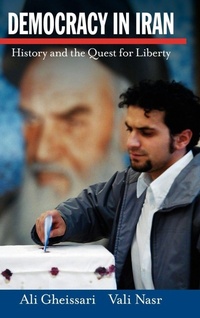
Democracy in Iran
History and the Quest for Liberty
Published on 27. July 2006
Book
Hardback
232 pages
978-0-19-518967-4 (ISBN)
Description
Today Iran is once again in the headlines. Part of President George W. Bush's "Axis of Evil" and next-door neighbor to tumultuous Iraq, Iran's future is a matter of grave concern both for the stability of the region and for the safety of the global community. In this book, Ali Gheissari and Vali Nasr look at the political history of Iran in the modern era, and offer an optimistic assessment of the prospects for democracy to flourish there. After having produced the only successful Islamist challenge to the state, a revolution and an Islamic Republic, Iran is now poised to produce the first genuine indigenous democracy in the Muslim world. Democracy in Iran is neither a sudden development nor a western import, Gheissari and Nasr argue. The concept of democracy in Iran today may appear to be a reaction to totalitarianism, but it is an old idea with a complex history, one that is tightly interwoven with the main forces that have shaped Iranian society and politics, institutions, identities, and interests. Indeed, the demand for democracy first surfaced in Iran a century ago at the end of the Qajar period, and helped produce Iran's surprisingly liberal first constitution in 1906. Gheissari and Nasr seek to understand why democracy failed to grow roots and lost ground to an autocratic Iranian state. Why was democracy absent from the ideological debates of the 1960s and 1970s? Most important, why has it now become a powerful social, political, and intellectual force? How have modernization, social change, economic growth, and the experience of the revolution converged to make this possible? Gheissari and Nasr trace the fortunes of the democratic ideal from the inchoate demands for rule of law and constitutionalism of a century ago to today's calls for individual rights and civil liberties. In the process they provide not just a fresh look at Iran's politics but a new understanding of the way in which democracy as an idea can develop in a Muslim country.
Reviews / Votes
In this sophisticated yet accessible volume, two scholars of Iranian origin, Gheissari and Nasr, trace the trials and tribulations of state building and democratization in Iran over the past century....Highly Recommended. * Library Journal * If ever policymakers in Washington, DC, needed a slim, thoughtful account of Iran's experiments with pluralism and democracy, now is surely the time. * The Economist * Gheissari and Nasr provide us with a clear and readable account of politics in the Islamic Republic... * Washington Post *More details
Language
English
Place of publication
New York
United States
Target group
Professional and scholarly
Dimensions
Height: 235 mm
Width: 157 mm
Thickness: 18 mm
Weight
537 gr
ISBN-13
978-0-19-518967-4 (9780195189674)
Copyright in bibliographic data and cover images is held by Nielsen Book Services Limited or by the publishers or by their respective licensors: all rights reserved.
Schweitzer Classification
Other editions
Additional editions
Book
07/2009
Oxford University Press Inc
€35.60
Shipment within 15-20 days
E-Book
06/2006
1st Edition
OUP USA
€13.49
Available for download
E-Book
06/2006
1st Edition
OUP eBook
€13.49
Available for download
Persons
Ali Gheissari is Adjunct Professor of History and Religious Studies at the University of San Diego. Vali Nasr is Professor of Middle East and South Asian Politics and Associate Chair of Research, Department of National Security Affairs, Naval Postgraduate School.
Author
Adjunct Professor of History and Religious StudiesAdjunct Professor of History and Religious Studies, University of San Diego
Professor of Middle East and South Asian Politics and Associate Chair of Research, Department of National Security AffairsProfessor of Middle East and South Asian Politics and Associate Chair of Research, Department of National Security Affairs, Naval Postgraduate School
Content
Chronology
Introduction
Part I: Rise of the State
1. Democracy or State-Building? 1906-1941
2. The Triumph of the State, 1941-1979
Part II: The Crucible of Revolution
3. Revolution and War Fundamentalism, 1979-1989
4. An Islamic Developmental State? 1989-1997
5. State and Limits to Democracy, 1997-2005
6. Epilogue
Prospects for a Democratic State
Notes
Bibliography
Index
Introduction
Part I: Rise of the State
1. Democracy or State-Building? 1906-1941
2. The Triumph of the State, 1941-1979
Part II: The Crucible of Revolution
3. Revolution and War Fundamentalism, 1979-1989
4. An Islamic Developmental State? 1989-1997
5. State and Limits to Democracy, 1997-2005
6. Epilogue
Prospects for a Democratic State
Notes
Bibliography
Index