

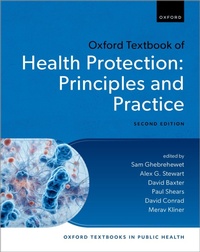
Oxford Textbook of Health Protection
Principles and Practice
2nd Edition
Published on 19. March 2026
Book
Paperback/Softback
480 pages
978-0-19-287081-0 (ISBN)
Description
The Oxford Textbook of Health Protection: Principles and Practice is a comprehensive guide to this important field, addressing all key domains, from communicable disease control and emergency preparedness to environmental public health. Written by leading practitioners and specialists in the field, the book is rooted in a practice-led and evidence-based, all-hazards approach, which facilitates easy access to real-world practice and application of health protection and health security principles. This second edition has been fully revised and expanded to meet the needs of an ever-evolving audience and now sits within the authoritative Oxford Textbooks in Public Health series.
This second edition includes 12 new chapters, covering new and emerging topics such as COVID-19 pandemics, genomics epidemiology, non-pharmaceutical interventions, and concepts and framework for future pandemic preparedness. The chapters are arranged into six distinct sections. Each chapter provides trustworthy evidence and a wealth of practical advice, including case studies in community and hospital settings, and practical scenarios. The real-life scenarios provide topic-specific information, explore a wide range of responses using the 'what if' questions that are supported by tools of the trade to encourage reflection, and reinforce consolidation of knowledge.
The book also includes a unique tool of self-contained checklists (SIMCARDS) covering more than 180 common and important topics that can arise in health protection practice (including those featured in the scenario chapters), with concise and succinct stand-alone quick reference guides on how to handle them within and out-of-hours.
This resource is essential reading for professionals working at all levels in public health and health protection, including those with a non-specialist background in this continually evolving and complex field of public health.
'All the editors and authors have been active in the field of health security and involved through experiential learning in the management of incidents, outbreaks, and other health protection situations for decades. All were at the forefront of the response to the COVID-19 pandemic. They are uniquely able to reflect pragmatically and personally on health security and health protection practice in a variety of situations. This book is, therefore, a practical product of the wealth of their combined experience and will support current professionals in their efforts to ensure the protection and health security of individuals and populations in the UK and internationally.'
From the Foreword by Professor Dame Jenny Harries DBE DL, First Chief Executive,
UK Health Security Agency (UKHSA)
This second edition includes 12 new chapters, covering new and emerging topics such as COVID-19 pandemics, genomics epidemiology, non-pharmaceutical interventions, and concepts and framework for future pandemic preparedness. The chapters are arranged into six distinct sections. Each chapter provides trustworthy evidence and a wealth of practical advice, including case studies in community and hospital settings, and practical scenarios. The real-life scenarios provide topic-specific information, explore a wide range of responses using the 'what if' questions that are supported by tools of the trade to encourage reflection, and reinforce consolidation of knowledge.
The book also includes a unique tool of self-contained checklists (SIMCARDS) covering more than 180 common and important topics that can arise in health protection practice (including those featured in the scenario chapters), with concise and succinct stand-alone quick reference guides on how to handle them within and out-of-hours.
This resource is essential reading for professionals working at all levels in public health and health protection, including those with a non-specialist background in this continually evolving and complex field of public health.
'All the editors and authors have been active in the field of health security and involved through experiential learning in the management of incidents, outbreaks, and other health protection situations for decades. All were at the forefront of the response to the COVID-19 pandemic. They are uniquely able to reflect pragmatically and personally on health security and health protection practice in a variety of situations. This book is, therefore, a practical product of the wealth of their combined experience and will support current professionals in their efforts to ensure the protection and health security of individuals and populations in the UK and internationally.'
From the Foreword by Professor Dame Jenny Harries DBE DL, First Chief Executive,
UK Health Security Agency (UKHSA)
Reviews / Votes
Review from previous edition Overall, I would recommend [Health Protection: Principles and Practice] as an introduction, easy refresher and handy quick reference. * Anil Adisesh, Occupational Medicine * Health Protection: Principles and Practice is likely to be of value to a wider, global audience because of its all-hazards scope: it covers communicable disease surveillance/control, emergency preparedness, resilience and response, and environmental public health activities that in many countries are the responsibility of different organisations. * Health Protection Report, Public Health England * This book is easy both to read and to use as a day-to-day reference. Use of sub-sections and bullet points makes it easy for the reader to quickly locate the desired information. In many chapters scenarios are used to put the reader into real life situations. I think that these would be particularly valuable as a teaching aid for trainees, but they are relevant to all readers. * Philip Milner, Journal of Hospital Infection * The book contains useful case studies on dealing with outbreaks and more than a hundred health protection checklists crossing the gamut of injections disease from avian influenza to viral haemorrhagic fevers. It would be more than worth its price for these alone. * William Hatchett, Environmental Health News * This book was really well thought out. To an impressive degree, because many textbooks are dense, wordy, appealing to an enthusiast for the subject, but a slog for non-experts. By contrast, this one seems designed precisely to meet all the needs of someone on their first day in a health protection job, worried they will be faced with a really difficult scenario. * Andy Beckingham, Public Health Today *More details
Series
Edition
2nd Revised edition
Language
English
Place of publication
Oxford
United Kingdom
Target group
College/higher education
Edition type
Revised edition
Dimensions
Height: 276 mm
Width: 221 mm
Thickness: 29 mm
Weight
1304 gr
ISBN-13
978-0-19-287081-0 (9780192870810)
Copyright in bibliographic data and cover images is held by Nielsen Book Services Limited or by the publishers or by their respective licensors: all rights reserved.
Schweitzer Classification
Persons
Professor Ghebrehewet is a Visting Professor at the Institute of Medicine, University of Chester Medical School, and Head of Vaccination and Immunisation Division for Scotland. Prior to joining Public Health Scotland in October 2023, he has held several senior professional leadership roles in health protection in England for over 20 years: Consultant in Health Protection, Director of Health Protection Unit (Health Protection Agency), Deputy Director of Health Protection (Public Health England), and most recently Regional Deputy Director of Health Protection, Northwest UK Health Security Agency. Professor Ghebrehewet is a Medical Doctor (MD), and earlier in his medical career, he has worked as a General Practitioner and Regional Director of Public Health Programmes in Western part of Ethiopia.
Following a successful career of around 20 years in the northern mountains of Pakistan as a rural GP, Dr Stewart returned to the UK where he trained in Public Health in Cheshire and Merseyside. He was a Consultant in Health Protection for eleven years, with special interest in the acute and long-term effects of the environment on health. He has investigated and responded to many complex public health issues, and has developed an understanding of how to support local and national agencies and the public in the face of limited information, incomplete understanding, and often great uncertainty. He has published extensively, is a member of the editorial team for the Journal of Environmental Geochemistry and Health, reviews for several journals, and continues to teach postgraduate students in health protection and public health, actively maintaining his interest in health protection.
Professor Baxter has been a Consultant in Communicable Disease Control and currently is a Consultant in Health Protection for Stockport MBC Public Health Department. He has worked in Communicable Diseases Control and Health Protection for over 30 years. Over the last 35 years he has successfully run the UK National Immunisation Conference for Health Care Workers, attracting more than 200 delegates every year from all over the country, and delivered by key national and international experts.
Dr Shears is a former consultant medical microbiologist and Director of Infection Prevention and Control at Arrowe Park Wirral University Hospital, North West, UK. He has a special interest in the epidemiology and control of health care associated infections. Dr Shears was previously senior lecturer in medical microbiology at Liverpool University/Liverpool School of Hygiene & Tropical Medicine, with postgraduate teaching responsibilities and public health microbiology projects in Sudan and Bangladesh. Dr Shears was a member of WHO working groups on antimicrobial resistance and public health laboratory development.
Mr Conrad is Director of Public Health Evidence & Improvement at Hertfordshire County Council, where he has led the management of infectious disease outbreaks in community settings and oversees local infectious disease epidemiology and surveillance work.
Dr Kliner is Regional Deputy Director for Health Protection for the North West in UK Health Security Agency. She is also a consultant in health protection, having worked within the North West for nearly 10 years. She has a special interest in TB and sexual health research, which developed during clinical training, guideline development work with WHO, and academic work within Good Shepherd Hospital in Swaziland, with the University of Leeds.
Following a successful career of around 20 years in the northern mountains of Pakistan as a rural GP, Dr Stewart returned to the UK where he trained in Public Health in Cheshire and Merseyside. He was a Consultant in Health Protection for eleven years, with special interest in the acute and long-term effects of the environment on health. He has investigated and responded to many complex public health issues, and has developed an understanding of how to support local and national agencies and the public in the face of limited information, incomplete understanding, and often great uncertainty. He has published extensively, is a member of the editorial team for the Journal of Environmental Geochemistry and Health, reviews for several journals, and continues to teach postgraduate students in health protection and public health, actively maintaining his interest in health protection.
Professor Baxter has been a Consultant in Communicable Disease Control and currently is a Consultant in Health Protection for Stockport MBC Public Health Department. He has worked in Communicable Diseases Control and Health Protection for over 30 years. Over the last 35 years he has successfully run the UK National Immunisation Conference for Health Care Workers, attracting more than 200 delegates every year from all over the country, and delivered by key national and international experts.
Dr Shears is a former consultant medical microbiologist and Director of Infection Prevention and Control at Arrowe Park Wirral University Hospital, North West, UK. He has a special interest in the epidemiology and control of health care associated infections. Dr Shears was previously senior lecturer in medical microbiology at Liverpool University/Liverpool School of Hygiene & Tropical Medicine, with postgraduate teaching responsibilities and public health microbiology projects in Sudan and Bangladesh. Dr Shears was a member of WHO working groups on antimicrobial resistance and public health laboratory development.
Mr Conrad is Director of Public Health Evidence & Improvement at Hertfordshire County Council, where he has led the management of infectious disease outbreaks in community settings and oversees local infectious disease epidemiology and surveillance work.
Dr Kliner is Regional Deputy Director for Health Protection for the North West in UK Health Security Agency. She is also a consultant in health protection, having worked within the North West for nearly 10 years. She has a special interest in TB and sexual health research, which developed during clinical training, guideline development work with WHO, and academic work within Good Shepherd Hospital in Swaziland, with the University of Leeds.
Author
Head of Vaccination and ImmunisationHead of Vaccination and Immunisation, Public Health Scotland (PHS)
Retired Consultant in Health ProtectionRetired Consultant in Health Protection, UKHSA
Consultant in Communicable Disease Control and Director of Medical EducationConsultant in Communicable Disease Control and Director of Medical Education, Stockport NHS Foundation Trust
Retired Consultant MicrobiologistRetired Consultant Microbiologist, Wirral University Teaching Hospital
Director of Public Health Evidence & ImprovementDirector of Public Health Evidence & Improvement, Hertfordshire County Council
Regional Deputy Director for Health Protection and Consultant in Health ProtectionRegional Deputy Director for Health Protection and Consultant in Health Protection, UKHSA
Content
Section 1 - The basics 1: Sam Ghebrehewet and Alex G. Stewart: Health Security and Health Protection 2: Sam Ghebrehewet, Alex G. Stewart, and A-Lan Banks: Health Protection professionals and partners 3: Sam Ghebrehewet, Alex G. Stewart, and Ian Rufus: Key principles and practice of health protection 4: Paul Shears and David Harvey: The fundamentals of public health microbiology 5: Alex G. Stewart, John Astbury, and Sam Ghebrehewet: The fundamentals of environmental public health practice 6: Elizabeth Stratford and Hilary Kirkbride: International Health Regulations Section 2 - Infectious disease control case studies and scenarios 7: Sam Rowell, Andrew Fox, and Anjila Shah: Shiga toxin producing Escherichia coli (STEC) 8: Rita Huyton, Sam Ghebrehewet, and David Baxter: Hepatitis B 9: David Harvey, and Sam Ghebrehewet: Hospital multi-resistant infections 10: Anjila Shah and Sam Ghebrehewet: Influenza 11: Falguni Naik and Sam Ghebrehewet: Legionnaires disease 12: Gill Marsh, David Baxter, and Sam Ghebrehewet: Measles 13: Sam Ghebrehewet, Katie Smith, and Gill Marsh: Meningitis and meningococcal disease 14: Musarrat Afza, Sam Ghebrehewet, and Merav Kliner: Tuberculosis 15: Evdokia Dardamissis and Sam Ghebrehewet: Hepatitis A 16: Stephen Flanagan and Andrew Fox: Cryptosporidiosis 17: Andrew Lee, Sam Ghebrehewet, and Soeren Metelmann: SARS-Cov-2/COVID-19 Section 3 - Emergency preparedness, resilience and response (EPRR), and business continuity case studies and scenarios 18: Alex G. Stewart, Sam Ghebrehewet, David Baxter, and Dyfan Jones: Business Continuity: illustrated by hospital ward closures 19: Laura Mitchem, Henrietta Harrison, and Alex G. Stewart: Fire and health protection 20: John Astbury, Alex G. Stewart, and Sam Ghebrehewet: Radiation and health protection Section 4 - Environmental Public Health practice case studies and scenarios 21: Alex G. Stewart, Alan Wilton, Sam Ghebrehewet, and Dyfan Jones: Flooding and health protection: immediate and long-term implications 22: John Reid, Giovanni Leonardi, and Alex G. Stewart: Ambient air pollution and health 23: Alex G. Stewart, Sam Ghebrehewet, and Richard Jarvis: Cancer and chronic disease cluster(s) investigation Section 5 - Health protection tools 24: Paul Shears, David Harvey, and Rita Huyton: Hospital & Community Infection prevention and control 25: David Baxter, Sam Ghebrehewet, and Gill Marsh: Immunisation 26: Sam Ghebrehewet, Alex G. Stewart, and A-Lan Banks: Incidents & Outbreak Management 27: Caoimhe Mckerr and Sam Ghebrehewet: Genomic epidemiology for outbreak management 28: Roberto Vivancos, Alex J. Elliot, and Giovanni Leonardi: Health Protection Surveillance 29: Paul Cleary, Sam Ghebrehewet, and David Baxter: Essential Statistics and Epidemiology 30: Sam Ghebrehewet, Paul Cleary, Merav Kliner, and Ewan Wilkinson: Conducting Epidemiological Studies in health protection 31: Merav Kliner, Ewan Wilkinson, Sam Ghebrehewet, and Alex G. Stewart: Using Evidence to guide practice in health protection 32: Amal Rushdy and Sam Ghebrehewet: Quality Assurance & Audit 33: Jo Mackenzie, Martin Logue, David Conrad, and Sam Ghebrehewet: Evaluation in Health Protection 34: Alex G. Stewart, Ewan Wilkinson, and Sam Ghebrehewet: Screening in Health Protection 35: Wendi Shepherd, Rita Huyton, Sam Ghebrehewet, and Alex G. Stewart: Non-pharmacutical Interventions, isolation, and quarantine 36: David Baxter, Rita Huyton, and Sam Ghebrehewet: Occupational Health and Health Protection Section 6 - New and emerging health protection issues 37: Titus H. Divala, Alex G. Stewart, Sam Ghebrehewet, and Peter MacPherson: Emerging Infectious Diseases 38: Willam Welfare, Samihah Moazam, and Dominic Mellon: Preparing for pandemics in the context of COVID-19 39: Alec Dobney, Greg Hodgson and Rachel Smith: Emerging Environmental Public Health issues 40: Virginia Murray, Jonathan Abrahams, and Alex G. Stewart: Disasters and risk reduction strategies: applying international learning at local level 41: Alex G. Stewart, Sam Ghebrehewet, Richard Jarvis, and A-Lan Banks: Sustainability and health protection