

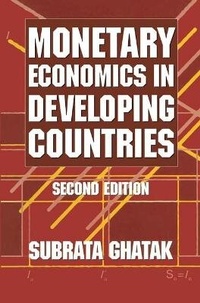
Monetary Economics in Developing Countries
2nd Edition
Published on 17. March 1995
Book
Hardback
278 pages
978-0-333-57224-5 (ISBN)
Description
This text highlights some of the basic principles of monetary economics and their application to the Third World. Drawing on recent data from a wide variety of developing countries, the author discusses central issues such as: money supply and demand and associated problems of stability; causes and consequences of financial liberalization; the "structuralist" versus the "monetarist" debate; inflation and economic development and problems of Third World debt. This new edition revises earlier material and has new chapters on rural financial institutions, exchange rate policies and the debt crisis in less-developed countries. The book also features case studies and separate technical and mathematical sections.
More details
Edition
2nd Revised edition
Language
English
Place of publication
Basingstoke
United Kingdom
Target group
College/higher education
Professional and scholarly
Edition type
Revised edition
Illustrations
Illustrations
Dimensions
Height: 234 mm
Width: 154 mm
Weight
437 gr
ISBN-13
978-0-333-57224-5 (9780333572245)
Copyright in bibliographic data and cover images is held by Nielsen Book Services Limited or by the publishers or by their respective licensors: all rights reserved.
Schweitzer Classification
Other editions
New editions
Subrata Ghatak | Jose R. Sanchez-Fung
Monetary Economics in Developing Countries
Book
3rd Edition
Palgrave Macmillan
€74.28
The article will not be published
Content
The role of money in a less-developed country; the Keynesian and monetarist views on the importance of money; the demand for money in LDCs by D. Deadman; monetary institutions in LDCs; theories of money and economic growth; money, inflation and growth with P.C.I. Ayre and D. Deadman; the Polax Model - its application to the LDCs; monetary policies in developing countries; international liquidity, LDCs and the SDRs with P.C.I Ayre; rural financial institutions in LDCs; the international debt crisis; exchange rate policies in developing countries.