

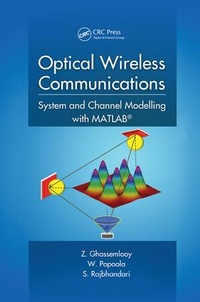
Optical Wireless Communications
System and Channel Modelling with MATLAB (R)
1st Edition
Published on 31. March 2017
Book
Paperback/Softback
576 pages
978-1-138-07480-4 (ISBN)
Description
Detailing a systems approach, Optical Wireless Communications: System and Channel Modelling with MATLAB (R), is a self-contained volume that concisely and comprehensively covers the theory and technology of optical wireless communications systems (OWC) in a way that is suitable for undergraduate and graduate-level students, as well as researchers and professional engineers.
Incorporating MATLAB (R) throughout, the authors highlight past and current research activities to illustrate optical sources, transmitters, detectors, receivers, and other devices used in optical wireless communications. They also discuss both indoor and outdoor environments, discussing how different factors-including various channel models-affect system performance and mitigation techniques.
In addition, this book broadly covers crucial aspects of OWC systems:
Fundamental principles of OWC
Devices and systems
Modulation techniques and schemes (including polarization shift keying)
Channel models and system performance analysis
Emerging visible light communications
Terrestrial free space optics communication
Use of infrared in indoor OWC
One entire chapter explores the emerging field of visible light communications, and others describe techniques for using theoretical analysis and simulation to mitigate channel impact on system performance. Additional topics include wavelet denoising, artificial neural networks, and spatial diversity. Content also covers different challenges encountered in OWC, as well as outlining possible solutions and current research trends. A major attraction of the book is the presentation of MATLAB simulations and codes, which enable readers to execute extensive simulations and better understand OWC in general.
Incorporating MATLAB (R) throughout, the authors highlight past and current research activities to illustrate optical sources, transmitters, detectors, receivers, and other devices used in optical wireless communications. They also discuss both indoor and outdoor environments, discussing how different factors-including various channel models-affect system performance and mitigation techniques.
In addition, this book broadly covers crucial aspects of OWC systems:
Fundamental principles of OWC
Devices and systems
Modulation techniques and schemes (including polarization shift keying)
Channel models and system performance analysis
Emerging visible light communications
Terrestrial free space optics communication
Use of infrared in indoor OWC
One entire chapter explores the emerging field of visible light communications, and others describe techniques for using theoretical analysis and simulation to mitigate channel impact on system performance. Additional topics include wavelet denoising, artificial neural networks, and spatial diversity. Content also covers different challenges encountered in OWC, as well as outlining possible solutions and current research trends. A major attraction of the book is the presentation of MATLAB simulations and codes, which enable readers to execute extensive simulations and better understand OWC in general.
Reviews / Votes
"This book presents a thorough theoretical analysis of optical wireless communication while bridging theory with practice through MATLAB (R) programming. Using MATLAB will enable the reader to experiment with concepts directly on the computer while reading the book. It will also give the reader the opportunity to develop further concept since the basic code is readily available."-Driss Benhaddou, University of Houston, Texas, USA
"As the field of optical wireless communications continues to spread, researchers, students, and industry practitioners face the need of an up-to-date and comprehensive textbook with sufficient detail. The book by Ghassemlooy et al. fills this critical gap and provides a much-needed resource that covers both indoor and outdoor optical wireless applications. I recommend it highly to anyone interested in the emerging area of optical wireless communications."
-Murat Uysal, OEzyegin University, Istanbul, Turkey
"... a valuable book!"
-Prof. Erich Leiteb, Graz University of Technology, Austria
More details
Language
English
Place of publication
London
United Kingdom
Publishing group
Taylor & Francis Ltd
Target group
Professional and scholarly
Academic and Professional Practice & Development
Illustrations
268 s/w Abbildungen, 53 s/w Tabellen
53 Tables, black and white; 268 Illustrations, black and white
Dimensions
Height: 234 mm
Width: 156 mm
Weight
1070 gr
ISBN-13
978-1-138-07480-4 (9781138074804)
Copyright in bibliographic data and cover images is held by Nielsen Book Services Limited or by the publishers or by their respective licensors: all rights reserved.
Schweitzer Classification
Other editions
Additional editions
Z. Ghassemlooy | W. Popoola | S. Rajbhandari
Optical Wireless Communications
System and Channel Modelling with MATLAB (R)
Book
08/2012
1st Edition
CRC Press
€217.01
Article exhausted; check for reprint
Persons
Professor Zabih Ghassemlooy (CEng, Fellow of IET, senior member of IEEE) received his BSc (Hons.) in electrical and electronics engineering from the Manchester Metropolitan University in 1981, and his MSc and Ph.D in optical communications from the University of Manchester Institute of Science and Technology thereafter in 1984 and 1987, respectively. Currently he is an associate dean for research in the School of Computing, Engineering and Information Sciences, University of Northumbria at Newcastle upon Tyne, UK. He also heads the Northumbria Communications Research Laboratories within the school. His research interests are mainly in the area of optical communications, and published over 415 papers. He is the founder and the chairman of the IEEE, IET International Symposium on Communication Systems, Network and Digital Signal Processing.
Dr. W. Popoola had his national diploma in electrical engineering from The Federal Polytechnic, Ilaro, Nigeria and later graduated with first class honours degree in electronic and electrical engineering from Obafemi Awolowo University, Nigeria. He later proceeded to Northumbria University at Newcastle upon Tyne, England, UK, for his MSc in optoelectronic and communication systems where he graduated with distinction in 2006. He was awarded his Ph.D. in 2009 at the Northumbria University for his research work in free-space optical communications. He is currently a researcher with the Institute for Digital Communications, University of Edinburgh, UK working on visible light communications.
Dr. S. Rajbhandari obtained his bachelor degree in electronics and communication engineering from the Institute of Engineering, Pulchowk Campus (Tribhuvan University), Nepal in 2004. In 2006, he received an MSc in optoelectronic and communication systems with distinction and was awarded the P. O. Byrne prize for most innovative project. He then joined the Optical Communications Research Lab (OCRG) at Northumbria University and was awarded a Ph.D degree in 2010. Since 2009, he has been with the OCRG at Northumbria University working as a postdoctoral researcher. He has published more than 70 scholarly articles in the area of optical wireless communications.
Dr. W. Popoola had his national diploma in electrical engineering from The Federal Polytechnic, Ilaro, Nigeria and later graduated with first class honours degree in electronic and electrical engineering from Obafemi Awolowo University, Nigeria. He later proceeded to Northumbria University at Newcastle upon Tyne, England, UK, for his MSc in optoelectronic and communication systems where he graduated with distinction in 2006. He was awarded his Ph.D. in 2009 at the Northumbria University for his research work in free-space optical communications. He is currently a researcher with the Institute for Digital Communications, University of Edinburgh, UK working on visible light communications.
Dr. S. Rajbhandari obtained his bachelor degree in electronics and communication engineering from the Institute of Engineering, Pulchowk Campus (Tribhuvan University), Nepal in 2004. In 2006, he received an MSc in optoelectronic and communication systems with distinction and was awarded the P. O. Byrne prize for most innovative project. He then joined the Optical Communications Research Lab (OCRG) at Northumbria University and was awarded a Ph.D degree in 2010. Since 2009, he has been with the OCRG at Northumbria University working as a postdoctoral researcher. He has published more than 70 scholarly articles in the area of optical wireless communications.
Content
Introduction: Optical Wireless Communication Systems. Optical Sources and Detectors. Channel Modelling. Modulation Techniques. System Performance Analysis: Indoor. FSO Link Performance under the Effect of Atmospheric Turbulence. Outdoor OWC Links with Diversity Techniques. Visible Light Communications.