

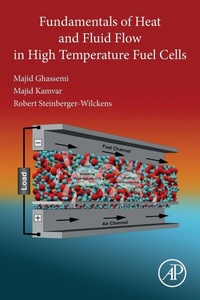
Fundamentals of Heat and Fluid Flow in High Temperature Fuel Cells
Published on 19. August 2020
Book
Paperback/Softback
196 pages
978-0-12-815753-4 (ISBN)
Description
Fundamentals of Heat and Fluid Flow in High Temperature Fuel Cells introduces key-concepts relating to heat, fluid and mass transfer as applied to high temperature fuel cells. The book briefly covers different type of fuel cells and discusses solid oxide fuel cells in detail, presenting related mass, momentum, energy and species equation. It then examines real case studies of hydrogen- and methane-fed SOFC, as well as combined heat and power and hybrid energy systems. This comprehensive reference is a useful resource for those working in high temperature fuel cell modeling and development, including energy researchers, engineers and graduate students.
More details
Language
English
Place of publication
San Diego
United States
Publishing group
Elsevier Science Publishing Co Inc
Target group
Professional and scholarly
energy researchers, engineers and graduate students in the area of fuel cells and CHP systems
Dimensions
Height: 227 mm
Width: 149 mm
Thickness: 10 mm
Weight
328 gr
ISBN-13
978-0-12-815753-4 (9780128157534)
Copyright in bibliographic data and cover images is held by Nielsen Book Services Limited or by the publishers or by their respective licensors: all rights reserved.
Schweitzer Classification
Other editions
Additional editions
Majid Ghassemi | Majid Kamvar | Robert Steinberger-Wilckens
Fundamentals of Heat and Fluid Flow in High Temperature Fuel Cells
E-Book
08/2020
Academic Press
€160.00
Available for download
Persons
Prof. Majid Ghassemi is Professor in the Department of Mechanical Engineering at the K. N. Toosi University of Technology; one of the most prestigious technical universities in Tehran, Iran. Professor Ghassemi has been recognized as Global Talent, also known as an Exceptional Talent, endorsed by the Royal Academy of Engineering of the United Kingdom, since 2015. He received that honor when he was acting as a Visiting Professor at the Centre for Fuel Cell and Hydrogen Research at the University of Birmingham, United Kingdom. He teaches graduate and undergraduate courses and conducts research in the area of heat transfer and its application in bio and micro sensors, drug delivery, fuel cells,micro channels and alternative energy. He has over 20 years of academic and industrial experience and served as the President of the K. N. Toosi University of Technology from 2010 to 2013. Majid Kamvar works in the Department of Engineering, Parand Branch at Islamic Azad University in Parand, Iran Robert Steinberger-Wilckens is Professor for Fuel Cell and Hydrogen research in Chemical Engineering. He is director of the research Fuel Cell and Hydrogen group and the Centre for Doctoral Training Fuel Cells and their Fuels, which is run by the universities of Birmingham, Nottingham, and Loughborough, Imperial College, and University College of London. He works and has worked in many areas across the fields of renewable energies, energy efficiency, fuel cells, hydrogen production and distribution, as well as electric vehicles. Currently, his main areas of interest include Solid Oxide Fuel Cells, high temperature electrolysis (SOE) and reversible fuel cells (SOC) with methane synthesis, intermediate temperature polymer fuel cells, and market introduction of fuel cells and fuel cell vehicles. He has a total of over 200 publications in journals, books, and conference proceedings and is a regular peer reviewer for a large number of journals, as well as international funding programmes and publishing houses. He is member of the strategic advisory bodies for EPSRC, the EU Fuel Cell and Hydrogen Joint Undertaking, and the European Fuel Cell Forum. Professor Steinberger-Wilckens coordinates the modules Conventional Energy and Renewable Energy and Energy Storage for 2nd Year students and the module Introduction to Fuel Cell and Hydrogen Technologies for 4th Year and CDT students.
Author
Professor, K. N. Toosi University of Technology, Tehran, Iran
Department of Mechanical Engineering, Parand Branch, Islamic Azad University, Parand, Iran.
Chair in Fuel Cell and Hydrogen Research, Centre for Doctoral Training in Fuel Cells and Their Fuels, School of Chemical Engineering, University of Birmingham, UK
Content
1. Introduction to fuel cells2. What is a fuel cell?3. How does a fuel cell work?4. Main fuel cell layers5. Anode layer6. Anode catalyst layer7. Cathode layer8. Cathode catalyst layer9. Electrolyte layer10. Different types of fuel cells11. Solid oxide fuel cell 12. Classification of SOFCs13. Conventional SOFCs14. Single chamber SOFCs15. No chamber SOFCs16. SOFC advantages and disadvantages17. Conventional materials used in SOFC layers18. Different SOFC geometries19. Planar type20. Tubular type21. Anode supported design22. Cathode supported design23. Electrolyte supported design24. Fundamentals of Heat transfer25. Different modes of Heat transfer26. Conduction27. Convection28. Radiation29. Energy conservation30. Heat transfer in free and porous media 31. Transient and steady state heat transfer32. Heat generation33. Some applicable boundary conditions34. Conduction heat transfer in SOFCs35. Heat conduction equation36. Thermal conductivity37. Conduction in porous media38. Convection heat transfer in SOFCs39. Fundamental convection principles40. Laminar flow41. Turbulent flow42. Natural and forced convection convectively43. Convection in porous media44. Fundamentals of fluid flow45. Mass conservation46. Momentum conservation47. Different types of motion equation48. Compressible and incompressible flow49. Fluid flow in porous media 50. Some applicable boundary conditions51. Fully coupling in modelling 52. Case Studies 53. Hydrogen-fed SOFC54. Methane-fed SOFC55. Combined systems 56. Combined SOFC and CHP57. Combined SOFC and power plant