

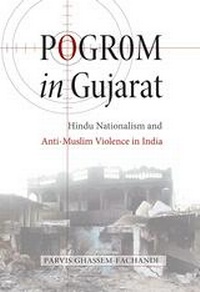
Pogrom in Gujarat
Hindu Nationalism and Anti-Muslim Violence in India
Published on 8. April 2012
Book
Hardback
320 pages
978-0-691-15176-2 (ISBN)
Description
In 2002, after an altercation between Muslim vendors and Hindu travelers at a railway station in the Indian state of Gujarat, fifty-nine Hindu pilgrims were burned to death. The ruling nationalist Bharatiya Janata Party blamed Gujarat's entire Muslim minority for the tragedy and incited fellow Hindus to exact revenge. The resulting violence left more than one thousand people dead--most of them Muslims--and tens of thousands more displaced from their homes. Parvis Ghassem-Fachandi witnessed the bloodshed up close. In Pogrom in Gujarat, he provides a riveting ethnographic account of collective violence in which the doctrine of ahimsa--or nonviolence--and the closely associated practices of vegetarianism became implicated by legitimating what they formally disavow. Ghassem-Fachandi looks at how newspapers, movies, and other media helped to fuel the pogrom. He shows how the vegetarian sensibilities of Hindus and the language of sacrifice were manipulated to provoke disgust against Muslims and mobilize the aspiring middle classes across caste and class differences in the name of Hindu nationalism.
Drawing on his intimate knowledge of Gujarat's culture and politics and the close ties he shared with some of the pogrom's sympathizers, Ghassem-Fachandi offers a strikingly original interpretation of the different ways in which Hindu proponents of ahimsa became complicit in the very violence they claimed to renounce.
Drawing on his intimate knowledge of Gujarat's culture and politics and the close ties he shared with some of the pogrom's sympathizers, Ghassem-Fachandi offers a strikingly original interpretation of the different ways in which Hindu proponents of ahimsa became complicit in the very violence they claimed to renounce.
Reviews / Votes
"This is an insightful and subtle account, capturing much of a moment which is already being made to be forgotten by new forms of political will and national ambition in Gujarat."--Edward Simpson, Journal of the Royal Anthropological Institute "The book makes a number of noteworthy contributions throughout. Foremost among these is its discussion on women, who stand at the center of all deliberations, yet are denied agency."--R. Khan, Asian Affairs "Although there have been many eye-witness accounts of the 2002 pogrom in Gujarat, in the wake of the Godhra train tragedy there has been no book-like treatment of the subject by an academic, who lived and observed the events before, during and after the pogrom. Pogrom in Gujarat fills this void admirably."--V. Venkatesan, Frontline "Pogrom in Gujarat: Hindu Nationalism and Anti-Muslim Violence in India is an original and unique contribution to the literature on the anthropology of violence. Ghassem-Fachandi's style of writing is lucid, and his arguments are based on an authoritative understanding of Gujarati society and culture (both rural and urban)."--Rubina Jasani, Journal of Church and State "The uniqueness of the book lies in the author's intimate experience of ethnic violence, which is quite exceptional for academic research on ethnic violence in India. Often written in the first person, the ethnographic narrative is powerful and extends beyond this experience into an in-depth analysis of the larger cultural context of violence in Gujarat. This book will remain a classic analysis of the politics of the Hindu right in India that draws its sustenance from the blood of the innocent."--Sanal Mohan, Social AnthropologyMore details
Language
English
Place of publication
New Jersey
United States
Target group
College/higher education
Professional and scholarly
Product notice
Trade binding
Illustrations
20 halftones.
Dimensions
Height: 229 mm
Width: 152 mm
Weight
624 gr
ISBN-13
978-0-691-15176-2 (9780691151762)
Copyright in bibliographic data and cover images is held by Nielsen Book Services Limited or by the publishers or by their respective licensors: all rights reserved.
Schweitzer Classification
Other editions
Additional editions
Book
04/2012
Princeton University Press
€37.50
Shipment within 10-20 days
E-Book
04/2012
1st Edition
Princeton University Press
€30.49
Available for download
Person
Parvis Ghassem-Fachandi is assistant professor of anthropology at Rutgers University. He is the editor of Violence: Ethnographic Encounters.
Content
List of Figures vii Introduction 1 Chapter 1 "Why do you leave? Fight for us!" 31 Chapter 2 Word and Image 59 Chapter 3 The Gujarat Pogrom 93 Chapter 4 The Lack of Muslim Vulnerability 123 Chapter 5 Vibrant Vegetarian Gujarat 153 Chapter 6 Ahimsa, Gandhi, and the Angry Hindu 185 Chapter 7 Split City Body 213 Chapter 8 Heterogeneity and the Nation 257 Postscript 273 Notes 283 List of Abbreviations 303 Glossary 305 References 309 Index 323