

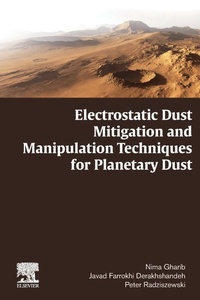
Electrostatic Dust Mitigation and Manipulation Techniques for Planetary Dust
Published on 24. August 2022
Book
Paperback/Softback
272 pages
978-0-12-821975-1 (ISBN)
Description
Electrostatic Dust Mitigation and Manipulation Techniques for Planetary Dust explains how to control and remove dust in space due to the presence of a vacuum, abrasiveness of dust particles and electrostatic charge on particles. The book introduces innovative technologies that use electrostatic and di-electrophoretic forces to remove and transport small particles away from surfaces. In addition, it discusses how to resolve thermal control problems and reduce lung inhalation and eye irritation problems. The book includes two abrasive wear test devices that were designed to study the rate of volume wear for di?erent materials when subjected to lunar dust simulant of di?erent size ranges.
This will be an ideal resource for space system engineers, space exploration researchers, and advanced students and professionals in space engineering.
This will be an ideal resource for space system engineers, space exploration researchers, and advanced students and professionals in space engineering.
More details
Language
English
Place of publication
United States
Target group
Professional and scholarly
Product notice
Paperback (trade)
Illustrations
130 illustrations (40 in full color); Illustrations
Dimensions
Height: 229 mm
Width: 152 mm
Thickness: 15 mm
Weight
371 gr
ISBN-13
978-0-12-821975-1 (9780128219751)
Copyright in bibliographic data and cover images is held by Nielsen Book Services Limited or by the publishers or by their respective licensors: all rights reserved.
Schweitzer Classification
Other editions
Additional editions
Nima Gharib | Javad Farrokhi Derakhshandeh | Peter Radziszewski
Electrostatic Dust Mitigation and Manipulation Techniques for Planetary Dust
E-Book
08/2022
Elsevier
€160.00
Available for download
Persons
Nima Gharib is a former Assistant Professor and McGill graduate. He has been a space enthusiast and studied dust mitigation techniques experimentally and numerically for years. He received an award from the Canadian Space Agency for his article on dust mitigation. He is now consulting on combining different numerical methods (CFD, FEM and DEM) to model and optimise multidisciplinary problems. Javad Farrokhi Derakhshandeh earned his Ph.D. in Mechanical Engineering from the University of Adelaide, in South Australia. His Ph.D. project focused on harnessing hydropower energy from ocean and rivers using flow-induced vibration phenomenon. Currently, he has a position of associate professor at the American University of the Middle East (AUM), and he has made significant contributions to academia with many technical articles. Javad Farrokhi Derakhshandeh has published over 80 high-impact journal articles in leading publications such as Journal of Fluids and Structures, Ocean Engineering, ISA Transactions, International Communications in Heat and Mass Transfer, and Physics of Fluid. In addition to his journal contributions, he is the co-author of the textbook "Electrostatic Dust Mitigation and Manipulation Techniques for Planetary Dust? and numerous peer-reviewed conference papers. Peter Radziszewski is a former Associate Professor in Engineering Design at McGill University who pursued R&D and teaching activities in design and mineral processing. Joining Metso in 2012 as VP Solutions Offering Development, his conceptual design efforts encompassed mineral processes equipment as well as wear and consumables. In 2021, he joined Rampart Detection Systems as VP Research and Innovation.
Content
1. Introduction
2. Dust related problems
3. Fundamentals of electrodynamics and simulations
4. Dust mitigation techniques
5. Charging techniques and measurements
6. Particle handling with electrostatic force
7. Analytical and numerical modeling
8. Conclusions
2. Dust related problems
3. Fundamentals of electrodynamics and simulations
4. Dust mitigation techniques
5. Charging techniques and measurements
6. Particle handling with electrostatic force
7. Analytical and numerical modeling
8. Conclusions