

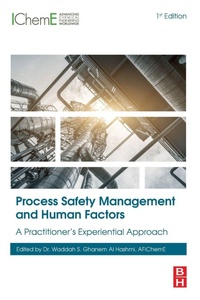
Process Safety Management and Human Factors
A Practitioner's Experiential Approach
Published on 18. November 2020
Book
Paperback/Softback
346 pages
978-0-12-818109-6 (ISBN)
Description
Process Safety Management and Human Factors: A Practitioner's Experiential Approach addresses human factors in process safety management (PSM) from a reflective learning approach. The book is written by engineers and technical specialists who spent the last 15-20 years of their professional career looking at behavioral-based safety, human factor research, and safety culture development in organizations. It is a fundamental resource for operational, technical and safety managers in high-risk industries who need to focus on personal and occupational safety management to prevent safety accidents. Real-life examples illustrate how a good, effective understanding of human factors supports PSM and positive impacts on accident occurrence.
More details
Language
English
Place of publication
Woburn
United States
Publishing group
Elsevier - Health Sciences Division
Target group
Professional and scholarly
Plant and Operational Managers; Senior PSM experts; HSE and Safety Engineers; HSE Managers; Industrial/Occupational Ergonomists/Hygienists; Industrial/Occupational Physiologists working the field of Safety and Organisational Safety Culture Development; Technical, Asset Integrity and Process Optimization Specialists and Managers. Human Factor Practitioners
Product notice
Paperback (trade)
Illustrations
50 B/W illustrations
Dimensions
Height: 228 mm
Width: 150 mm
Thickness: 18 mm
Weight
578 gr
ISBN-13
978-0-12-818109-6 (9780128181096)
Copyright in bibliographic data and cover images is held by Nielsen Book Services Limited or by the publishers or by their respective licensors: all rights reserved.
Schweitzer Classification
Other editions
Additional editions
Waddah S. Ghanem Al Hashmi
Process Safety Management and Human Factors
A Practitioner's Experiential Approach
E-Book
11/2020
Butterworth-Heinemann
€105.00
Available for download
Person
Dr. Waddah S. Ghanem Al Hashmi graduated from the University of Wales College Cardiff, School of Engineering, with a Bachelor of Engineering (Honours) in Environmental Engineering. Waddah is considered one of the global authorities on governance and leadership in EHS. He is currently the Senior Director for Sustainability, Operational and Business Excellence for the ENOC Group. He was appointed in 2015 as Executive Director, EHSSQ & Corporate Affairs, and in June of 2018, he was given the role of Senior Director for Sustainability, Operational and Business Excellence. He also chairs various committees in ENOC including the Governance and Oversight for the SAP Digital Transformation, Operational Excellence Framework Committee, and the Asset Integrity Committee. Waddah has received several awards in his career, most notably, the Rashid Prize for Scholarship Excellence in 2007 (Dubai), and the IEMA Sustainability Leader of the Year (UK) in 2019. His publications include various research, practitioner journals, and conference papers, as well as seven internationally published books. Waddah is also a Fellow of IEMA, EI, an Associate Fellow of IChemE, and a member of the IoD, UK. He was born and is based in Dubai, United Arab Emirates.Dr. Waddah S. Ghanem Al Hashmi graduated from the University of Wales College Cardiff, School of Engineering, with a Bachelor of Engineering (Honours) in Environmental Engineering. Waddah is considered one of the global authorities on governance and leadership in EHS. He is currently the Senior Director for Sustainability, Operational and Business Excellence for the ENOC Group. He was appointed in 2015 as Executive Director, EHSSQ & Corporate Affairs, and in June of 2018, he was given the role of Senior Director for Sustainability, Operational and Business Excellence. He also chairs various committees in ENOC including the Governance and Oversight for the SAP Digital Transformation, Operational Excellence Framework Committee, and the Asset Integrity Committee. Waddah has received several awards in his career, most notably, the Rashid Prize for Scholarship Excellence in 2007 (Dubai), and the IEMA Sustainability Leader of the Year (UK) in 2019. His publications include various research, practitioner journals, and conference papers, as well as seven internationally published books. Waddah is also a Fellow of IEMA, EI, an Associate Fellow of IChemE, and a member of the IoD, UK. He was born and is based in Dubai, United Arab Emirates.
Content
1. Introduction to process safety management in a practical context
2. Introduction to human factors and the human element
3. Leadership and process safety management
4. The awareness of risk, complacency, and the normalization of deviance
5. Competence assurance and organizational learning
6. Integration of human factors in hazard identification and risk assessment
7. Inherent safety impact in complying process safety regulations and reducing human error
8. Asset and mechanical integrity management
9. Management of change
10. Management of risk through safe work practices
11. Process safety information, hazard control, and communication
12. Prestart-up and shutdown safety reviews
13. Contractor management
14. Emergency response management and control
15. Human performance within process safety management compliance assurance
16. Regulating PSM and the impact of effectiveness
17. Readying the organization for change: communication and alignment
18. Do we really learn from loss incidents?
19. Gauging the effectiveness of implementation and measuring the performance of PSM activities
20. Human errors, organization culture, and leadership
Appendix
1. Sample PSSR checklist and report
2. Reference list and international standards and codes
2. Introduction to human factors and the human element
3. Leadership and process safety management
4. The awareness of risk, complacency, and the normalization of deviance
5. Competence assurance and organizational learning
6. Integration of human factors in hazard identification and risk assessment
7. Inherent safety impact in complying process safety regulations and reducing human error
8. Asset and mechanical integrity management
9. Management of change
10. Management of risk through safe work practices
11. Process safety information, hazard control, and communication
12. Prestart-up and shutdown safety reviews
13. Contractor management
14. Emergency response management and control
15. Human performance within process safety management compliance assurance
16. Regulating PSM and the impact of effectiveness
17. Readying the organization for change: communication and alignment
18. Do we really learn from loss incidents?
19. Gauging the effectiveness of implementation and measuring the performance of PSM activities
20. Human errors, organization culture, and leadership
Appendix
1. Sample PSSR checklist and report
2. Reference list and international standards and codes