

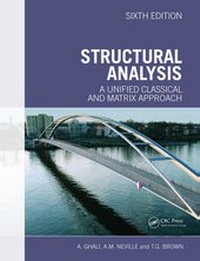
Structural Analysis
A Unified Classical and Matrix Approach
6th Edition
Published on 11. February 2009
Book
Paperback/Softback
836 pages
978-0-415-77433-8 (ISBN)
Description
This comprehensive textbook, now in its sixth edition, combines classical and matrix-based methods of structural analysis and develops them concurrently. New solved examples and problems have been added, giving over 140 worked examples and more than 400 problems with answers.
The introductory chapter on structural analysis modelling gives a good grounding to the beginner, showing how structures can be modelled as beams, plane or space frames and trusses, plane grids or assemblages of finite element. Idealization of loads, anticipated deformations, deflected shapes and bending moment diagrams are presented. Readers are also shown how to idealize real three-dimensional structures into simplified models that can be analyzed with little or no calculation, or with more involved calculations using computers. Dynamic analysis, essential for structures subject to seismic ground motion, is further developed in this edition and in a code-neutral manner. The topic of structural reliability analysis is discussed in a new chapter.
Translated into six languages, this textbook is of considerable international renown, and is widely recommended by many civil and structural engineering lecturers to their students because of its clear and thorough style and content.
The introductory chapter on structural analysis modelling gives a good grounding to the beginner, showing how structures can be modelled as beams, plane or space frames and trusses, plane grids or assemblages of finite element. Idealization of loads, anticipated deformations, deflected shapes and bending moment diagrams are presented. Readers are also shown how to idealize real three-dimensional structures into simplified models that can be analyzed with little or no calculation, or with more involved calculations using computers. Dynamic analysis, essential for structures subject to seismic ground motion, is further developed in this edition and in a code-neutral manner. The topic of structural reliability analysis is discussed in a new chapter.
Translated into six languages, this textbook is of considerable international renown, and is widely recommended by many civil and structural engineering lecturers to their students because of its clear and thorough style and content.
More details
Edition
6th New edition
Language
English
Place of publication
London
United Kingdom
Target group
College/higher education
Edition type
New edition
Illustrations
29 s/w Tabellen, 150 s/w Zeichnungen
150 Line drawings, black and white; 29 Tables, black and white
Dimensions
Height: 248 mm
Width: 191 mm
Weight
1588 gr
ISBN-13
978-0-415-77433-8 (9780415774338)
Copyright in bibliographic data and cover images is held by Nielsen Book Services Limited or by the publishers or by their respective licensors: all rights reserved.
Schweitzer Classification
Other editions
New editions
Amin Ghali | A.M. Neville
Structural Analysis
A Unified Classical and Matrix Approach, Seventh Edition
Book
09/2017
7th Edition
CRC Press
€110.50
Shipment within 15-20 days
Additional editions
Book
02/2009
6th Edition
Taylor & Francis
€222.84
Article exhausted; check for reprint
Persons
Amin Ghali is Fellow of the Canadian Academy of Engineering and Professor Emeritus in the Civil Engineering Department of the University of Calgary, Canada
Adam Neville is former Vice President of the Royal Academy of Engineering and former Principal and Vice-Chancellor of the University of Dundee, Scotland
Tom G. Brown is Professor and Head of the Civil Engineering Department of the University of Calgary, Canada
Adam Neville is former Vice President of the Royal Academy of Engineering and former Principal and Vice-Chancellor of the University of Dundee, Scotland
Tom G. Brown is Professor and Head of the Civil Engineering Department of the University of Calgary, Canada
Content
1. Structural analysis modelling
2. Statically determinate structures
3. Introduction to the analysis of statically indeterminate structures
4. Force method of analysis
5. Displacement method of analysis
6. Use of force and displacement methods
7. Strain energy and virtual work
8. Determination of displacements by virtual work
9. Important energy theorems
10. Displacement of elastic structures by special methods
11. Application of force and displacement methods
12. Influence lines for beams, frames grids, arches, and trusses
13. Effects of axial forces on flexural stiffness
14. Analysis of shear-wall structures
15. Method of finite differences
16. Finite-element method
17. Further development of finite-element method
18. Plastic analysis of continuous beams and frames
19. Yield-line and strip methods for slabs
20. Structural dynamics and seismic analysis
21. Computer analysis of framed structures
22. Implementation of computer analysis
23. Nonlinear analysis
24. Structural reliability analysis
Appendices
2. Statically determinate structures
3. Introduction to the analysis of statically indeterminate structures
4. Force method of analysis
5. Displacement method of analysis
6. Use of force and displacement methods
7. Strain energy and virtual work
8. Determination of displacements by virtual work
9. Important energy theorems
10. Displacement of elastic structures by special methods
11. Application of force and displacement methods
12. Influence lines for beams, frames grids, arches, and trusses
13. Effects of axial forces on flexural stiffness
14. Analysis of shear-wall structures
15. Method of finite differences
16. Finite-element method
17. Further development of finite-element method
18. Plastic analysis of continuous beams and frames
19. Yield-line and strip methods for slabs
20. Structural dynamics and seismic analysis
21. Computer analysis of framed structures
22. Implementation of computer analysis
23. Nonlinear analysis
24. Structural reliability analysis
Appendices