

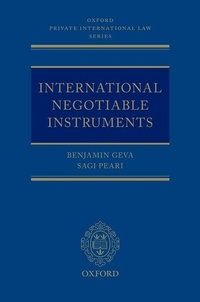
International Negotiable Instruments
Published on 10. December 2020
Book
Hardback
300 pages
978-0-19-882868-6 (ISBN)
Description
For centuries, bills of exchange, cheques, and promissory notes ('negotiable instruments') have played a vital role in the smooth operation of domestic and international commerce. The payment mechanisms have been subject to rapid technological progress and law has needed to adapt and respond to ensure that the legal framework remains relevant and effective.
This book provides a comprehensive and thorough analysis of the question of applicable law to negotiable instruments. Given significant differences in the treatment of important issues under the laws governing negotiable instruments of the various jurisdictions, the question of applicable law plays a key role in contemporary commerce. Resolution of such issues frequently has cross-border dimensions, affecting residents from different countries, and meeting the needs of commerce as it rapidly moves towards an online mode of communication and documentation. To such ends, the book elaborates on the conceptual underpinnings of negotiable instruments law, provides an overview of the key differences between the systems in this area of law and contemplates the question of applicable law.
The book provides a systematic inquiry into the relevant principles of law, statutes, and international conventions, and analyses the underlying rationale for both applicable and negotiable instruments laws' rules. In this way, it aims to identify and resolve some of the existing uncertainties in the case law and literature with respect to one of the central aspects of commerce.
Specifically, the authors challenge the conventional view according to which the fundamentals of negotiable instruments law are excluded from the scope and insights of general contract and property law doctrines and as such not subject to the general conflict of laws rules governing them. The authors make concrete suggestions for reform and contemplate on the nature of the legal rules that can also be applied in the digital age of communication.
This book provides a comprehensive and thorough analysis of the question of applicable law to negotiable instruments. Given significant differences in the treatment of important issues under the laws governing negotiable instruments of the various jurisdictions, the question of applicable law plays a key role in contemporary commerce. Resolution of such issues frequently has cross-border dimensions, affecting residents from different countries, and meeting the needs of commerce as it rapidly moves towards an online mode of communication and documentation. To such ends, the book elaborates on the conceptual underpinnings of negotiable instruments law, provides an overview of the key differences between the systems in this area of law and contemplates the question of applicable law.
The book provides a systematic inquiry into the relevant principles of law, statutes, and international conventions, and analyses the underlying rationale for both applicable and negotiable instruments laws' rules. In this way, it aims to identify and resolve some of the existing uncertainties in the case law and literature with respect to one of the central aspects of commerce.
Specifically, the authors challenge the conventional view according to which the fundamentals of negotiable instruments law are excluded from the scope and insights of general contract and property law doctrines and as such not subject to the general conflict of laws rules governing them. The authors make concrete suggestions for reform and contemplate on the nature of the legal rules that can also be applied in the digital age of communication.
Reviews / Votes
...the authors have delved very deeply into their subject, and, and have identified sources with which many readers may be unfamiliar. The writers are to be congratulated on producing such a comprehensive work. * Charles Proctor, Lloyd's Maritime and Commercial Law Quarterly * International Negotiable Instruments is a well-timed and important contribution to the literature ... It will satisfy the need of a wife and varied audience, including practicing lawyers, bankers, regulators, academics and anyone engaged or interested in international trade and finance. * Dr Rasiah Gengatharen, Journal of International Banking and Regulation * The authors have provided a stimulating and original approach to a long-neglected topic ... it deserves to be read widely throughout the common law world. * Peter Hanford, Australian Yearbook of International Law * Geva and Peari have crafted a wide ranging yet precise book on the nature of and potential future for the analysis of choice of law in negotiable instruments. In a field that is highly technical and often impenetrable, the authors have broken down the varied history and divergent approaches to negotiable instruments and moved the thinking into a singular and coherent framework. * University of Western Australia Law Review * International Negotiable Instruments is a well-timed and important contribution to the literature on negotiable instruments and conflict of laws. * Dr Rasiah Gengatharen, UWA Law School, The University of Western Australia, Thomson Reuters * This book provides a comprehensive and thorough analysis of the question of applicable law to negotiable instruments... The authors make concrete suggestions for reform and contemplate * H. W. Micklitz, Journal of Consumer Policy * The leading - and only - modern academic treatise on international negotiable instruments * UK Law Reform Commission *More details
Series
Edition
1
Language
English
Place of publication
Oxford
United Kingdom
Target group
Professional and scholarly
Product notice
sewn/stitched
Cloth over boards
Dimensions
Height: 236 mm
Width: 155 mm
Thickness: 20 mm
Weight
617 gr
ISBN-13
978-0-19-882868-6 (9780198828686)
Copyright in bibliographic data and cover images is held by Nielsen Book Services Limited or by the publishers or by their respective licensors: all rights reserved.
Schweitzer Classification
Other editions
Additional editions
Benjamin Geva | Sagi Peari
International Negotiable Instruments
E-Book
04/2024
1st Edition
OUP eBook
€146.99
Available for download
Benjamin Geva | Sagi Peari
International Negotiable Instruments
E-Book
12/2020
1st Edition
OUP eBook
€92.49
Available for download
Persons
Benjamin Geva is Professor of Law at Osgoode Hall Law School in Toronto. He specializes and teaches in the areas of commercial, financial, and banking law, and has published extensively on these topics, including in leading legal journals and Bank Collections and Payment Transactions (Oxford University Press, 2001). Under the IMF technical assistance program, he has advised and drafted key financial sector and payment systems legislation for the authorities of several countries, and he is also a member of MOCOMILA.
Sagi Peari is a Senior Lecturer (Associate Professor) and the Director of the Business Law Major at the University of Western Australia Law School where he teaches private law, commercial law and their cross-border dimensions. He has published extensively on these topics, including articles in leading legal journals and a monograph, The Foundation of Choice-of-Law: Choice & Equality (Oxford University Press, 2018).
Sagi Peari is a Senior Lecturer (Associate Professor) and the Director of the Business Law Major at the University of Western Australia Law School where he teaches private law, commercial law and their cross-border dimensions. He has published extensively on these topics, including articles in leading legal journals and a monograph, The Foundation of Choice-of-Law: Choice & Equality (Oxford University Press, 2018).
Content
I: Negotiability, Negotiable Instruments, and the Law of Bills, Notes, and Cheques
II: General Law and Negotiable Instruments: A Brief Historical Perspective
III: Choice of Law Question, Three Major Developments, and the Need for Harmonization
IV: Negotiable Instruments Choice-of-Law Rules in the Various Systems
V: The Foreign Element and Party Autonomy in Negotiable Instruments Law
VI: Choice-of-Law Rules in the Absence of Party Autonomy: The Most Significant Relationship Principle
VII: The Boundaries of the Proposed Argument
VIII: International Negotiable Instruments in the Electronic Age
XI: Conclusion
II: General Law and Negotiable Instruments: A Brief Historical Perspective
III: Choice of Law Question, Three Major Developments, and the Need for Harmonization
IV: Negotiable Instruments Choice-of-Law Rules in the Various Systems
V: The Foreign Element and Party Autonomy in Negotiable Instruments Law
VI: Choice-of-Law Rules in the Absence of Party Autonomy: The Most Significant Relationship Principle
VII: The Boundaries of the Proposed Argument
VIII: International Negotiable Instruments in the Electronic Age
XI: Conclusion