


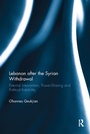
Lebanon after the Syrian Withdrawal
External Intervention, Power-Sharing and Political Instability
1st Edition
Published on 24. October 2016
Book
Hardback
326 pages
978-1-4724-8220-4 (ISBN)
Description
Lebanon experienced serious instability and ethno-national conflict following the Syrian withdrawal in 2005, compounded by the Arab Spring, which led to regional instability and civil war in Iraq and Syria. Why did consociational democracy fail? Was failure inevitable? What impact could external powers play in creating an environment where consociationalism might be successfully implemented?
This book addresses these key questions and provides a comprehensive analysis of how internal and external elite relations influence the chances of a successful regulation of ethno-national conflict through power-sharing. Exploring the roles played by Syria, Qatar, Iran, Saudi Arabia, the United States and France, it argues that external actors in the Lebanese conflict largely determined whether power-sharing was successfully established and shows that the consociational democratic model cannot provide long-term conflict regulation in their absence. The author argues that relationships between internal and external actors determine the prospects for successful conflict regulation and pinpoints the crucial role of the external forces in the creation of power-sharing agreements in Lebanon concluding that future success is dependent on the maintenance of positive, exogenous pressures.
This book will be of key interest to students and scholars studying politics, international relations, and Middle East studies.
This book addresses these key questions and provides a comprehensive analysis of how internal and external elite relations influence the chances of a successful regulation of ethno-national conflict through power-sharing. Exploring the roles played by Syria, Qatar, Iran, Saudi Arabia, the United States and France, it argues that external actors in the Lebanese conflict largely determined whether power-sharing was successfully established and shows that the consociational democratic model cannot provide long-term conflict regulation in their absence. The author argues that relationships between internal and external actors determine the prospects for successful conflict regulation and pinpoints the crucial role of the external forces in the creation of power-sharing agreements in Lebanon concluding that future success is dependent on the maintenance of positive, exogenous pressures.
This book will be of key interest to students and scholars studying politics, international relations, and Middle East studies.
More details
Language
English
Place of publication
London
United Kingdom
Publishing group
Taylor & Francis Ltd
Target group
College/higher education
Dimensions
Height: 234 mm
Width: 156 mm
Weight
640 gr
ISBN-13
978-1-4724-8220-4 (9781472482204)
Copyright in bibliographic data and cover images is held by Nielsen Book Services Limited or by the publishers or by their respective licensors: all rights reserved.
Schweitzer Classification
Other editions
Additional editions
Ohannes Geukjian
Lebanon after the Syrian Withdrawal
External Intervention, Power-Sharing and Political Instability
Book
08/2018
1st Edition
Routledge
€67.11
Shipment within 10-20 days

Ohannes Geukjian
Lebanon after the Syrian Withdrawal
External Intervention, Power-Sharing and Political Instability
E-Book
11/2016
Routledge
€52.99
Available for download

Ohannes Geukjian
Lebanon after the Syrian Withdrawal
External Intervention, Power-Sharing and Political Instability
E-Book
11/2016
Routledge
€52.99
Available for download
Person
Ohannes Geukjian is Assistant Professor in Comparative Politics and Conflict Resolution in the Political Science and Public Administration Department at the American University of Beirut, Lebanon.
Content
1. Introduction
2. Lebanon's Power-Sharing Arrangements
3. The Post-Tai'f Period: Power-Sharing and External Intervention
4. External Intervention and the Syrian Withdrawal in 2005
5. Escalating Tensions, War and External Intervention, 2006
6. Political and Military Escalation and the Doha Agreement, 2007-08
7. Regional and International Dynamics to Stabilize Lebanon, 2009-10
8. The Limits of Lebanon's Consociationalism to Manage Internal Conflict, 2011-12
9. Political Instability and Contradictory Resilience of Lebanese Consociationalism, 2013-16
Conclusion
2. Lebanon's Power-Sharing Arrangements
3. The Post-Tai'f Period: Power-Sharing and External Intervention
4. External Intervention and the Syrian Withdrawal in 2005
5. Escalating Tensions, War and External Intervention, 2006
6. Political and Military Escalation and the Doha Agreement, 2007-08
7. Regional and International Dynamics to Stabilize Lebanon, 2009-10
8. The Limits of Lebanon's Consociationalism to Manage Internal Conflict, 2011-12
9. Political Instability and Contradictory Resilience of Lebanese Consociationalism, 2013-16
Conclusion