

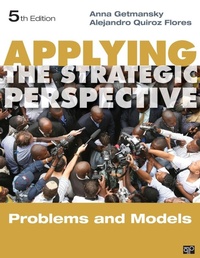
Applying the Strategic Perspective
Problems and Models, Workbook
5th Edition
Published on 9. April 2013
Book
Paperback/Softback
144 pages
978-1-4522-2800-6 (ISBN)
Description
Fully revised and reorganized by Anna Getmansky and Alejandro Quiroz Flores to fit the exciting new edition of Bruce Bueno de Mesquita's Principles of International Politics, this accompanying workbook continues to feature class-tested, user-friendly exercises that walk students through the building blocks of the strategic method, ensuring that even novice students have the opportunity to develop and hone their problem-solving skills and can successfully apply what they have learned in the text. The fifth edition of Applying the Strategic Perspective: Problems and Models, Workbook introduces students to a wide range of problems so that they master basic principles as well as test their capabilities with more challenging material. Easy for students to use, and with perforated pages for turning in assignments.
More details
Series
Edition
5th Revised edition
Language
English
Place of publication
Washington
United States
Publishing group
SAGE Publications Inc
Target group
College/higher education
Edition type
Revised edition
Dimensions
Height: 280 mm
Width: 216 mm
Thickness: 8 mm
Weight
387 gr
ISBN-13
978-1-4522-2800-6 (9781452228006)
Copyright in bibliographic data and cover images is held by Nielsen Book Services Limited or by the publishers or by their respective licensors: all rights reserved.
Schweitzer Classification
Other editions
Previous edition
Book
08/2009
4th Edition
CQ Press
€59.67
Article exhausted; check for reprint
Persons
Anna Getmansky (PhD, New York University) is a postdoctoral fellow in the Department of Social and Decision Sciences and a visiting fellow in the Center for International Relations and Politics at Carnegie Mellon University. Her research interests include conflict and violence, both inter- and intra-state, and her dissertation considered the effects of domestic politics on government protection from insurgency and terrorism, and on the insurgents' and terrorists' choices of targets. At Carnegie Mellon she teaches courses on terrorism and insurgency as well as international conflict, and she previously taught international relations at NYU. Alejandro Quiroz Flores is Lecturer (Assistant Professor) at the Department of Government, University of Essex. He obtained his PhD in Politics at New York University in 2010, where he was also Clinical Assistant Professor. He specializes in Methodology, Political Economy, and International Relations. His work has appeared or is forthcoming at the British Journal of Political Science, International Studies Quarterly, Economics and Politics, Conflict Management and Peace Science, and Foreign Policy Analysis.
Content
Introduction
I. FOUNDATIONS
1. Evaluating Arguments about International Politics
2. The Strategic Perspective: When Foreign Policy Collides With Domestic Politics
3. Tools for Analyzing International Affairs
4. An Introduction to Game Theory
II. WAR
5. Why War: The Big Picture
6. Domestic Theories of War
III. PEACE
7. How International Organizations Work, Or Don't Work
8. Global Warming: Designing a Solution
9. Human Rights, International Law and Norms
10. Free Trade or Fair: The Domestic Politics of Tariffs
11. Globalization: International Winners and Losers
IV. WORLD ORDER
12. Foreign Aid, Poverty and Revolution
13. Can Terrorism be Rational?
14. A Democratic World Order: Peace without Democratization
I. FOUNDATIONS
1. Evaluating Arguments about International Politics
2. The Strategic Perspective: When Foreign Policy Collides With Domestic Politics
3. Tools for Analyzing International Affairs
4. An Introduction to Game Theory
II. WAR
5. Why War: The Big Picture
6. Domestic Theories of War
III. PEACE
7. How International Organizations Work, Or Don't Work
8. Global Warming: Designing a Solution
9. Human Rights, International Law and Norms
10. Free Trade or Fair: The Domestic Politics of Tariffs
11. Globalization: International Winners and Losers
IV. WORLD ORDER
12. Foreign Aid, Poverty and Revolution
13. Can Terrorism be Rational?
14. A Democratic World Order: Peace without Democratization