

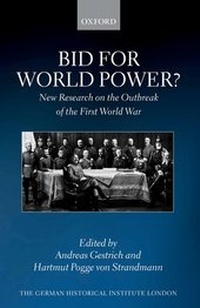
Bid for World Power?
New Research on the Outbreak of the First World War
Published on 11. May 2017
Book
Hardback
476 pages
978-0-19-879241-3 (ISBN)
Description
Over fifty years ago the German historian Fritz Fischer published his famous book Germany's Aims in the First World War. It departed from the established consensus that many countries and governments had a shared responsibility for the outbreak of the war, and put the onus primarily on Germany. The book initiated a fierce international debate which Fischer seems to have mostly won. By the middle of the 1970s many of his controversial positions had become
mainstream. More recent research, however, started to question this consensus again. Many scholars moved away from focusing on the responsibility of individual countries or politicians and turned to the complex structures and mechanisms of the international system. How does this 'systemic' perspective alter the
importance Fischer's findings and interpretations?
This volume brings together the latest research by many of the most prominent historians of the First World War from a wide range of countries and it presents the most important trends and results of recent international scholarship, frequently based on new archival findings unavailable to Fischer at the time. By concentrating on key controversial areas of his arguments and asking which of his assumptions and interpretations still stand the test of new research, the essays in this book provide
an excellent and focused overview of the complex history of the outbreak of the war. However, they also demonstrate that no clear new consensus has emerged so far regarding a comprehensive explanation for what still has to be seen as the 'great seminal catastrophe' of the twentieth century (G. F.
Kennan).
mainstream. More recent research, however, started to question this consensus again. Many scholars moved away from focusing on the responsibility of individual countries or politicians and turned to the complex structures and mechanisms of the international system. How does this 'systemic' perspective alter the
importance Fischer's findings and interpretations?
This volume brings together the latest research by many of the most prominent historians of the First World War from a wide range of countries and it presents the most important trends and results of recent international scholarship, frequently based on new archival findings unavailable to Fischer at the time. By concentrating on key controversial areas of his arguments and asking which of his assumptions and interpretations still stand the test of new research, the essays in this book provide
an excellent and focused overview of the complex history of the outbreak of the war. However, they also demonstrate that no clear new consensus has emerged so far regarding a comprehensive explanation for what still has to be seen as the 'great seminal catastrophe' of the twentieth century (G. F.
Kennan).
More details
Series
Language
English
Place of publication
Oxford
United Kingdom
Target group
College/higher education
Dimensions
Height: 223 mm
Width: 148 mm
Thickness: 33 mm
Weight
674 gr
ISBN-13
978-0-19-879241-3 (9780198792413)
Copyright in bibliographic data and cover images is held by Nielsen Book Services Limited or by the publishers or by their respective licensors: all rights reserved.
Schweitzer Classification
Persons
Andreas Gestrich read history and Latin at the universities of Berlin (FU) and Tuebingen. He is a social historian and has published widely on the history of the family, of poverty, and of the welfare state in modern Germany and Europe. He taught at the universities of Stuttgart, Karlsruhe, and Wuerzburg before he was appointed full Professor of Modern History at Trier University in 1997. Since 2007 he has been Director of the German Historical Institute
London. He has also published on German youth in the First World War, and edited volumes on violence in twentieth-century warfare and on nineteenth- and twentieth-century pacifism.
Hartmut Pogge von Strandmann read history, philosophy, and geography at the universities of Bon, Berlin, and Hamburg, where he worked with Fritz Fischer. In 1962 he won a scholarship to Oxford where he did his doctorate. He taught at the universities of Sussex and Oxford 1970-2005 and was Visiting Professor at universities in America, Namibia, and East Germany.
London. He has also published on German youth in the First World War, and edited volumes on violence in twentieth-century warfare and on nineteenth- and twentieth-century pacifism.
Hartmut Pogge von Strandmann read history, philosophy, and geography at the universities of Bon, Berlin, and Hamburg, where he worked with Fritz Fischer. In 1962 he won a scholarship to Oxford where he did his doctorate. He taught at the universities of Sussex and Oxford 1970-2005 and was Visiting Professor at universities in America, Namibia, and East Germany.
Content
I GERMAN AUSKREISUNG OR EINKREISUNG (SELF-EXCLUSION OR ENCIRCLEMENT)?; II NEW EVIDENCE ON THE DECISIONS FOR WAR: GERMANY AND AUSTRIA-HUNGARY; III NEW EVIDENCE ON THE DECISIONS FOR WAR: FRANCE AND ITALY; IV NEW EVIDENCE ON THE DECISIONS FOR WAR: RUSSIA AND THE BALKANS; V THE WAR AIMS OF THE CENTRAL AND ENTENTE POWERS; VI REVOLUTIONIZING POLICIES IN THE FIRST WORLD WAR; VII CONTINUITIES IN GERMAN HISTORY