

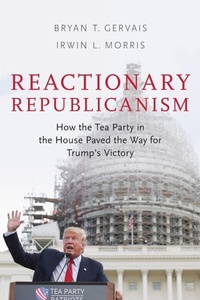
Reactionary Republicanism
How the Tea Party in the House Paved the Way for Trumps Victory
Published on 6. September 2018
Book
Paperback/Softback
328 pages
978-0-19-087075-1 (ISBN)
Description
The shocking election of President Trump spawned myriad analyses and post-mortems, but they consistently underestimate the crucial role of the Tea Party on the GOP and Republican House members specifically. In Reactionary Republicanism, Bryan T. Gervais and Irwin L. Morris develop the most sophisticated analysis to date for gauging the Tea Party's impact upon the U.S. House of Representatives. They employ multiple types of data to illustrate the multi-dimensional impact of the Tea Party movement on members of Congress. Contrary to conventional wisdom, they find that Republicans associated with the Tea Party movement were neither a small minority of the Republican conference nor intransigent backbenchers. Most importantly, the invigoration of racial hostility and social conservatism among Tea Party supporters fostered the growth of reactionary Republicanism. Tea Party legislators, in turn, endeavored to aggravate these feelings of resentment via digital home styles that incorporated uncivil and aversion-inducing rhetoric. Trump fed off of this during his run, and his symbiotic relationship with Tea Party regulars has guided-and seems destined to-the trajectory of his administration.
Reviews / Votes
Bryan T. Gervais and Irwin L. Morris develop the most sophisticated analysis to date for gauging the Tea Party's impact upon the U.S. House of Representatives. They employ multiple types of data to illustrate the multi-dimensional impact of the Tea Party movement on members of Congress. * Wordtrade.com * More importantly - at least for those of us interested in clues about the future direction of American politics - they suggest that there is still much to be gained from continued examination of the 2016 presidential election. Reactionary Republicanism is an important contribution to that effort. * Ruth Bloch Rubin, University of Chicago, Congress & the Presidency *More details
Language
English
Place of publication
New York
United States
Target group
Professional and scholarly
Illustrations
35 black and white line drawings
Dimensions
Height: 234 mm
Width: 156 mm
Thickness: 18 mm
Weight
503 gr
ISBN-13
978-0-19-087075-1 (9780190870751)
Copyright in bibliographic data and cover images is held by Nielsen Book Services Limited or by the publishers or by their respective licensors: all rights reserved.
Schweitzer Classification
Other editions
Additional editions
Bryan T. Gervais | Irwin L. Morris
Reactionary Republicanism
How the Tea Party in the House Paved the Way for Trumps Victory
Book
09/2018
Oxford University Press Inc
€185.80
Shipment within 15-20 days
Bryan T. Gervais | Irwin L. Morris
Reactionary Republicanism
How the Tea Party in the House Paved the Way for Trump's Victory
E-Book
07/2018
OUP eBook
€18.99
Available for download
Bryan T. Gervais | Irwin L. Morris
Reactionary Republicanism
How the Tea Party in the House Paved the Way for Trump's Victory
E-Book
07/2018
OUP eBook
€14.49
Available for download
Persons
Irwin L. Morris is Professor and Chair of the Department of Government and Politics at the University of Maryland, College Park. His research focuses on a variety of topics in the fields of American politics, including political economy, public policymaking, race and ethnic politics, and Southern politics. Dr. Morris is the author of several books, including The American Presidency: An Analytical Approach (Cambridge 2010)and The Rational Southerner: Black Mobilization, Republican Growth, and the Partisan Transformation of the American South (coauthored with M.V. Hill III and Quentin Kidd, Oxford 2012). Professor Morris has also published many articles in top ranked journals such as Legislative Studies Quarterly, Electoral Studies, American Journal of Political Science; Public Choice, American Politics Research, Social Science Quarterly, and Political Behavior.
Bryan T. Gervais is an Assistant Professor in the Department of Political Science & Geography at the University of Texas at San Antonio (UTSA). In addition to his work on the Tea Party in Congress, his research focuses on the effects of exposure to political incivility and the connection between uncivil discourse and anti-deliberative attitudes. He is also the coordinator of the Digital Politics Studio at UTSA, whose mission it is to archive and analyze political elites' social media posts. Dr. Gervais' journal publications have appeared in Political Communication; Politics, Groups, and Identities; PS: Political Science & Politics; Social Science Quarterly; the International Journal of Public Opinion Research; and the Journal of Information Technology & Politics.
Bryan T. Gervais is an Assistant Professor in the Department of Political Science & Geography at the University of Texas at San Antonio (UTSA). In addition to his work on the Tea Party in Congress, his research focuses on the effects of exposure to political incivility and the connection between uncivil discourse and anti-deliberative attitudes. He is also the coordinator of the Digital Politics Studio at UTSA, whose mission it is to archive and analyze political elites' social media posts. Dr. Gervais' journal publications have appeared in Political Communication; Politics, Groups, and Identities; PS: Political Science & Politics; Social Science Quarterly; the International Journal of Public Opinion Research; and the Journal of Information Technology & Politics.
Content
Chapter 1 Resentful Republicanism: How the Tea Party in the House Paved the Way for Trump's Victory
Chapter 2 Tea Party to Trump: Representing Resentful Republicans
Chapter 3 The Tea Party in the House of Representatives
Chapter 4 The Representational Foundations of Tea Party Association in the House
Chapter 5 Tea Party-ness and Roll Call Voting in the House
Chapter 6 Tea Party-ness, Bill Sponsorship, and Legislative Effectiveness
Chapter 7 Tea Party-ness and Public Presentation: Aversion-Inducing Rhetoric and Anti-Deliberative Behavior
Chapter 8 Civility and Tea Party Rhetoric: The Bridge to Trumpian Bluster?
Chapter 9 Tea Partiers on the National Stage: The 2012 and 2016 Elections
Chapter 10 Tea Party-ness, Trump, and the Future of the Republican Party
Chapter 2 Tea Party to Trump: Representing Resentful Republicans
Chapter 3 The Tea Party in the House of Representatives
Chapter 4 The Representational Foundations of Tea Party Association in the House
Chapter 5 Tea Party-ness and Roll Call Voting in the House
Chapter 6 Tea Party-ness, Bill Sponsorship, and Legislative Effectiveness
Chapter 7 Tea Party-ness and Public Presentation: Aversion-Inducing Rhetoric and Anti-Deliberative Behavior
Chapter 8 Civility and Tea Party Rhetoric: The Bridge to Trumpian Bluster?
Chapter 9 Tea Partiers on the National Stage: The 2012 and 2016 Elections
Chapter 10 Tea Party-ness, Trump, and the Future of the Republican Party