

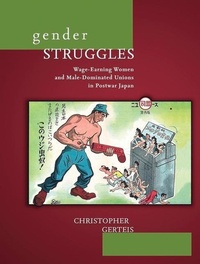
Gender Struggles
Wage-Earning Women and Male-Dominated Unions in Postwar Japan
Published on 1. February 2010
Book
Hardback
275 pages
978-0-674-03569-0 (ISBN)
Description
In the formative years of the Japanese labor movement after World War II, the socialist unions affiliated with the General Council of Trade Unions (the labor federation known colloquially as Sohyo) formally endorsed the principles of women's equality in the workforce and put in place measures to promote women's active participation in union activities. However, union leaders did not embrace the legal framework for gender equality mandated by their American occupiers; rather, they pressured thousands of women labor activists to assume supportive roles that privileged a male-centered social agenda. By the late 1950s, even Japan's radical socialist unions had reestablished the primacy of conservative gender norms, channeling women's labor activism to support political campaigns that advantaged a male-headed household and that relegated women's wage-earning value to the periphery of the household economy.
By showing how unions raised the wages of male workers in part by transforming working-class women into middle-class housewives, Christopher Gerteis demonstrates that organized labor's discourse on womanhood not only undermined women's status within the labor movement but also prevented unions from linking with the emerging woman-led, neighborhood-centered organizations that typified social movements in the 1960s-a misstep that contributed to the decline of the socialist labor movement in subsequent decades.
By showing how unions raised the wages of male workers in part by transforming working-class women into middle-class housewives, Christopher Gerteis demonstrates that organized labor's discourse on womanhood not only undermined women's status within the labor movement but also prevented unions from linking with the emerging woman-led, neighborhood-centered organizations that typified social movements in the 1960s-a misstep that contributed to the decline of the socialist labor movement in subsequent decades.
More details
Series
Language
English
Place of publication
Cambridge
United States
Target group
Professional and scholarly
Product notice
sewn/stitched
Cloth over boards
With dust jacket
Illustrations
15 halftones
Dimensions
Height: 238 mm
Width: 161 mm
Thickness: 27 mm
Weight
553 gr
ISBN-13
978-0-674-03569-0 (9780674035690)
Copyright in bibliographic data and cover images is held by Nielsen Book Services Limited or by the publishers or by their respective licensors: all rights reserved.
Schweitzer Classification
Other editions
Additional editions
E-Book
11/2024
1st Edition
Harvard University Press
€89.99
Available for download
Person
Christopher Gerteis is Senior Lecturer in the History of Contemporary Japan in the School of Oriental and African Studies (SOAS), University of London.
Content
Figures and Tables Introduction 1. Women and Unions in Occupied Japan 2. The Erotic and the Vulgar 3. Wage Struggles and Struggle Politics 4. Teachers and Coal Wives 5. Family Unions 6. Federation Wives Conclusion Bibliography Index