

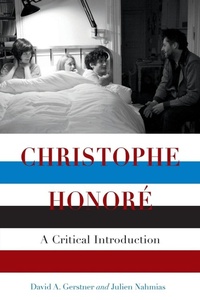
Christophe Honore
A Critical Introduction
Published on 30. December 2015
Book
Paperback/Softback
320 pages
978-0-8143-3863-6 (ISBN)
Description
French filmmaker Christophe Honore challenges audiences with complex cinematic form, intricate narrative structures, and aesthetically dynamic filmmaking. But the limited release of his films outside of Europe has left him largely unknown to U.S. audiences. In Christophe Honore: A Critical Introduction, authors David A. Gerstner and Julien Nahmias invite English-speaking scholars and cineastes to explore Honore's three most recognized films, Dans Paris (2006), Les Chansons d'amour (2007), and La Belle personne (2008)-"the trilogy." Gerstner and Nahmias analyze Honore's filmmaking as the work of a queer auteur whose cinematic engagement with questions of family, death, and sexual desire represent new ground for queer theory.
Considering each of the trilogy films in turn, the authors take a close look at Honore's cinematic technique and how it engages with France's contemporary cultural landscape. With careful attention to the complexity of Honore's work, they consider critically contested issues such as the filmmaker's cinematic strategies for addressing AIDS, the depth of his LGBTQ politics, his representations of death and sexual desire, and the connections between his films and the New Wave. Anchored by a comprehensive interview with the director, the authors incorporate classical and contemporary film theories to offer a range of cinematic interventions for thinking queerly about the noted film author.
Christophe Honore: A Critical Introduction reconceptualizes the relationship between film theory and queer theory by moving beyond predominant literary and linguistic models, focusing instead on cinematic technique. Students and teachers of queer film will appreciate this thought-provoking volume.
Considering each of the trilogy films in turn, the authors take a close look at Honore's cinematic technique and how it engages with France's contemporary cultural landscape. With careful attention to the complexity of Honore's work, they consider critically contested issues such as the filmmaker's cinematic strategies for addressing AIDS, the depth of his LGBTQ politics, his representations of death and sexual desire, and the connections between his films and the New Wave. Anchored by a comprehensive interview with the director, the authors incorporate classical and contemporary film theories to offer a range of cinematic interventions for thinking queerly about the noted film author.
Christophe Honore: A Critical Introduction reconceptualizes the relationship between film theory and queer theory by moving beyond predominant literary and linguistic models, focusing instead on cinematic technique. Students and teachers of queer film will appreciate this thought-provoking volume.
More details
Series
Language
English
Place of publication
Detroit, MI
United States
Target group
College/higher education
Illustrations
118 illustrations
Dimensions
Height: 229 mm
Width: 152 mm
Thickness: 15 mm
Weight
396 gr
ISBN-13
978-0-8143-3863-6 (9780814338636)
Copyright in bibliographic data and cover images is held by Nielsen Book Services Limited or by the publishers or by their respective licensors: all rights reserved.
Schweitzer Classification
Persons
David A. Gerstner is professor of cinema studies at the City University of New York, College of Staten Island and Graduate Center. His books include Queer Pollen: White Seduction, Black Male Homosexuality, and the Cinematic and Authorship and Film (coedited with Janet Staiger).
Julien Nahmias is a psychiatrist and works at the Institut Paul Sivadon-Association L'Elan Retrouve, Paris, France. He has written a medical thesis about the cinematic representation of the psychiatrist and has given lectures on the topic of psychiatry and cinema (University of Paris V).
Julien Nahmias is a psychiatrist and works at the Institut Paul Sivadon-Association L'Elan Retrouve, Paris, France. He has written a medical thesis about the cinematic representation of the psychiatrist and has given lectures on the topic of psychiatry and cinema (University of Paris V).