

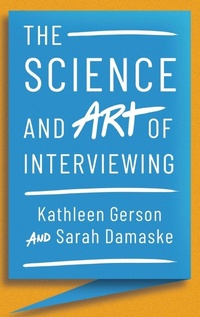
The Science and Art of Interviewing
Published on 10. December 2020
Book
Hardback
292 pages
978-0-19-932428-6 (ISBN)
Description
Qualitative interviewing is among the most widely used methods in the social sciences, but it is arguably the least understood. In The Science and Art of Interviewing, Kathleen Gerson and Sarah Damaske offer clear, theoretically informed and empirically rich strategies for conducting interview studies. They present both a rationale and guide to the science-and art-of in-depth interviewing to take readers through all the steps in the research process, from the initial stage of formulating a question to the final one of presenting the results. Gerson and Damaske show readers how to develop a research design for interviewing, decide on and find an appropriate sample, construct a questionnaire, conduct probing interviews, and analyze the data they collect. At each stage, they also provide practical tips about how to address the ever-present, but rarely discussed challenges that qualitative researchers routinely encounter, particularly emphasizing the relationship between conducting well-crafted research and building powerful social theories. With an engaging, accessible style, The Science and Art of Interviewing targets a wide range of audiences, from upper-level undergraduates and graduate methods courses to students embarking on their dissertations to seasoned researchers at all stages of their careers.
Reviews / Votes
All in all, The Science and Art of Interviewing has two substantial achievements. First, it makes a compelling case for interviewing. It convinces us that it is a powerful tool to uncover rarely observed or even taken-for-granted phenomena given that interviews facilitate 'opening the black box' of individual or organisational processes that are otherwise difficult to observe. Metaphorically speaking, they allow us to get into the kitchen where the dish is being cooked and talk to many different actors that take part in the process. Through this, we get to know key actors, interact with them and uncover processes through their experiences. Second, as interviewing is a laborious, demanding task and process, from identifying our research puzzles to reporting our findings, this book guides us through constructing the road to the end of the research tunnel where enlightenment may dazzle us. * LSE Review of Books * Recent debates around interviewing have raised awareness about the centrality of this method to the social sciences, and about how to make sense of the data. This new book by master interviewers Kathleen Gerson and Sarah Damaske is destined to become the new 'go-to' for learning and teaching about best practices, tricks of the trade, ad recent controversies. It is sure to become the Learning from Strangers for the new generations of scholars. I recommend it wholeheartedly! * Michele Lamont, Harvard University, and Former president of the American Sociological Association * Building on Gerson and Damaske's own highly esteemed interview-based work as well as on that of numerous other social researchers, The Science and Art of Interviewing explores the intellectual, ethical, and practical mechanics of 'depth interviewing.' Stressing both scientific rigor and artistic creativity, it walks the reader through the various steps of the interview-based research process - from sampling and recruiting, through listening(!) and probing, to adapting to surprises and contradictions - offering future researchers the best possible advice on how to capture people's 'voice thereby realizing the very goal of 'verstehen,' interpretive sociology. * Eviatar Zerubavel, author of Generally Speaking and The Clockwork Muse * In this lively and multi-faceted book, Gerson and Damaske provide a useful and comprehensive guide to in-depth interview research - a fresh update to classic handbooks by Glaser and Strauss, Merton, Weiss, and others. Chock-full of examples from the works of contemporary scholars, The Science and Art of Interviewing will prove a valuable reference to researchers across the social sciences. * Mario Small, Grafstein Family Professor of Sociology, Harvard University *More details
Language
English
Place of publication
New York
United States
Target group
Professional and scholarly
Dimensions
Height: 240 mm
Width: 161 mm
Thickness: 20 mm
Weight
605 gr
ISBN-13
978-0-19-932428-6 (9780199324286)
Copyright in bibliographic data and cover images is held by Nielsen Book Services Limited or by the publishers or by their respective licensors: all rights reserved.
Schweitzer Classification
Other editions
Additional editions
Kathleen Gerson | Sarah Damaske
The Science and Art of Interviewing
Book
12/2020
Oxford University Press Inc
€34.00
Shipment within 15-20 days
Kathleen Gerson | Sarah Damaske
The Science and Art of Interviewing
E-Book
10/2020
1st Edition
OUP eBook
€16.49
Available for download
Kathleen Gerson | Sarah Damaske
The Science and Art of Interviewing
E-Book
10/2020
1st Edition
OUP eBook
€16.49
Available for download
Persons
Kathleen Gerson is Professor of Sociology and Collegiate Professor of Arts and Science at New York University. She is the author of The Unfinished Revolution: Coming of Age in a New Era of Gender, Work, and Family (Oxford, 2011) and The Time Divide: Work, Family, and Gender Inequality (with Jerry A. Jacobs, 2004).
Sarah Damaske is Associate Professor of Sociology and Labor & Employment Relations at The Pennsylvania State University. She is the author of For the Family? How Class and Gender Shape Women's Work (Oxford, 2011).
Sarah Damaske is Associate Professor of Sociology and Labor & Employment Relations at The Pennsylvania State University. She is the author of For the Family? How Class and Gender Shape Women's Work (Oxford, 2011).
Author
Professor of Sociology and Collegiate Professor of Arts and ScienceProfessor of Sociology and Collegiate Professor of Arts and Science, New York University
Associate Professor of Sociology and Labor & Employment RelationsAssociate Professor of Sociology and Labor & Employment Relations, The Pennsylvania State University
Content
Acknowledgments
Chapter 1: Depth Interviewing as Science and Art
Chapter 2: Getting Started: Pinning Down the Questions and Research Design
Chapter 3: Interviews with Whom? When a Big Question Meets a Small Sample
Chapter 4: Constructing an Interview Guide: Creating a Flexible Structure
Chapter 5: Conducting Interviews: Seeking Discoveries That Matter
Chapter 6: Analyzing Interviews: Making Sense of Complex Material
Chapter 7: Pulling It All Together: Telling Your Story and Making Your Case
Appendix A: Examples of Recruitment Documents and Procedures
Appendix B: Examples of Consent Forms
Appendix C: Interview Schedules
Notes
References
Index
Chapter 1: Depth Interviewing as Science and Art
Chapter 2: Getting Started: Pinning Down the Questions and Research Design
Chapter 3: Interviews with Whom? When a Big Question Meets a Small Sample
Chapter 4: Constructing an Interview Guide: Creating a Flexible Structure
Chapter 5: Conducting Interviews: Seeking Discoveries That Matter
Chapter 6: Analyzing Interviews: Making Sense of Complex Material
Chapter 7: Pulling It All Together: Telling Your Story and Making Your Case
Appendix A: Examples of Recruitment Documents and Procedures
Appendix B: Examples of Consent Forms
Appendix C: Interview Schedules
Notes
References
Index