

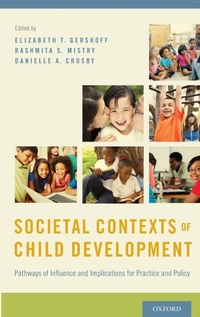
Societal Contexts of Child Development
Pathways of Influence and Implications for Practice and Policy
Published on 17. October 2013
Book
Hardback
272 pages
978-0-19-994391-3 (ISBN)
Description
In the last half century, developmental scientists have become increasingly interested in studying contexts beyond the home environment that contribute to children's growth and development, including physical contexts such as schools and neighborhoods, as well as social contexts such as poverty. During this same period, a number of social trends have significantly impacted children's daily lives, including shifts in gender roles and expectations, the emergence of an early care and education system, and the proliferation of media technology.
Societal Contexts of Child Development provides comprehensive literature reviews for six broad contextual influences on children's development that have emerged as key areas of inquiry in contemporary society - gender, child care, culture and ethnicity, poverty, schools and neighborhoods, and media. In the spirit of applied developmental science, this book considers these six contextual domains in a series of two linked chapters written by experts in the interdisciplinary field of developmental science. The first chapter in each section is organized as a review of basic research relevant to a particular context, including a discussion of prominent theoretical and methodological issues. The second chapter in each section then addresses the same context from an applied research perspective, examining and documenting how research has been, can be, or should be used to enhance the everyday lives and developmental outcomes of children and their families through interventions and/or social policies. The book concludes with a chapter specifically dedicated to making connections between research and practice and an epilogue that situates the book's chapters within the field's study of contexts. Societal Contexts of Child Development will appeal to a broad audience of scholars, students, practitioners, and policymakers from the disciplines of psychology, sociology, economics, human development, and public policy.
Societal Contexts of Child Development provides comprehensive literature reviews for six broad contextual influences on children's development that have emerged as key areas of inquiry in contemporary society - gender, child care, culture and ethnicity, poverty, schools and neighborhoods, and media. In the spirit of applied developmental science, this book considers these six contextual domains in a series of two linked chapters written by experts in the interdisciplinary field of developmental science. The first chapter in each section is organized as a review of basic research relevant to a particular context, including a discussion of prominent theoretical and methodological issues. The second chapter in each section then addresses the same context from an applied research perspective, examining and documenting how research has been, can be, or should be used to enhance the everyday lives and developmental outcomes of children and their families through interventions and/or social policies. The book concludes with a chapter specifically dedicated to making connections between research and practice and an epilogue that situates the book's chapters within the field's study of contexts. Societal Contexts of Child Development will appeal to a broad audience of scholars, students, practitioners, and policymakers from the disciplines of psychology, sociology, economics, human development, and public policy.
Reviews / Votes
I am widely recommending this excellent book. * Judith Tomey-Purta, University of Maryland, Journal of Applied Developmental Psychology Book Review *More details
Language
English
Place of publication
New York
United States
Target group
College/higher education
Professional and scholarly
Scholars, students, practitioners, and policymakers from the disciplines of psychology, sociology, economics, human development, and public policy.
Dimensions
Height: 240 mm
Width: 161 mm
Thickness: 19 mm
Weight
567 gr
ISBN-13
978-0-19-994391-3 (9780199943913)
Copyright in bibliographic data and cover images is held by Nielsen Book Services Limited or by the publishers or by their respective licensors: all rights reserved.
Schweitzer Classification
Other editions
Additional editions
Elizabeth T. Gershoff | Rashmita S. Mistry | Danielle A. Crosby
Societal Contexts of Child Development
Pathways of Influence and Implications for Practice and Policy
E-Book
09/2013
1st Edition
OUP eBook
€56.49
Available for download
Persons
Elizabeth T. Gershoff is Associate Professor of Human Development and Family Sciences at the University of Texas, Austin. Dr. Gershoff studies the impacts of parenting, poverty, community violence, neighborhoods, and school contexts on child and youth development over time.
Rashmita S. Mistry is Associate Professor of Education at the University of California, Los Angeles. Dr. Mistry's research examines the consequences of poverty and economic stress on family and child well-being, children's reasoning about social class and inequality, and the design and evaluation of elementary and middle school curricula focused on social and economic inequality.
Danielle A. Crosby is Associate Professor of Human Development and Family Studies at the University of North Carolina, Greensboro. Dr. Crosby studies the environments, programs, and policies that impact young children's development in the context of social and economic disadvantage.
Rashmita S. Mistry is Associate Professor of Education at the University of California, Los Angeles. Dr. Mistry's research examines the consequences of poverty and economic stress on family and child well-being, children's reasoning about social class and inequality, and the design and evaluation of elementary and middle school curricula focused on social and economic inequality.
Danielle A. Crosby is Associate Professor of Human Development and Family Studies at the University of North Carolina, Greensboro. Dr. Crosby studies the environments, programs, and policies that impact young children's development in the context of social and economic disadvantage.
Editor
Associate Professor of Human Development and Family SciencesAssociate Professor of Human Development and Family Sciences, University of Texas, Austin
Associate Professor of EducationAssociate Professor of Education, University of California, Los Angeles
Associate Professor of Human Development and Family StudiesAssociate Professor of Human Development and Family Studies, University of North Carolina, Greensboro
Content
Acknowledgments ; About the Editors ; Contributors ; Introduction: Contextualizing Child Development ; Elizabeth T. Gershoff, Rashmita S. Mistry, and Danielle A. Crosby ; Section I: Gender Roles as a Restrictive Context ; 1. Gender Development: From Universality to Individuality ; Lynn S. Liben, Rebecca S. Bigler, and Lacey J. Hilliard ; 2. Gender and Achievement Choices ; Jacquelynne S. Eccles ; Section II: Child Care: An Early Contextual Opportunity ; 3. Women's Work and Child Care: Perspectives and Prospects ; Marion O'Brien, Jennifer M. Weaver, Margaret Burchinal, Alison Clarke-Stewart, and Deborah Lowe Vandell ; 4. Issues of Quality and Access Emerging from the Changing Early Childhood Policy Context: Towards the Next Generation of Research ; Martha Zaslow, Danielle A. Crosby, and Nina Smith ; Section III: Cultural Contexts and Immigrant Families ; 5. An Ecological Approach to Understanding Immigrant Child and Adolescent Developmental Competencies ; Amy K. Marks, Camila Godoy, and Cynthia Garcia Coll ; 6. Beyond Families and Schools: Future Directions in Practice and Policy for Children in Immigrant Families ; Ana Maria Nieto and Hirokazu Yoshikawa ; Section IV: Child Poverty as a Limiting Context of Development ; 7. Poverty and Children's Development: Familial Processes as Mediating Influences ; Vonnie McLoyd, Rashmita S. Mistry, and Cecily R. Hardaway ; 8. The World Isn't Linear or Additive or Decontextualized: Pluralism and Mixed Methods in Understanding the Effects of Anti-Poverty Programs on Children and Parenting ; Thomas S. Weisner and Greg J. Duncan ; Section V: Schools and Neighborhoods: The Microcosms of Childhood ; 9. Neighborhood and School Contexts in the Lives of Children ; Elizabeth T. Gershoff and Aprile D. Benner ; 10. School- and Neighborhood-Based Interventions to Improve the Lives of Disadvantaged Children ; Robert Crosnoe and Tama Leventhal ; Section VI: Development in the Context of Omnipresent Media ; 11. Children and Electronic Media ; Sandra L. Calvert and Ellen A. Wartella ; 12. Language, Literacy and Media: What's the Word on Sesame Street? ; Rosemarie T. Truglio and Jennifer A. Kotler ; Section VII: Programs and Policies as Contextual Opportunities for Improving Children's Lives ; 13. Connecting Research and Practice ; Robert C. Granger, Vivian Tseng, and Brian L. Wilcox ; Epilogue: The Ecology of Human Development in the Twenty-First Century ; Aletha C. Huston ; Index