

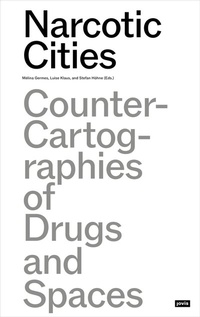
Narcotic Cities
Counter-Cartographies of Drugs and Spaces
1st Edition
Published on 18. September 2023
Book
Paperback/Softback
320 pages
978-3-98612-000-9 (ISBN)
Description
With debates about the decriminalization of drugs on the rise, an exploration of drug maps is long overdue.
Narcotic Cities
traces the complex entanglements of drugs, institutions, activities, and the way they are represented with spaces and places, shedding new light on our cities. Through the medium of graphic essays, this book explores urban stories, as well as the histories, policies, communities, digital spaces, and pleasures associated with drugs, gathering together more than forty contributors working with Geographic Information Systems, hand drawings, satellite images, and memories. By experimenting with different graphic languages, this volume assembles a rich mosaic of multi-scalar urban perspectives on drugs, sharing little-known knowledge as well as reflections on the pitfalls, omissions, and failures of drug cartographies.
More details
Language
English
Place of publication
Berlin
Germany
Target group
Professional and scholarly
US School Grade: College Graduate Student
Edition type
New edition
Product notice
Klappenbroschur
Illustrations
65 farbige Abbildungen
65 col. ill.
Dimensions
Height: 29.7 cm
Width: 18.7 cm
Weight
840 gr
ISBN-13
978-3-98612-000-9 (9783986120009)
Schweitzer Classification
Other editions
Additional editions
E-Book
09/2023
1st Edition
JOVIS
€39.00
Available for download
Persons
Mélina Germes ist Sozial- und Stadtgeografin und lebt in Bordeaux und Berlin. Sie ist wissenschaftliche Mitarbeiterin am CNRS (PASSAGES, Centre Émile Durkheim, Centre Marc Bloch). Neben ihrer Arbeit im Bereich der kritischen Kartografie befasst sie sich mit Themen wie Stadtpolitik in Frankreich und Deutschland sowie Behindertenfeindlichkeit und Barrierefreiheit. Stefan Höhne ist Stadt- und Kulturhistoriker mit Sitz in Berlin und Essen. Sein Forschungsschwerpunkt am Kulturwissenschaftlichen Institut (KWI) Essen liegt auf der Verflechtung von Technologie, Gouvernementalität und Alltagsleben in Europa und Nordamerika im 20. und 21. Jahrhundert. Luise Klaus ist Sozialgeografin und promoviert derzeit an der Goethe-Universität Frankfurt am Main. Sie untersucht den Alltag von marginalisierten Drogenkonsument*innen in deutschen Städten mithilfe von Emotional-Mapping-Interviews. Ihre Forschung konzentriert sich auf die Wechselwirkungen von Stadtpolitik, Kriminalisierung, Polizei- und Sozialarbeit.