

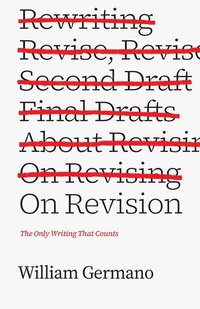
On Revision
The Only Writing That Counts
Published on 5. November 2021
Book
Paperback/Softback
208 pages
978-0-226-41065-4 (ISBN)
Description
So you've just finished writing something? Congratulations! Now revise it. Because revision is about getting from good to better, and it's only finished when you decide to stop. But where to begin? In On Revision, William Germano shows authors how to take on the most critical stage of writing anything: rewriting it.
For more than twenty years, thousands of writers have turned to Germano for his insider's take on navigating the world of publishing. A professor, author, and veteran of the book industry, Germano knows what editors want and what writers need to know: Revising is not just correcting typos. Revising is about listening and seeing again. Revising is a rethinking of the principles from the ground up to understand why the writer is doing something, why they're going somewhere, and why they're taking the reader along with them.
On Revision steps back to take in the big picture, showing authors how to hear their own writing voice and how to reread their work as if they didn't write it. On Revision will show you how to know when your writing is actually done-and, until it is, what you need to do to get it there.
For more than twenty years, thousands of writers have turned to Germano for his insider's take on navigating the world of publishing. A professor, author, and veteran of the book industry, Germano knows what editors want and what writers need to know: Revising is not just correcting typos. Revising is about listening and seeing again. Revising is a rethinking of the principles from the ground up to understand why the writer is doing something, why they're going somewhere, and why they're taking the reader along with them.
On Revision steps back to take in the big picture, showing authors how to hear their own writing voice and how to reread their work as if they didn't write it. On Revision will show you how to know when your writing is actually done-and, until it is, what you need to do to get it there.
Reviews / Votes
"All writers are, or should be, re-writers, Germano insists, and rewriting begins with rereading, with "listening" to what your text wants to say. The advice compiled in this revelatory, generous book--tips on discovering or rediscovering your argument, on organizing its archive, on helping your readers identify its takeaways--will be useful for everyone from seasoned authors to dissertating graduate students. Best of all, interspersed with the practical counsel, On Revision contains a moving vindication of the importance and the pleasure of scholarly writing and reading."--Deidre Lynch, author of Loving Literature: A Cultural History
More details
Series
Language
English
Place of publication
Chicago
United States
Publishing group
The University of Chicago Press
Product notice
Paperback (trade)
Unsewn / adhesive bound
Dimensions
Height: 216 mm
Width: 142 mm
Thickness: 20 mm
Weight
289 gr
ISBN-13
978-0-226-41065-4 (9780226410654)
Copyright in bibliographic data and cover images is held by Nielsen Book Services Limited or by the publishers or by their respective licensors: all rights reserved.
Schweitzer Classification
Other editions
Additional editions
E-Book
11/2021
University of Chicago Press
€24.49
Available for download
Person
William Germano is the author of several books, including Getting it Published: A Guide for Scholars and Anyone Else Serious about Serious Books and From Dissertation to Book, both also published by the University of Chicago Press. His most recent book, co-written with Kit Nicholls, is Syllabus: The Remarkable, Unremarkable Document That Changes Everything. He has served as editor-in-chief at Columbia University Press, vice president and publishing director at Routledge, and dean of the faculty of humanities and social sciences at the Cooper Union for the Advancement of Science and Art, where he is now professor of English literature.
Content
1 Press start
2 Good to better
3 Know what you've got
4 Look for an argument
5 Build an architecture
6 Remember the audience
7 What writing wants
Acknowledgments
A very short bibliography
Index
2 Good to better
3 Know what you've got
4 Look for an argument
5 Build an architecture
6 Remember the audience
7 What writing wants
Acknowledgments
A very short bibliography
Index