

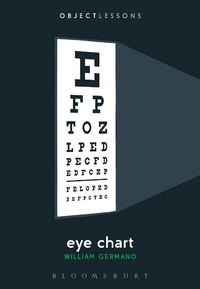
Eye Chart
Published on 7. September 2017
Book
Paperback/Softback
192 pages
978-1-5013-1234-2 (ISBN)
Description
Object Lessons is a series of short, beautifully designed books about the hidden lives of ordinary things.
Desert nomads tested their vision by distinguishing a pair of stars. But we have since created more disquieting ways to test the strength of the eyes.
Reading the eye chart is an exercise in failure, since it only gets interesting when you cannot read any further. It is the opposite of interpretative reading, like one does with literature. When you have finished reading an eye chart, what exactly have you even read? From a Spanish cleric's Renaissance guide to testing vision, to a Dutch ophthalmologist's innovation in optical tech, to the witty subversion of the eye chart in advertising and popular culture, William Germano's Eye Chart lets people see the eye chart at last.
Object Lessons is published in partnership with an essay series in The Atlantic.
Desert nomads tested their vision by distinguishing a pair of stars. But we have since created more disquieting ways to test the strength of the eyes.
Reading the eye chart is an exercise in failure, since it only gets interesting when you cannot read any further. It is the opposite of interpretative reading, like one does with literature. When you have finished reading an eye chart, what exactly have you even read? From a Spanish cleric's Renaissance guide to testing vision, to a Dutch ophthalmologist's innovation in optical tech, to the witty subversion of the eye chart in advertising and popular culture, William Germano's Eye Chart lets people see the eye chart at last.
Object Lessons is published in partnership with an essay series in The Atlantic.
Reviews / Votes
Germano's style is conversational yet also deeply informative. He manages to turn font design and typography into a fascinating history about the diagnosis of vision. * Times Higher Education * I can see people in the ocular industry finding much that's new on these pages, and as for the average reader ... they have a veritable bijou box of delights ... It's a great little read about something you wouldn't expect to find fun in the exploration of. * The Bookbag * William Germano's Eye Chart is a surprisingly compelling and at times quite poetic examination of this now ubiquitous technological innovation ... Germano begins his exploration of the eye chart with a simple question: "What can you see?" Soon, though, the reader understands that things are more complex than simply providing a concrete response to a clear question. It's not just about identifying objects near and far. It's also about why we see, when we see, how clearly we see, and what we understand about the things we see ... If this medical innovation has ever been intimidating, or a measure of increasing failure as you slip into your final years, Germano's Eye Chart should be a graceful reminder that the art of vision has many levels. * PopMatters * As one who has failed countless eye tests, I had no idea that my condition was metaphysical. Then I read William Germano's comprehensive and witty history of this amazing object. There it is, at the crossroads of vision and blindness, clarity and obscurity, scientific objectivity and subjectivity. Germano shows that the humble eye chart is everywhere, a central object, image, and text in the world of visual culture. His book is a feast of learning, precision, and humor. * W. J. T. Mitchell, Professor of English and Art History, University of Chicago, USA, and author of What Do Pictures Want? *More details
Series
Language
English
Place of publication
New York
United States
Publishing group
Bloomsbury Publishing Plc
Product notice
Paperback (trade)
Unsewn / adhesive bound
Illustrations
38 b/w illustrations
Dimensions
Height: 165 mm
Width: 118 mm
Thickness: 20 mm
Weight
175 gr
ISBN-13
978-1-5013-1234-2 (9781501312342)
Copyright in bibliographic data and cover images is held by Nielsen Book Services Limited or by the publishers or by their respective licensors: all rights reserved.
Schweitzer Classification
Other editions
Person
William Germano is Professor of English Literature at The Cooper Union for the Advancement of Science and Art, USA. His previous publications include The Tales of Hoffmann (2013) and Getting It Published: A Guide for Scholars and Anyone Else Serious about Serious Books (3rd edition, 2016). He writes a biweekly language blog for the Chronicle of Higher Education.
Content
List of Figures
Acknowledgments
1. What can you see?
2. Reading stars, reading stones
3. How to choose eyeglasses (circa 1623)
4. The persistence of memory
5. Eleven lines, nine letters
6. Reading close up
7. Looking for trouble
8. Eye terror
9. Eye poetry
10. Optical allusions
11. The bottom line
Notes
Index
Acknowledgments
1. What can you see?
2. Reading stars, reading stones
3. How to choose eyeglasses (circa 1623)
4. The persistence of memory
5. Eleven lines, nine letters
6. Reading close up
7. Looking for trouble
8. Eye terror
9. Eye poetry
10. Optical allusions
11. The bottom line
Notes
Index