

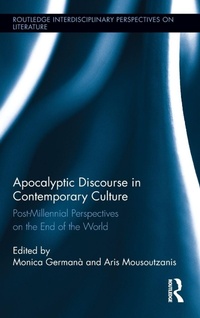
Apocalyptic Discourse in Contemporary Culture
Post-Millennial Perspectives on the End of the World
1st Edition
Published on 25. July 2014
Book
Hardback
260 pages
978-0-415-71258-3 (ISBN)
Description
This interdisciplinary collection of essays focuses on critical and theoretical responses to the apocalypse of the late twentieth- and early twenty-first-century cultural production. Examining the ways in which apocalyptic discourses have had an impact on how we read the world's globalised space, the traumatic burden of history, and the mutual relationship between language and eschatological belief, fifteen original essays by a group of internationally established and emerging critics reflect on the apocalypse, its past tradition, pervasive present and future legacy.
The collection seeks to offer a new reading of the apocalypse, understood as a complex - and, frequently, paradoxical - paradigm of (contemporary) Western culture. The majority of published collections on the subject have been published prior to the year 2000 and, in their majority of cases, locate the apocalypse in the future and envision it as something imminent. This collection offers a post-millennial perspective that perceives "the end" as immanent and, simultaneously, rooted in the past tradition.
The collection seeks to offer a new reading of the apocalypse, understood as a complex - and, frequently, paradoxical - paradigm of (contemporary) Western culture. The majority of published collections on the subject have been published prior to the year 2000 and, in their majority of cases, locate the apocalypse in the future and envision it as something imminent. This collection offers a post-millennial perspective that perceives "the end" as immanent and, simultaneously, rooted in the past tradition.
Reviews / Votes
"A compelling examination of ongoing crises, this book provides essential tools to unite the terminal and revelatory dimensions of apocalyptic discourse and mobilize it for thinking our future otherwise." -- Sherryl Vint, Professor of Science Fiction Media Studies, University of California, Riverside, USAMore details
Series
Language
English
Place of publication
London
United Kingdom
Publishing group
Taylor & Francis Ltd
Target group
College/higher education
Illustrations
7 s/w Photographien bzw. Rasterbilder
7 Halftones, black and white
Dimensions
Height: 235 mm
Width: 157 mm
Thickness: 19 mm
Weight
535 gr
ISBN-13
978-0-415-71258-3 (9780415712583)
Copyright in bibliographic data and cover images is held by Nielsen Book Services Limited or by the publishers or by their respective licensors: all rights reserved.
Schweitzer Classification
Other editions
Additional editions
Monica Germana | Aris Mousoutzanis
Apocalyptic Discourse in Contemporary Culture
Post-Millennial Perspectives on the End of the World
Book
02/2018
1st Edition
Routledge
€85.60
Shipment within 10-20 days
Monica Germana | Aris Mousoutzanis
Apocalyptic Discourse in Contemporary Culture
Post-Millennial Perspectives on the End of the World
E-Book
09/2014
1st Edition
Routledge
€73.99
Available for download
Monica Germana | Aris Mousoutzanis
Apocalyptic Discourse in Contemporary Culture
Post-Millennial Perspectives on the End of the World
E-Book
09/2014
1st Edition
Routledge
€73.99
Available for download
Persons
Monica Germana is Senior Lecturer in English Literature and Creative Writing at the University of Westminster, UK.
Aris Mousoutzanis is a Lecturer in Film and Screen Studies at the University of Brighton, UK.
Aris Mousoutzanis is a Lecturer in Film and Screen Studies at the University of Brighton, UK.
Content
Introduction: After the End? Monica Germana & Aris Mousoutzanis Part 1: Theory 1. Apocalyptic Security: Biopower and the Changing Skin of Historic Germination Lee Quinby 2. To Have Done with the End Times: Turning the Apocalypse into a Non-Event Sophie Fuggle 3. Are Ruses Necessary to Evade Catastrophe? On Slavoj Zizek's Endorsement of Jean-Pierre Dupuy's "Faire comme si le pire etait inevitable" John Vignaux Smyth 4. The Apocalyptic Sublime: Then and Now Avril Horner and Sue Zlosnik Part 2: Space, Place and Environment 6. The Post-Apocalyptic Sublime: A Gothic Response to Contemporary Environmental Crisis in John Burnside's Glister (2009) Emily Horton 7. Under the Westway and Up in the Air: New Brutalist Aftermath Aesthetics in J.G. Ballard's Concrete Island (1974) and High-Rise (1975) Joanne Murray 8. Escape / Landscape / Genderscape: No Futures for Women Elizabeth Russell 9. 'Soul Delay': Trauma and Globalization in William Gibson's Pattern Recognition (2003) Aris Mousoutzanis Part 3: Time and History 10. The Not so Cozy Catastrophe: Re-Imagining the British Disaster Novel in J. G. Ballard's The Drowned World (1962) and Brian Aldiss's Barefoot in the Head (1969) Christopher Daley 11. Apocalyptic Themes in Jonathan Littell's The Kindly Ones (2009) Magdalena Zolkos 12. "Billows of Ash": Cormac McCarthy's Road Back to Auschwitz Francesca Haig 13. The Ambassadors of Nil: Notes on the Zombie Apocalypse Alexandra Warwick and David Cunningham Part 4: Language and the End of the Word 14. Language Decay and Creation in Post-Apocalyptic Fiction William Abberley 15. "What are all those things he once thought he knew, and where have they gone?": The End of the Wor(l)d in Margaret Atwood's Oryx and Crake (2003) Monica Germana 16. Zpocalypse Adam C. Roberts