

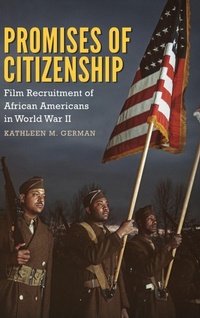
Promises of Citizenship
Film Recruitment of African Americans in World War II
Published on 30. June 2017
Book
Hardback
272 pages
978-1-4968-1235-3 (ISBN)
Description
Since the earliest days of the nation, US citizenship has been linked to military service. Even though blacks fought and died in all American wars, their own freedom was usually restricted or denied. In many ways, World War II exposed this contradiction.
As demand for manpower grew during the war, government officialsand military leaders realized that the war could not be won without black support. To generate African American enthusiasm, the federal government turned to mass media. Several government films were produced and distributed, movies that have remained largely unexamined by scholars. Kathleen M. German delves into the dilemma of race and the federal government's attempts to appeal to black patriotism and pride even while postponing demands for equality and integration until victory was achieved.
German's study intersects three disciplines: the history of the African American experience in World War II, the theory of documentary film, and the study of rhetoric. One of the main films of the war era, The Negro Soldier, fractured the long tradition of degrading minstrel caricatures by presenting a more dignifiedpublic image of African Americans. Along with other government films, the narrative within The Negro Soldier transformed the black volunteer into an able soldier. It included African Americans in the national mythology by retelling American history to recognize black participation. As German reveals, through this new narrative with more dignified images, The Negro Soldier and other films performed rhetorical work by advancing the agenda of black citizenship.
As demand for manpower grew during the war, government officialsand military leaders realized that the war could not be won without black support. To generate African American enthusiasm, the federal government turned to mass media. Several government films were produced and distributed, movies that have remained largely unexamined by scholars. Kathleen M. German delves into the dilemma of race and the federal government's attempts to appeal to black patriotism and pride even while postponing demands for equality and integration until victory was achieved.
German's study intersects three disciplines: the history of the African American experience in World War II, the theory of documentary film, and the study of rhetoric. One of the main films of the war era, The Negro Soldier, fractured the long tradition of degrading minstrel caricatures by presenting a more dignifiedpublic image of African Americans. Along with other government films, the narrative within The Negro Soldier transformed the black volunteer into an able soldier. It included African Americans in the national mythology by retelling American history to recognize black participation. As German reveals, through this new narrative with more dignified images, The Negro Soldier and other films performed rhetorical work by advancing the agenda of black citizenship.
More details
Series
Language
English
Place of publication
Jackson
United States
Target group
College/higher education
Professional and scholarly
Dimensions
Height: 235 mm
Width: 157 mm
Thickness: 21 mm
Weight
603 gr
ISBN-13
978-1-4968-1235-3 (9781496812353)
Copyright in bibliographic data and cover images is held by Nielsen Book Services Limited or by the publishers or by their respective licensors: all rights reserved.
Schweitzer Classification
Other editions
Additional editions
E-Book
06/2017
Penguin Random House South Africa
€29.49
Available for download
Person
Kathleen M. German, Eaton, Ohio, is professor of media and culture at Miami University. She is coauthor of The Ethics of Emerging Media and Queer Identities/Political Realities. German has published articles in Communication Studies, Western Journal of Communication, Communication Education, and Newspaper Research Journal.